February 26, 2021 – SNOQUALMIE PASS, Wash. — A volunteer ski patroller started an “Are You Beeping?” project to help save lives in the Cascade mountains.
A snowy year in the Cascades
It has been an especially snowy February in the mountains of western Washington. There have been feet of snow falling in a matter of days. Significant storm systems have forced closures at the passes. And raised the avalanche danger for the backcountry.
On Friday Snoqualmie Pass got another foot of snow overnight. This brought the season total to 396 inches, or 33 feet. The evidence of that is clear. There are mounds of snow reaching the top of light poles, and walls of ice taller than semi-trailers.
Stevens Pass closed for a period Friday after avalanche debris covered US 2.
So it’s no doubt that avalanches are on Scott Waller’s mind. He’s a volunteer ski patroller with King County Search and Rescue. He started a project to improve avalanche safety a decade ago.
The “Are you beeping?” Project
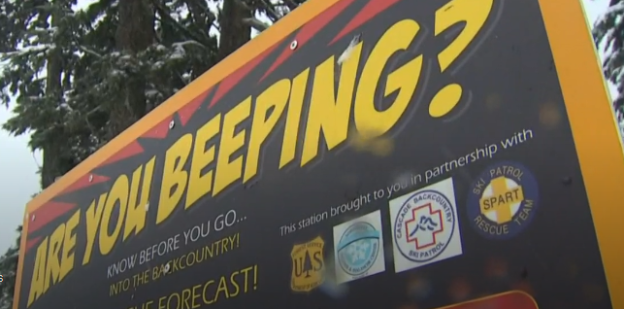
Waller’s project “Are You Beeping?” installs avalanche beacon test sites and signage at resort gates and forest trailheads before users enter risky terrain. It’s a chance for explorers to turn on their avalanche beacons. The signs also include information about avoiding risky terrain and unstable snow conditions.
Waller sees it as a friendly reminder to be prepared.
“It’s amazing how people will intend to put on their avalanche transceiver. But then they forget it in their car,” he said.
Some ski resorts have purchased the signs at cost, and some are funded by non-profit donations.
On Friday he installed a new one on the Pacific Crest Trail near the Alpental exit off I-90. Which is a popular snowshoeing and touring destination. It was funded by Ski Patrol Rescue Team (SPART). Which is a volunteer group that works with King County Search and Rescue. Two more check stations will be installed at Alpental’s backcountry gates this weekend.
Saving Lives
It’s tough to know if the signs have saved lives, Waller said, but that’s the goal.
“That’s the hope,” he said. “It’s hard to measure, or quantify it. But know I’ve sat at trailheads putting these up all over. And it’s amazing how someone will show up, they’re a backcountry skier, and they forgot to turn it on. Yeah, it happens. Just reminding them.”
Sat, Feb. 27 – Juneau’s urban avalanche forecast is for “extreme” Juneau avalanche danger as of Saturday evening. There is a potential for “historic avalanches” in residential areas. City officials recommend that residents in the avalanche zone in downtown Juneau evacuate their homes.
The advisory also recommends that residents avoid avalanche paths including the Flume Trail. “People need to make their own safety decisions,” it stated. “But we feel that with the forecast for the next 24 – 48 hours natural avalanches are likely and of great size.”
The city and the Red Cross will open Centennial Hall as an emergency shelter. The doors opened at 8:00 p.m. on Saturday. COVID-19 mitigation measures are in place.
Juneau Avalanche Warnings were issued Friday
Juneau city officials said on Friday that there is a potential for “historic avalanches”. Depending on temperatures and how much snow falls, the city’s Urban Avalanche Advisory could be raised to an “extreme” Juneau avalanche danger, which is the highest level on the scale.
“I have never forecasted an extreme avalanche condition,” said Tom Mattice, the city’s emergency programs manager. He advised residents to be cautious, especially near the Behrends Avenue avalanche path.
Mattice says they’ve recently seen avalanches of snow four to six feet deep throughout the region. “In the urban environment, if we have a four foot deep avalanche that’s wide enough across the face of the Behrends path, (then) that’s more than enough to hit houses,” he said.
Widespread Activity and increased hazards
The Alaska Department of Transportation & Public Facilities has warned of increased avalanche hazard along Thane Road. Residents along the road should be prepared for an extended road closure if crews are unable to safely remove any avalanche debris.
The Coastal Alaska Avalanche Center says they’ve already seen widespread avalanche activity all around Juneau. They expect more avalanches over the weekend.
Rain Crust
A freezing rain crust has formed on top of recent snow that fell on a weak snow layer. The snow’s weakness can even be triggered from a flat spot. “And then, it’ll travel through that freezing rain crust and collapse the looser snow below and the denser snow above. So it can travel great distances. We’ve already seen avalanches that have traveled over a quarter mile just from propagating through the snowpack.”
They’re warning people heading out to the backcountry to use extreme caution. Even in terrain that is generally considered safe from any avalanches.
He says the unstable snowpack conditions could potentially last through the rest of the season.
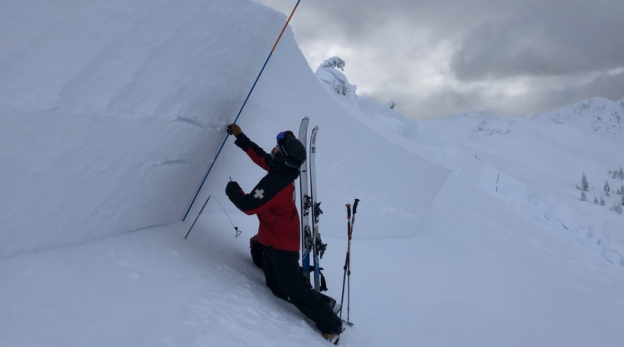
A ski patroller examines snow layers during avalanche mitigation. (Coastal Alaska Avalanche Center)
AP – Two Alpine Meadows avalanche lawsuits have been filed by the widow and a friend of a dead skier. They accuse the resort of negligently rushing to open the unsafe slopes for a busy holiday weekend.
Cole Comstock, 34, of Blairsden, California, was killed. His close friend Kaley Bloom was seriously injured. They were caught in an avalanche on an Alpine Meadows ski run on Jan. 17, 2020. Nobody else was seriously hurt.
Two Alpine Meadows avalanche lawsuits filed
The two Alpine meadows avalanche lawsuits were filed in Placer County Superior Court by Bloom and by Cole’s widow. They seek unspecified damages from Alpine Meadows. The allegations include negligence, gross negligence and breach of contract. Raymond’s lawsuit also alleged the resort was to blame for her late husband’s death.
The resort had closed the previous day following several days of heavy snow and high winds that dramatically increased avalanche risks, the lawsuits claimed. The National Weather Service in Reno reported wind gusts up to 116 mph the night before the avalanche.
Alpine Meadows “premature opening” that Friday “was in response to public and economic pressure to open that particular lift and callous disregard for the dangerous combination of conditions,” according to Bloom’s lawsuit. He says he suffered severe and ongoing injuries.
Avalanche Control work done
The avalanche happened after avalanche control work was performed, the resort said in a statement. Such work involves the use of explosive detonations. They intentionally trigger avalanches while guests are not in the area.
“While we cannot comment on ongoing litigation, January 17, 2020 was a devastating day for our team at Squaw Valley Alpine Meadows, and we continue to share our deepest sympathies with the family and friends of those affected,” Alex Spychalsky, a spokeswoman for both of the neighboring resorts, said in an emailed statement.
Raymond’s lawsuit says Alpine Meadows “should not have opened the ski run under the circumstances.”
Most skiers who buy ski resort passes must sign release forms. Those warn that winter activities “can be dangerous and involve the risk of injury or death.”
But Raymond’s lawsuit said the resort increased the risks beyond those normally assumed by skiers. Cole and Bloom believed they were skiing on a run that was safe because avalanche control had been performed.
Reopening the runs after they’d been closed the day before “created a false and reckless illusion of safety,” the lawsuit said. “Inadequate and/or incomplete mitigation measures did not decrease or mitigate the risks, but instead further increased the risk and turned a dangerous area into a deadly one.”
Raymond’s lawsuit notes that most ski fatalities occur outside of ski resorts. In-bounds avalanche deaths are rare.
Experienced Skier
Comstock was an experienced skier. He grew up in the Sierra Nevada and skied both in-bounds and out-of-bounds. Depending on the conditions of the day and information from the resort and the ski patrol, his widow said in the lawsuit.
Raymond was on the other side of the mountain when she got a phone call from friends. Telling her there had been an avalanche. She went to wait for her husband beneath a chairlift.
That’s when she saw the ski patrol pulling a stretcher with someone covered with snow and blood. They stopped and began administering CPR to the victim. Then she recognized her husband’s maroon ski boots and realized it was him.
She said blood spewed from his mouth with each push on his chest as the ski patrol team took turns at CPR for 45 minutes.
“Eventually they stopped as she watched them pull the white sheet over him. Her last image of her husband was a broken and already dead body,” the lawsuit said.
Seven people were killed in an avalanche at Alpine Meadows in 1982.
Two Alpine Meadows lawsuits were filed after a guest died in an avalanche.
By the end of Friday the Sierra Avalanche Center had received numerous reports of Tahoe avalanches.
“Perfect Day” leads to many avalanches
Friday started as a perfect winter day. About a foot of new snow fell overnight. In the morning the sky cleared. Then by the end of the day the Sierra Avalanche Center had received many avalanche reports. Some happened naturally but many were caused by skiers and snowboarders.
In the morning the Sierra Avalanche Center posted its forecast. The center stated the obvious – that storm slabs in the new snow were a big concern. They rated the avalanche danger as “considerable,” meaning that skiers and snowboarders were likely to trigger avalanches.
Reports of Tahoe avalanches continued through the weekend. There were no fatalities but multiple people were buried in avalanches. At least one person was seriously injured.
New storm snow problem, different from Utah and Colorado
In the United States avalanches have killed 25 people so far this season, including 18 just in February. The snowpack across the mountain west has been riddled with inherent dangers since the beginning of the winter. In Colorado and Utah those persistent dangers are still playing a role in avalanches. The Sierra Nevada’s snowpack is generally faster to resolve those weaknesses. The avalanches on the holiday weekend were simply from new snow. According to the Sierra Avalanche Center the main issues are things like storm slabs and wind slabs.
Slew of Tahoe Avalanches
At Castle Peak, atop Donner Summit, a snowboarder jumped off a rock and was engulfed in snow.
Another skier-triggered avalanche near Carson Pass buried a person for about five minutes. The victim survived but had severe injuries.
At Mount Tallac the El Dorado County Sheriff’s Office dispatched a search and rescue team in a helicopter to respond to an avalanche triggered by a group of backcountry skiers. The response ended when authorities confirmed that no one had been caught in the avalanche.
“I would say any time you’re caught in a slide and you walk away, it’s lucky,” said Andrew Oesterreicher, a volunteer and board member with Tahoe Nordic Search and Rescue (TNSAR). “You don’t ever want to rely on that luck.”
An anonymous skier reported an avalanche on Flagpole Peak. After their first run they decided the snowpack was “bomber” and solid. So they skied a more aggressive line next.
“Clearly, it was a stupid mistake getting caught up with powder fever,” the skier reported. A few turns down the line a storm slab of new snow slid down the mountain, along with the skier.
TNSAR didn’t get any calls to respond to incidents over the weekend, Oesterreicher said. If they are dispatched it usually means the situation is tragic.
“The brutal reality is, typically, by the time we’re responding to an avalanche situation, it’s pretty much a recovery at that point,” Oesterreicher said. “Just because it takes our team so long to get to the scene.”
U.S. Forest Service, Sierra Avalanche Center
The Sierra Avalanche Center works to prevent accidents by issuing daily forecasts. The U.S. Forest Service hires three full-time avalanche forecasters who backcountry ski and then write reports. The Sierra Avalanche Center fundraises on behalf of the U.S. Forest Service to cover much of the payroll and related expenses. There are also three part-time paid observers who go skiing to check on conditions.
Due to the pandemic the center lost two fundraising sources they rely on to fund the Forest Service. The loss adds up to about $100,000, which is about a quarter of their annual budget.
A Summit County Court judge dismissed a motion to suppress a GoPro video of the avalanche. Evan Hannibal and Tyler DeWitt had given the video to the Colorado Avalanche Information Center (CAIC).
The video is evidence in the Summit County District Attorney’s case against Hannibal and DeWitt. They are charged with reckless endangerment and could face a $168,000 fine. These are the first criminal charges ever filed against skiers involved in an avalanche in Colorado.
The prosecution argues that the avalanche defendants endangered drivers near the west portal of the Eisenhower-Johnson Memorial Tunnels. They want $168,000 to replace an avalanche control system destroyed they destroyed. The CAIC said they triggered the avalanche.
The snowboarders argued that prosecutors conducted an unlawful search and seizure when they based the allegations on the helmet-cam video. The men gave the video to the CAIC voluntarily. They hoped it could be useful so others might avoid a similar slide.
CAIC is a State Agency
“This is a state agency, a constitutional actor, not informing citizens that what they are voluntarily disclosing in good faith to that that state agency could, and in this case was, turned over to law enforcement for purposes of prosecution,” Jason Flores-Williams, the attorney for DeWitt and Hannibal, said during the motions hearing on Tuesday. “This is extraordinarily problematic. There was a duty to inform Mr. Hannibal that what he was providing to the CAIC could be turned over to law enforcement.”
CAIC director Ethan Greene and avalanche forecaster Jason Konigsberg testified that the avalanche defendants voluntarily provided information and video about the avalanche. The CAIC report said the snowboarders triggered the avalanche. And also that the two “assumed that the avalanche mitigation to protect the tunnel infrastructure decreased the avalanche hazard on the slope.”
Greene said it is common for law enforcement to request information. The CAIC shares its reports. The state agency offers all reports for public review. “Our role is to facilitate people understanding avalanches, and we do that by sharing information,” Greene said. “If the public requests information from us, we provide it.”
The CAIC did not include the video in its public report, although they often do publishes videos. “It was my judgment that the content of the video did not add to the educational messages we were trying to get across in the report,” Greene said.
Video Provided Voluntarily
Konigsberg agreed with Flores-William in saying the sharing of the video was “voluntary and collegial.”
Flores-William asked Konigsberg if he thought the video could be handed over to law enforcement. “Can I think about that for a second?” Konigsberg asked. “Honestly, it’s not something I thought about. I kind of had a one-track mind to collect information for avalanche education and safety, like I always do.”
The prosecution argued that Hannibal and DeWitt, experienced with CAIC reports, should have known that CAIC publishes information. “I understand there is a concern about the public policy side of this, but we have to focus on the law,” McCollum said. “And none of the law supports the … argument that this video or the photos that were obtained should be suppressed.”
Judge Ed Casias found there was not any violation of constitutional protections from unlawful search and seizure because there was no search and nothing was seized. “It wasn’t a search of any kind. Mr. Hannibal was asked if he would provide it and he did,” Casias said.
Casias said he wouldn’t expect Konigsberg to tell Hannibal the video could be used by law enforcement. “Frankly, he didn’t know that was going to happen. That was not the reason he was collecting information,” Casias said.
Miranda Rights don’t apply
Casias also denied the argument that the collection of the video violated the men’s Miranda rights, which only applies to people in custody when they are advised that what they say can be used against them in court. “There is information here that was provided voluntarily. It was provided to CAIC, not law enforcement,” Casias said.
The courts should ensure police don’t circumvent constitutional protections against unlawful search and seizure, Casias said. Still, he could not connect a skier providing information to an avalanche center with a constitutional violation.
“If there are things that you, as a backcountry traveler do that cause new concern that law enforcement may be involved and someone reaches out and asks for information, you don’t have to give it,” Casias said. “I can’t make you disclose and I can’t make you withhold. But if your common goal is to make it safer for other people … it’s your decision.”
The two avalanche defendants started an avalanche that created a threat to I-70.
An elk survived an avalanche after being rescued by a nearby observer.
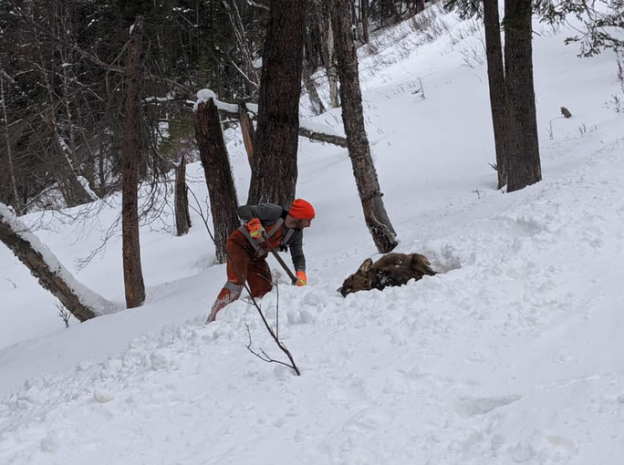
Jesse Dahlberg was watching railroad avalanche control crews use explosives to start relatively small avalanches near Field British Columbia. He noticed a lone elk was in the path of one of the avalanches. He hoped the elk might outrun the snow. But it was engulfed as the avalanche came down around it.
“I didn’t know how big the avalanche was going to be so I was hoping for the best. When I saw it, I thought there’s no way that elk is going to survive.” Dahlberg told CBC. “That wall of snow caught up to that elk so fast and just blasted it.”
Dahlberg decided to go see if there was a chance the elk survived an avalanche. After parking close to where the elk was last seen he and a friend followed debris uphill. Miraculously, Dahlberg saw a portion of the animal’s face peering out from the snow. The elk was trapped and immobilized in the avalanche debris.
Once Dahlberg found that the elk was alive he knew they’d have to act quickly. He began digging with his handsand sent his friend back to the vehicle for a shovel. It took only 15 minutes to dig the elk’s back legs free. Then, with a little prompting, the critter was able to shake its way clear and climb out of the snow.
“I put my arms up and started cheering because I was so excited that it was alive,” Dahlberg said. “I was so happy.” Rather than take flight, the forest denizen calmly gazed at them as they left the scene as if saying a silent “thank you.”
Jesse Dahlberg has a video of the avalanche and some photos of the rescue on his facebook page.
Jesse Dahlberg rescuing an elk that survived an avalanche.
SUMMIT COUNTY, Utah — Avalanche bombing experts work to ensure the safety of rescuers working on the ground. And on Sunday search and rescue crews worked on an avalanche recovery mission in Summit County.
The Utah Avalanche Center, Sheriff’s Office and Park City Mountain Resort Ski Patrol worked with Utah Department of Public Safety. Together they conducted avalanche mitigation. This was to help rescuers recover the skier who was buried the day before.
“We arrive and we serve the search and rescue or the sheriff’s office in that area. So if they say we’re going to mitigate, then we just follow their lead.” So said Sgt. Wyatt Weber, a tactical flight officer with the Utah Department of Public Safety Aero Bureau. “Obviously, the snow safety experts that know these avalanches from front to back. Whatever they suggest we just try to help them and assist them and do it as safely as possible with the tool.”
Utah DPS used explosive charges from Park City Ski Patrol for avalanche bombing the unstable snow above the area. The avalanche mitigation allowed rescuers to access the area with minimized risk of further avalanches.
“You talk to the Park City Ski Patrol and they’ll tell you [Square Top is] one of their scariest areas up there for avalanche potential. It always gives them sleepless nights,” said Utah DPS Aero Bureau pilot Bret Hutchings.
Hutchings piloted the helicopter on Sunday as members of the team deployed the explosives.
“Avalanche bombing requires the pilot and a crew of three comprised out of the various ski resort areas. You have a controller and a bomber and a prepper,” he said.
Two Avalanches by lift skiers at Park City Mountain Resort
There have been two deadly avalanches in Utah this winter. Both have taken place just outside of Park City Mountain Resort boundaries. In both cases the avalanche victims accessed the backcountry from the resort boundary area.
“Park City Mountain places the highest value on the safety of our guests and employees. Within the ski area boundaries, Ski Patrol performs avalanche mitigation work and provides emergency response. Park City Mountain does not prohibit public access to U.S. Forest Service lands outside the ski area boundary. Guests that access the backcountry from Park City Mountain must do so from designated backcountry gates that provide warnings and information about the inherent risks of backcountry travel. Park City Mountain does not manage the lands or the inherent hazards that exist outside its ski area boundary. Guests who access backcountry terrain do so at their own risk and are responsible for their safety. Guests leaving the Resort boundaries should be experienced and knowledgeable about backcountry travel, and be prepared with the appropriate gear and safety equipment.” – Jessica Miller, Park City Mountain Resort
PARK CITY, Utah — The Park City Mountain Canyons Ski Patrol closed off its access to the backcountry adjacent to the resort. The unusual step was taken after a couple of recent deadly slides amid high avalanche danger. Prior to a couple of recent fatal avalanches there had been numerous others in past years as well.
According to Utah.gov, “avalanches pose a significant hazard in Utah’s mountains between the months of January and April. These are seasons of heavy snow accumulation and unstable snowpack conditions.”
“An avalanche is a mass of snow, ice, and debris that slides rapidly down steep mountain slopes at speeds up to 80 mph when triggered by ground shaking, sound, or movement,” the official website stated.
Avalanches in Utah have claimed over 100 lives between 1958 and 2021. The snowpack this year is unusually thin, which contributes to the danger.
Park City Mountain responds to avalanche danger
Ski resorts around Utah are taking action to protect local winter enthusiasts.
Park City Mountain announced that resort management had directed the Canyons Ski Patrol to close off access to its adjacent backcountry areas. Skiers and snowboarders frequently access these areas from the resort.
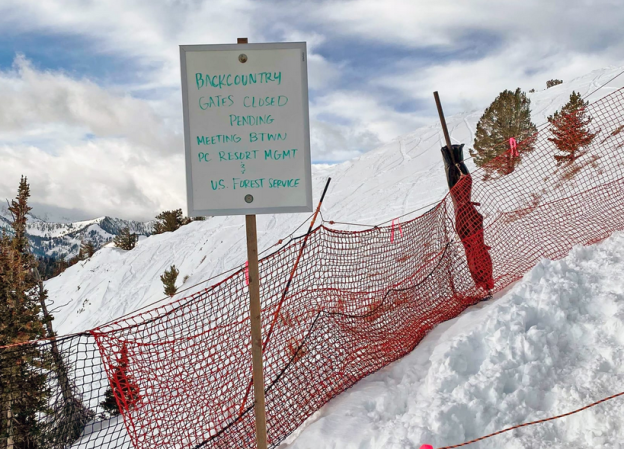
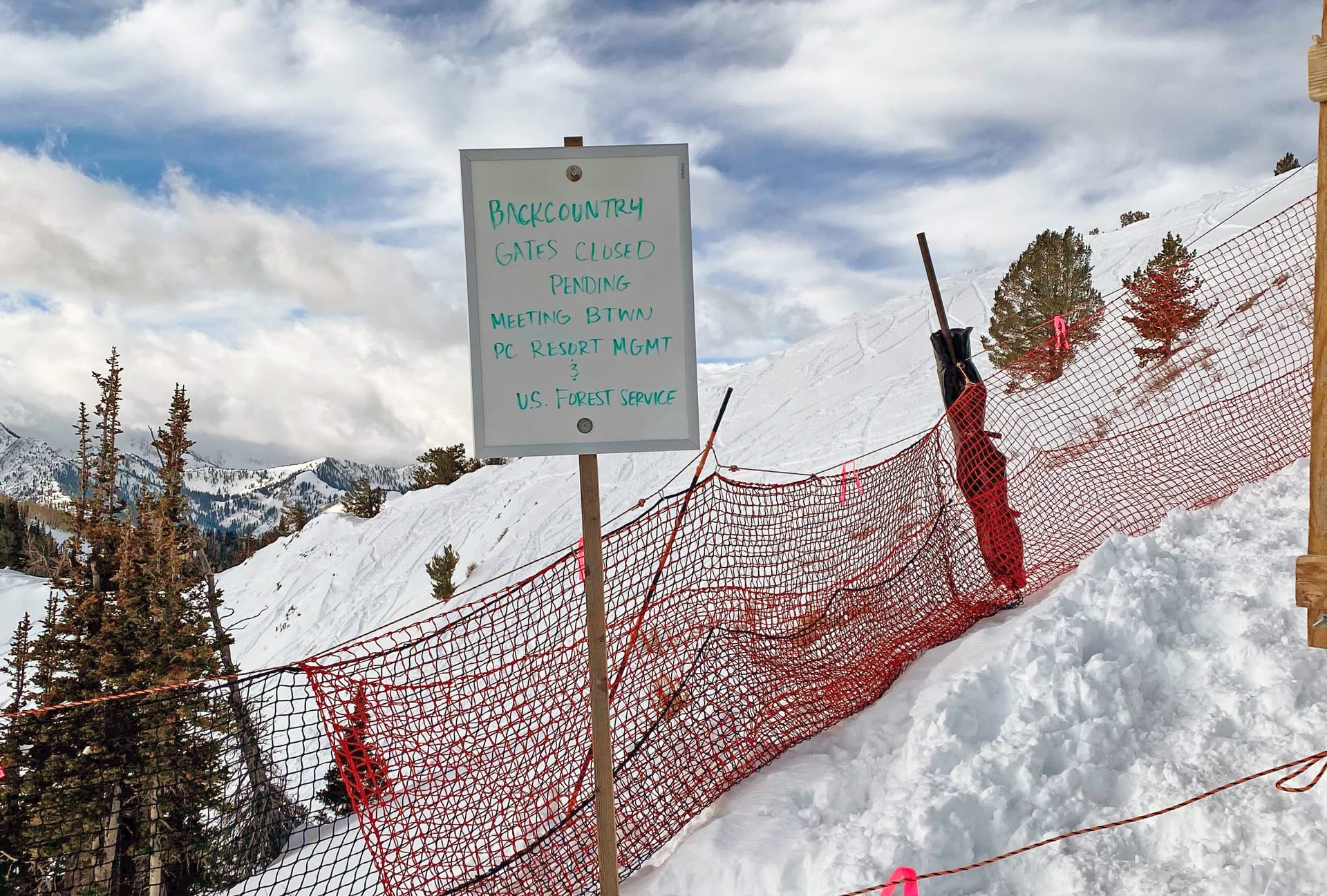
The resort posted signs at backcountry access points, restricting access. The sign reads, “Backcountry gates closed pending meeting between PC resort management and U.S. Forest Service.”
Due to the two deaths in January, the resort closed access to the backcountry from inbounds “until further notice.” Resort officials plan to meet with the U.S. Forest Service Thursday.
An unusually high number of avalanches in Iceland have fallen across East Iceland, North Iceland, and the Westfjords in mid-January. This is from the Icelandic Met Office. There were 133 reports of avalanches in Iceland in 10 days. But the true number is likely higher. The Civil Protection Department has declared an uncertainty phase in the North Westfjords. And also North and East Iceland. Because the risk continues.
Westfjords, Northeast Iceland, and Eastfjords
Most of the 133 reports were from the Westfjords (52) and Northeast Iceland (41). The third-highest number were reported in the Eastfjords (24). “It is clear that many more avalanches have occurred without being recorded. Many fall off the beaten track, others occur without being seen, and not all avalanches are reported.” Of course heavy snowfall is the cause. The snow blanketing the slopes is considered unstable. However, the office reports that some avalanches have fallen in still weather.
Roads Closed
Avalanches in Iceland have fallen on several roads across the country. Causing closures while snow is cleared. The Road and Coastal Administration notifies travelers of road closures across the country. The Met Office reports on avalanche risk.
No people have been injured as a result of the events. Though one recent avalanche in Skagafjörður killed at least three horses and destroyed a shed. One avalanche on the Skarðsdalur skiing grounds in North Iceland caused significant damage to the facilities. A third near Eskifjörður, East Iceland, damaged a shooting range and may have damaged facilities in the area as well.
Avalanches in Iceland are nothing new. There were catastrophic avalanches in the villages Súðavík and Flateyri in 1995. Which killed 34 people and caused extensive economic damage. Those avalanches made it clear that a substantial number of people in several Icelandic towns and villages live in areas where avalanche risk is unacceptable.
Two people caught in a Swiss avalanche were rescued after their dogs barked for help. The barking attracted the attention of nearby snowshoers who were able to dig them out.
The Swiss avalanche swept the pair off a hiking trail in the Avers Valley of south-western Switzerland. Near the Italian border and west of St Moritz. It occurred shortly after 3pm on Saturday.
“Their dogs, who were not buried by the masses of snow, drew attention to themselves by barking loudly,” a statement by REGA said.
“The dogs attracted the attention of a group of snowshoers who were some distance away in the same valley but had not witnessed the avalanche.”
About 15-20 minutes after the Swiss avalanche, the group was at the scene, where one of the avalanche victims’ hands was visible; the other person was buried entirely, Rega said. Both were dug out slightly injured and with mild hypothermia. Rega then flew them by helicopter to hospital.
A huge natural avalanche came down at 7.10pm. In darkness and poor weather the patrol carried out a search. The visibility was described as “very bad”.
Later that night at 11.45 the director of the patrol in Tignes, Frederic Bonnevie, returned. The weather had eased.
He heard a voice calling for help. A 35-year old local man had been caught in the slide, but his face was above the snow. He had been trapped in the snow and avalanche debris and unable to move. He had been buried for over four and a half hours.
Frederic Bonnevie and another pisteur dug him out and gave him first aid at the scene. The man was shaken but otherwise unharmed except for frostbite to his left ear.
That avalanche was 600m long and 200m wide. It had a vertical drop of 300m.