Tag Archives: avalanche control

An explosive business – Avalanche control

The explosive business of avalanche control keeps the ski area slopes safe for guests.

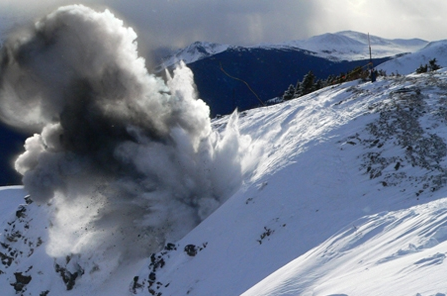
On many winter days explosions can be heard echoing across many ski areas. These are the sounds of avalanche mitigation.

Dutch Draw Avalanche

Last week an avalanche was reported in the Dutch Draw area of Park City, Utah between the lifts Peak Five and Ninety-Nine 90. According to Andy Van Houten, snow safety director of Park City Mountain, the avalanche occurred in the back country. “We worked with the Department of Public Safety helicopter,” he said. “It was established that nobody was involved. We had all of our witnesses accounted for, all is good.”

“There is no mitigation outside of the resort and so it’s 100% on the on the user, on themselves; we do worry about it from a rescue perspective but we do not do anything to mitigate that hazard,” Van Houten said.

Mitigation Methods

There are a few ways the ski patrol can mitigate avalanche risks. While the explosive business is the most dramatic two other methods are used as well. Ski cutting and compaction.

Ski cutting is where a patroller will ski intentionally across the top of a slope. This may trigger an avalanche as the slope is traversed. This method is used on smaller slides.

Another form of mitigation is called skier compaction.

“The best thing we can do is get this terrain open to public and get it skied,” Van Houten said. “That’s why we push so hard to get this terrain open, you know, in a timely fashion is that so we can get our guests up there to ski it and that’s what helps us, that kind of skis all the snow and it breaks up the layers that build up.”

Explosives

For bigger slopes there is the explosive business. There is a typically team of patrollers who go out in groups of two or three and carry explosives in their backpacks.

“It’s a cast booster, it’s about the size of a large can of soup and it’s a pentolite TNT combination,” Van Houten said. “It’s got 120-second fuse strain on it. It’s basically like a little cardboard tube and that’s it’s got a sparker in it. When we pull that, that’s what ignites the end of the fuse train. We either rope them, or we just throw them. And it’s like throwing a can of soup into the snowpack. It’s a good-sized shot. But we are usually pretty far away when it detonates and we kind of plug our ears and kind of turn our backs to it a little bit. So we’re not we’re not close to it by any means.”

Avalanche Control - An Explosive Business
Avalanche Control – An Explosive Business

Alpine Meadows avalanche lawsuits over dead and injured guests

AP – Two Alpine Meadows avalanche lawsuits have been filed by the widow and a friend of a dead skier. They accuse the resort of negligently rushing to open the unsafe slopes for a busy holiday weekend.

Cole Comstock, 34, of Blairsden, California, was killed. His close friend Kaley Bloom was seriously injured. They were caught in an avalanche on an Alpine Meadows ski run on Jan. 17, 2020. Nobody else was seriously hurt.

Two Alpine Meadows avalanche lawsuits filed

The two Alpine meadows avalanche lawsuits were filed in Placer County Superior Court by Bloom and by Cole’s widow. They seek unspecified damages from Alpine Meadows. The allegations include negligence, gross negligence and breach of contract. Raymond’s lawsuit also alleged the resort was to blame for her late husband’s death.

The resort had closed the previous day following several days of heavy snow and high winds that dramatically increased avalanche risks, the lawsuits claimed. The National Weather Service in Reno reported wind gusts up to 116 mph the night before the avalanche.

Alpine Meadows “premature opening” that Friday “was in response to public and economic pressure to open that particular lift and callous disregard for the dangerous combination of conditions,” according to Bloom’s lawsuit. He says he suffered severe and ongoing injuries.

Avalanche Control work done

The avalanche happened after avalanche control work was performed, the resort said in a statement. Such work involves the use of explosive detonations. They intentionally trigger avalanches while guests are not in the area.

“While we cannot comment on ongoing litigation, January 17, 2020 was a devastating day for our team at Squaw Valley Alpine Meadows, and we continue to share our deepest sympathies with the family and friends of those affected,” Alex Spychalsky, a spokeswoman for both of the neighboring resorts, said in an emailed statement.

Raymond’s lawsuit says Alpine Meadows “should not have opened the ski run under the circumstances.”

Most skiers who buy ski resort passes must sign release forms. Those warn that winter activities “can be dangerous and involve the risk of injury or death.”

But Raymond’s lawsuit said the resort increased the risks beyond those normally assumed by skiers. Cole and Bloom believed they were skiing on a run that was safe because avalanche control had been performed.

Reopening the runs after they’d been closed the day before “created a false and reckless illusion of safety,” the lawsuit said. “Inadequate and/or incomplete mitigation measures did not decrease or mitigate the risks, but instead further increased the risk and turned a dangerous area into a deadly one.”

Raymond’s lawsuit notes that most ski fatalities occur outside of ski resorts. In-bounds avalanche deaths are rare.

Experienced Skier

Comstock was an experienced skier. He grew up in the Sierra Nevada and skied both in-bounds and out-of-bounds. Depending on the conditions of the day and information from the resort and the ski patrol, his widow said in the lawsuit.

Raymond was on the other side of the mountain when she got a phone call from friends. Telling her there had been an avalanche. She went to wait for her husband beneath a chairlift.

That’s when she saw the ski patrol pulling a stretcher with someone covered with snow and blood. They stopped and began administering CPR to the victim. Then she recognized her husband’s maroon ski boots and realized it was him.

She said blood spewed from his mouth with each push on his chest as the ski patrol team took turns at CPR for 45 minutes.

“Eventually they stopped as she watched them pull the white sheet over him. Her last image of her husband was a broken and already dead body,” the lawsuit said.

Seven people were killed in an avalanche at Alpine Meadows in 1982.

Two Alpine Meadows lawsuits were filed after a guest died in an avalanche.

Elk Survived an Avalanche after fortuitous rescue by an observer

An elk survived an avalanche after being rescued by a nearby observer.

Jesse Dahlberg was watching railroad avalanche control crews use explosives to start relatively small avalanches near Field British Columbia. He noticed a lone elk was in the path of one of the avalanches. He hoped the elk might outrun the snow. But it was engulfed as the avalanche came down around it.

“I didn’t know how big the avalanche was going to be so I was hoping for the best. When I saw it, I thought there’s no way that elk is going to survive.” Dahlberg told CBC. “That wall of snow caught up to that elk so fast and just blasted it.”

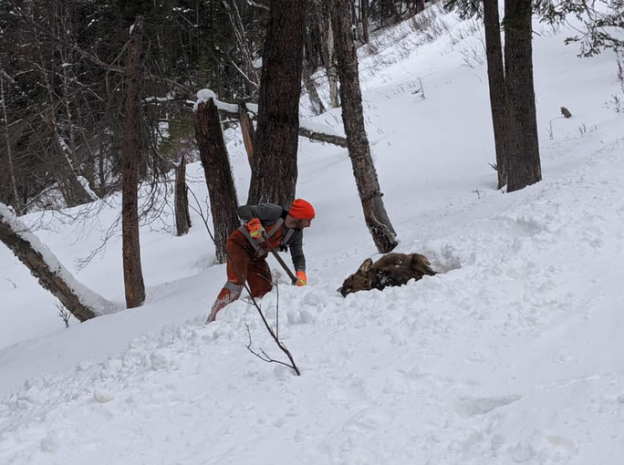
Dahlberg decided to go see if there was a chance the elk survived an avalanche. After parking close to where the elk was last seen he and a friend followed debris uphill. Miraculously, Dahlberg saw a portion of the animal’s face peering out from the snow. The elk was trapped and immobilized in the avalanche debris.

Once Dahlberg found that the elk was alive he knew they’d have to act quickly. He began digging with his handsand sent his friend back to the vehicle for a shovel. It took only 15 minutes to dig the elk’s back legs free. Then, with a little prompting, the critter was able to shake its way clear and climb out of the snow.

“I put my arms up and started cheering because I was so excited that it was alive,” Dahlberg said. “I was so happy.” Rather than take flight, the forest denizen calmly gazed at them as they left the scene as if saying a silent “thank you.”

Jesse Dahlberg has a video of the avalanche and some photos of the rescue on his facebook page.

An Elk survived and avalanche thanks to a rescue.
Jesse Dahlberg rescuing an elk that survived an avalanche.

Avalanche bombing deployed from the sky help rescuers on the ground

SUMMIT COUNTY, Utah — Avalanche bombing experts work to ensure the safety of rescuers working on the ground. And on Sunday search and rescue crews worked on an avalanche recovery mission in Summit County.

The Utah Avalanche Center, Sheriff’s Office and Park City Mountain Resort Ski Patrol worked with Utah Department of Public Safety. Together they conducted avalanche mitigation. This was to help rescuers recover the skier who was buried the day before.

“We arrive and we serve the search and rescue or the sheriff’s office in that area. So if they say we’re going to mitigate, then we just follow their lead.” So said Sgt. Wyatt Weber, a tactical flight officer with the Utah Department of Public Safety Aero Bureau. “Obviously, the snow safety experts that know these avalanches from front to back. Whatever they suggest we just try to help them and assist them and do it as safely as possible with the tool.”

Utah DPS used explosive charges from Park City Ski Patrol for avalanche bombing the unstable snow above the area. The avalanche mitigation allowed rescuers to access the area with minimized risk of further avalanches.

“You talk to the Park City Ski Patrol and they’ll tell you [Square Top is] one of their scariest areas up there for avalanche potential. It always gives them sleepless nights,” said Utah DPS Aero Bureau pilot Bret Hutchings.

Hutchings piloted the helicopter on Sunday as members of the team deployed the explosives.

“Avalanche bombing requires the pilot and a crew of three comprised out of the various ski resort areas. You have a controller and a bomber and a prepper,” he said.

Two Avalanches by lift skiers at Park City Mountain Resort

There have been two deadly avalanches in Utah this winter. Both have taken place just outside of Park City Mountain Resort boundaries. In both cases the avalanche victims accessed the backcountry from the resort boundary area.

“Park City Mountain places the highest value on the safety of our guests and employees. Within the ski area boundaries, Ski Patrol performs avalanche mitigation work and provides emergency response. Park City Mountain does not prohibit public access to U.S. Forest Service lands outside the ski area boundary. Guests that access the backcountry from Park City Mountain must do so from designated backcountry gates that provide warnings and information about the inherent risks of backcountry travel. Park City Mountain does not manage the lands or the inherent hazards that exist outside its ski area boundary. Guests who access backcountry terrain do so at their own risk and are responsible for their safety. Guests leaving the Resort boundaries should be experienced and knowledgeable about backcountry travel, and be prepared with the appropriate gear and safety equipment.” – Jessica Miller, Park City Mountain Resort

Dramatic video of avalanche control near Revelstoke

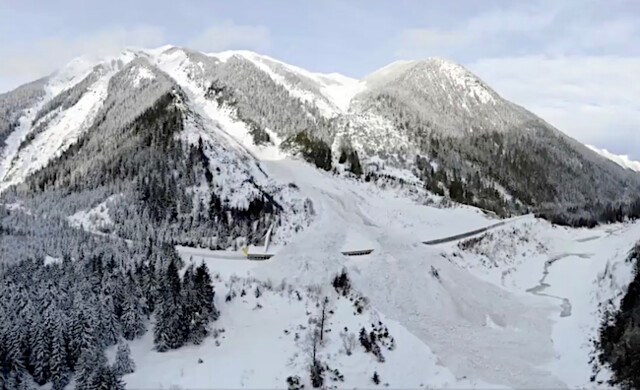
DriveBC has shared dramatic aerial video of avalanche control work along the Trans-Canada Highway near Revelstoke.

Avalanche control east of Revelstoke. Ministry of Transportation
Avalanches east of Revelstoke. Ministry of Transportation

The Ministry of Transportation’s Rocky Mountain District posted the avalanche control video to Twitter. It shows a slide being triggered and then thundering down a steep mountainside east of Revelstoke. The wave of snow careens down the slope and over a snow shed.