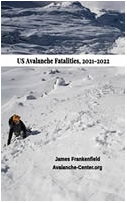
Description: Every year a multitude of people venture out into the snow to go snowshoeing, skiing, snowboarding, snowmobiling or climbing. Many are not fully informed of the dangers and the necessary risk management practices. This book sheds light on the fatalities that occurred last year and what went wrong in order to help others learn and improve their own margin of safety.
FOR IMMEDIATE RELEASE On sale now ISBN: 979-8371006769 <a href="https://<a href='http://www.avalanche-center.org/book/' rel='nofollow'>www.avalanche-center.org/book/https://www.avalanche-center.org/book/
Fatal Avalanches in the US: 2021-2022 reviews in detail all of the fatal snow avalanches of the season. They are summarized collectively, each is described, and noteworthy factors are discussed. Finally, the common factors and problems behind these tragic events are discussed. This information is invaluable for helping skiers, snowboarders, snowmobilers, climbers, and others avoid such incidents in the future.
This 1st edition reviews the 17 avalanche fatalities between October 1, 2021 and September 30, 2022 in clear terms with simple and clear snowpack diagrams and no technical obfuscation. The focus is on understanding what went wrong and how risk management could have been improved.
“While it remains our right to venture forth into avalanche terrain it also remains our responsibility to manage our own risk, to our own acceptable level. Hopefully these experiences of others will contribute in some way to that. “ – James Frankenfield, Author
Fatal Avalanches in the US: 2021-2022: A Review of the Season’s Fatal Avalanches is a must-have book for anyone recreating outdoors in winter. It can be found both in Paperback and Kindle form on Amazon at <a href="https://<a href='http://www.amazon.com/dp/B0BQY4RNZV' rel='nofollow'>www.amazon.com/dp/B0BQY4RNZVhttps://www.amazon.com/dp/B0BQY4RNZV
ABOUT THE AUTHOR – James Frankenfield is a snow and avalanche professional with decades of experience as a skier/climber, snow scientist and engineer and mountain safety educator. He earned his M.Sc. in Physics in 1990 by studying seasonal snow and avalanches and has done scientific work in the field. In 1993 he started Avalanche-Center.org on USENET and a university gopher server and manages this project on the web to this day. He has climbed, soloed and guided alpine climbs throughout the western US, soloed a section of the Northville-Placid trail in winter in 1984, and has soloed multi-day glacier ski tours in the Alps. His website is snowman-jim.org
###
CONTACT: The Avalanche Center (Avalanche-Center.org) 877-604-0166 snowavalanche-center.org
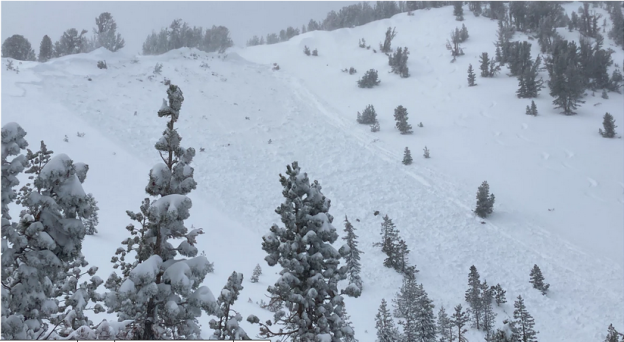
COOKE CITY — Avalanche forecasters trigger an avalanche: Even if you’re an expert, you can never be too safe in the backcountry. It’s something two avalanche forecasters learned firsthand last week after they triggered a slide near Cooke City.
Last Friday two Forest Service avalanche forecasters from the Gallatin National Forest Avalanche Center had a close call on Fisher Mountain.
“It’s incredibly terrifying,” said the director of the Gallatin National Forest Avalanche Center, Doug Chabot, on Wednesday.
The two forecasters had snowmobiled to an area on the mountain to dig some snow pits. “One of them rode and then the second person came, and when the second person was coming, he triggered the avalanche from below,” said Chabot.
The second rider was below the slope. “And he was able to propagate this fracture up the hill, which then caught him. Luckily the other guy, the first guy, he was safe,” Chabot said.
The first rider called for help on the radio and then rushed down to his colleague.
“And luckily he wasn’t buried. He had snow up to his thighs, but it was a really close call because it was a big avalanche,” said Chabot.
They were able to dig out the rider and his snowmobile, and thankfully no one was hurt but it’s a reminder that there are no rules when it comes to Mother Nature.
“December and January can be quite bad for avalanches in Montana. And the reason for that is, is we’re forming many weak layers in the snowpack right now,” Chabot said.
Chabot said the snowpack is relatively thin, usually only two to three feet thick in most places. Thin snowpacks can change really fast. At some point, the weak layer may break and that’s what triggers avalanches.
“But the ones that kill people in the United States are overwhelmingly, either the victim or someone in their party triggered the avalanche,” said Chabot. Like these guys.
A new avalanche backpack will increase a victim’s survival window from 15 To 90 minutes.
A Dangerous Experience
Skiing in the backcountry is potentially a rather dangerous experience. If you injure yourself or have an emergency rescue parties take a lot longer than they would at a resort. And there’s always the risk of avalanches. Fortunately, there are ways to limit that danger. Individuals can take courses to learn about mitigating the danger of an avalanche. Beacons, probes, and shovels make it easier for parties to rescue avalanche victims in shorter periods of time, and avalanche airbags give those caught in an avalanche a decent chance of staying above the snow.
With classes and devices the risk is limited but not completely removed. A Norwegian company has set out to increase chances of survival through the Safeback SBX avalanche backpack.
Avalanche Deaths – Cause and Prevention
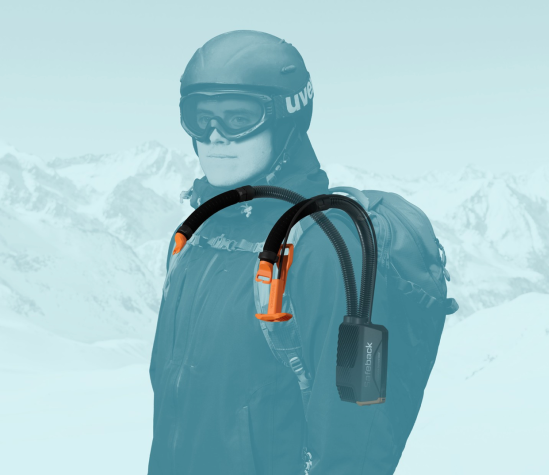
Avalanche caused deaths don’t result from a lack of oxygen. Dense avalanche debris sits at around 60-70% air. Victims succumb to carbon dioxide poisoning as gas builds up in the snow around them. The SBX seeks to limit that carbon dioxide buildup by pumping oxygen into the snow surrounding one’s mouth while pushing away the built up carbon dioxide. In an avalanche a victims pull the t-shaped handle located on the shoulder strap. This activates a fan located in the SBX Clean Air Intake placed on one’s back. That fan pumps oxygen from an area lacking CO2 buildup to the Clean Air Outlets on the wearer’s shoulders.
One major advantage is that it doesn’t require a mouthpiece. When you’re stuck under avalanche debris there’s a very good chance you won’t be able to move your arms very much. Meaning a mouthpiece just isn’t very reliable.
The company claims that the device can extend the survival window from 15 minutes to 90 minutes, increasing the chance of a successful rescue.
Coming Soon
The Safeback SBX avalanche backpack is set to release during the 2023/24 ski season, and once it’s out, I’m sure we’ll be seeing a lot more information relating to its capabilities.
Was the Uttarkashi avalanche triggered by an earthquake a couple days earlier? A 2.5 magnitude earthquake jolted the region on October 2. Just two days before the deadly avalanche hit the group from Nehru Institute of Mountaineering (NIM) at Draupadi ka Danda. Sixteen bodies were recovered by Thursday afternoon, fifteen were still reported missing.
The earthquake epicenter was not far from the Uttarkashi avalanche site. Experienced mountaineers as well as locals are now speculating that the earthquake may have triggered the avalanche.
According to National Center of Seismology the earthquake happened at around 10:43 am on October 2 with its epicentre in Bhatwari tehsil, Uttarkashi district. Significantly, the 25-km trek to Mount Draupadi ka Dana also lies in Bhatwari tehsil.
“Sometimes, even small tremors can cause cracks in the glaciers and the upper layer of snow could dislodge immediately after a small amount of pressure is exerted on it. In the past, we have seen earthquake-triggered-avalanches like the 2015 avalanche around the Mt Everest base camp,” said Love Raj Dharmshaktu, who has scaled Everest seven times.
The SE part of Uttarkashi district, including Bhatwari, falls under either zone IV or zone V of the seismic zone map. Senior geologist and executive director of Uttarakhand State Disaster Management Authority, Piyoosh Rautela, said that earthquakes do trigger avalanches and landslides.
He added: “A detailed investigation is needed to ascertain whether the October 2 quake, which was of low intensity, triggered the Uttarkashi avalanche on October 4.” Jayendra Rana, president of Uttarkashi trekking and mountaineering association, said, “Draupadi ka Danda is a safe peak and we have never heard of any major avalanche there. The October 4 incident occurred just two days after the quake. I think this angle should be explored.”
Indian Avalanche Survivor Aakash Lalwani, one of the rescued climbers, said the wall of snow took everyone down in a matter of seconds and threw them into a deep crevasse. “We were lucky that we could somehow breathe”.
A training expedition in the Himalayas was hit by a massive avalanche on a steep range in northern India, killing at least 16 and leaving about 10 others still missing.
About 15 people had been rescued as of Thursday, two long days after the expedition from the Nehru Institute of Mountaineering (NIM) were caught in the avalanche.
The avalanche struck around 17,000 feet near Mount Draupadi ka Danda-II as the team was returning from the summit. Draupadi ka Danda-II is in the Uttarakhand region.
Most of the Indian avalanche survivor are still in shock according to Vivek Pandey of the Indo-Tibetan Border Police.
Heavy rain and snowfall has limited both air and ground rescue efforts. On Wednesday a halt was called to rescue operations. The weather also posed a challenge to retrieving the bodies of those who died, officials said.
“Considering weather and other conditions, it is a difficult operation, which might continue for a couple of days,” Pandey said.
Many of the missing trainees were trapped in the 60- to 70-foot crevasse for at least two hours. “The hopes of survival are very bleak as the golden period of rescue in such situations is not even a couple of hours,” he said.
Among the dead was accomplished climber Savita Kanswal, the first Indian woman to summit Mount Everest and Mount Makalu. Kanswal, 27, was serving as an instructor on this week’s expedition.
Fourteen trainees were also among those killed, officials said.
Two Indian Air Force helicopters were sent to the region for the search.
Fatal climbing accidents are common in the Himalayas. In August, the body of a mountaineer was recovered two months after he fell into a crevasse while crossing a glacier in nearby Himachal Pradesh.
Oct. 7, 2022
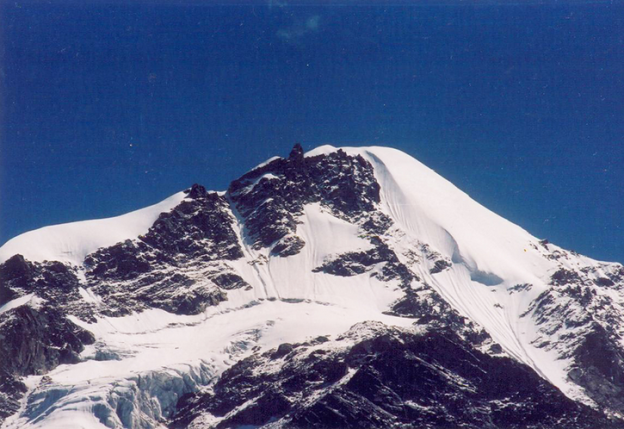
Draupadi Ka Danda II. Photo: Amar Chandra/Wikimedia Commons
A brave dog, presumed dead in an avalanche, was found alive several days later at a trailhead.
An avalanche triggered by a skier in Colorado hit a skier and snowboarder on Thursday, and their dog.
The skier deployed an airbag before being partially buried under snow. However, they lost sight of their four-legged friend amidst the chaos.
Fortunately for the skier and snowboarder, they were uninjured and able to make it out under their own power.
After looking all over for the dog presumed dead in the avalanche, the owners and a search crew had basically given up hope.
They left the scene and assumed the dog had died in the avalanche.
Search and rescue members didn’t see any signs of tracks.
Miraculously, however, after several days of being missing, the dog was found at a trailhead of Monarch Pass.
The reunion was incredibly emotional.
This isn’t the first time a pet has been rescued after dire circumstances in the Colorado mountains this season.
In December a video posted on YouTube showed skiers digging out a dog who had been under snow for 20 minutes after an avalanche.
Despite the positive outcome this time, Lazar reaffirmed that the best course of action when caught in an avalanche was for riders to keep an eye on their pet and only attempt to save them once it’s safe to do so
“We don’t want dogs to wear avalanche transceivers. We want people to be searchable by transceivers and not mixable with potential dogs with transceivers on,” Lazar said.
That’s one story that this courageously good boy or girl will remember for the rest of their dog years.
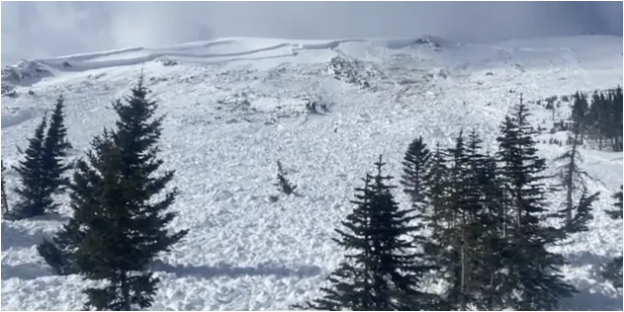
Site where a dog presumed dead in an avalanche was buried.
It appears that Silverton Avalanche School was dropped from the lawsuit by the Marshall family, along with their guide. Neither party has commented so a settlement amount was most likely agreed on.
The family of Peter Marshall, who died in an avalanche during an AIARE advanced avalanche safety class with the Silverton Avalanche School, has dropped the school and teacher from their lawsuit. It appears that a settlement was reached. A complaint remains open against Backcountry Access, their owner K2 Sports, and K2 owner Kohlberg & Company.
Settlement Reached with Silverton Avalanche School?
Two years after the death Marshall’s wife and daughter sued San Juan Search and Rescue, the Silverton Avalanche School and the school’s guide, Zachary Lovell, in a wrongful death lawsuit. Last month the family dropped its claims against the county, school and guide. Attorneys for the Marshall family have not returned calls or responded to emails and representatives from the county and school declined to comment, indicating a settlement amount was most likely agreed upon.
The Fatal Avalanche Accident and the Allegations
The family had argued that the school and guide had misled Marshall into taking the class by “falsely presenting” that school staff “possessed deep operational experience in avalanche terrain.” The family also claimed the school and guide displayed gross negligence.
Marshall had been participating in the Silverton Avalanche School Level 2 American Institute for Avalanche Research and Education (AIARE) class on Jan. 5, 2019. He was swept down a slope in an avalanche that caught five other skiers. Four were not buried. Another was buried but was able to extricate himself. When the skiers freed Marshall from the debris, he was not breathing.
The Colorado Avalanche Information Center (CAIC) report pointed to several mistakes during the advanced class, including a group of skiers gathered on a slope steep enough to slide, those skiers misjudging the steepness of that slope and a failure to recognize clear avalanche hazards. The guide triggered the first avalanche, which swept the whole group down the slope. A second avalanche buried Marshall under several feet of snow.
Remaining Complaint Against Backcountry Access and K2 Sports
The family of the 40-year-old Longmont skier is still suing K2 Sports and its subsidiary Backcountry Access, which makes an air bag backpack that was not deployed when rescuers found Marshall buried in more than 8 feet of avalanche debris. “Peter Marshall attempted to trigger his Float 32 avalanche air bag system but it did not fully deploy or inflate,” according to the complaint filed in Boulder District Court.
Marshall’s Backcountry Access Float 32 pack was not inflated. Colorado Avalanche Information Center investigators said in their report that the air bag backpack “was functioning properly,” with “the trigger out of the pack strap, but the bag was not deployed.”
K2 Sports, owned by private equity firm Kohlberg & Company, denied the allegations in a response filed this month. The K2 lawyers cited 16 facts they believe eliminate liability in their motion to dismiss the case.
Previous Float Pack Problems
The complaint notes that Backcountry Access recalled “substantially similar” Float packs due to a problem that could lead to a failure to deploy. The U.S. Consumer Products Safety Commission reported the recall of 8,200 Float 18 packs on Nov. 26, 2013. They warned that the trigger assembly can fail “resulting in the air bag not deploying, posing a risk of death and injury in the event of an avalanche.”
The complaint by the Marshall family argues Backcountry Access “should have known insufficient changes were made to the design of avalanche air bags manufactured after the recall to prevent such failures.” The lawsuit argues that Backcountry Access should have been aware of “safer alternative designs,” such as a remote or automatic triggering or inflation system.
Another skier in the group was wearing an avalanche air bag and attempted to use it when he was swept off his feet. It also failed to inflate. “Later, he determined that he assembled the trigger mechanism incorrectly,” reads the CAIC report. It did not identify the brand of air bag used by that skier.
A 2014 study showed 60% of avalanche accidents involving skiers with un-inflated air bags were because the skier never pulled the trigger. That study also showed 12% of so-called non-inflation incidents were due to user error, including assembling the trigger mechanism incorrectly.
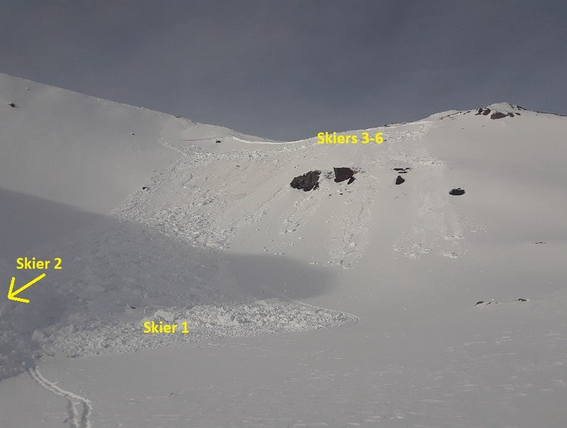
Site of the fatal avalanche during a Level 2 AIARE course behind the lawsuit against Silverton Avalanche School (settled) and Backcountry Access.
According to the US Forest Service, a skier was killed in an avalanche Saturday, December 11, in Silver Basin, a closed area of Crystal Mountain, Washington, that ski patrol had not mitigated for avalanche hazard. Six skiers from the same party were caught in the slide. The Pierce County Medical Examiner’s Office has identified the deceased as Robert “Bob” Weisel, 66, of Issaquah, Washington. This is the U.S.’s first avalanche fatality of the 2021/22 season.
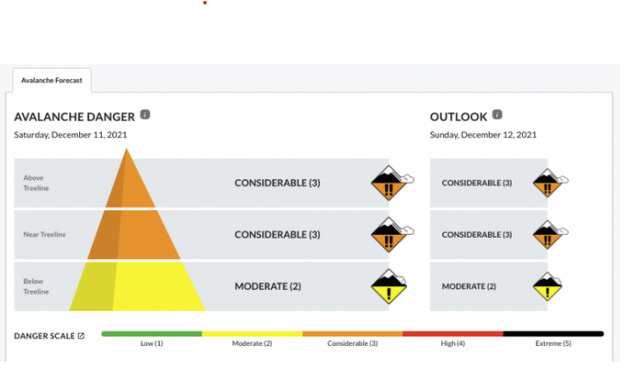
After a long dry spell that has plagued much of the continental United States this winter, Crystal Mountain reported receiving 12 inches of snow in 24 hours with winds up to 100 mph at the summit Saturday. The Friday evening advisory rated the avalanche hazard as considerable near and above tree line. “Look for storm slabs to develop on Saturday at all elevation bands as the West South is targeted by a potent winter storm,” it warned. It reported of the newly forming storm slab, which was resting atop another recent storm layer and a crust from late November. They advised those entering the backcountry to “choose conservative terrain and realize that early season conditions still exist.”
Silver Basin, where the fatality occurred, is a north- through east-facing slope at approximately 6,500 feet that is marked as a black diamond when open. According to a preliminary report, the six individuals were traveling uphill when they triggered a large avalanche. Another party of two in the area that witnessed the avalanche reported it to Crystal Mountain Ski Patrol at 10:50 a.m. and assisted in the rescue. Four skiers were partially or fully buried, three of whom were successfully recovered. The fourth skier was found unconscious and did not respond to resuscitation efforts. All skiers involved were carrying avalanche equipment and several had taken a recent avalanche course.
A statement from Crystal Mountain following the fatality read, “As snow continues to fall, Crystal Mountain Ski Patrol reminds backcountry skiers to research uphill travel policies and check the avalanche forecasts before heading into the backcountry.”
A week from graduating high school, Alaska avalanche survivor Peter Schutt was physically on top of the world as he climbed Donoho Peak near the Alaska/Canada border.
Unfortunately, Schutt’s adventure took a dangerous turn when an avalanche struck. Snow that was once a fixture on the frigid face of the mountain suddenly cut loose and turned into a freight train of cold, sugary crystals stampeding in rapid, unstoppable motion.
The avalanche pitched him over a 75-foot cliff on his tumble down 2,500 feet of the jagged mountain face. He remembers covering his head as best he could to prevent further injury.
After the avalanche Schutt’s friend and partner made his way down, contacted National Park Service via cell phone and provided cell phone GPS coordinates to aid the rescue response.
Alaska Air National Guardsmen of the 176th Wing partnered with multiple civil search and rescue partners to rescue Schutt during the May 26, 2021, ordeal.
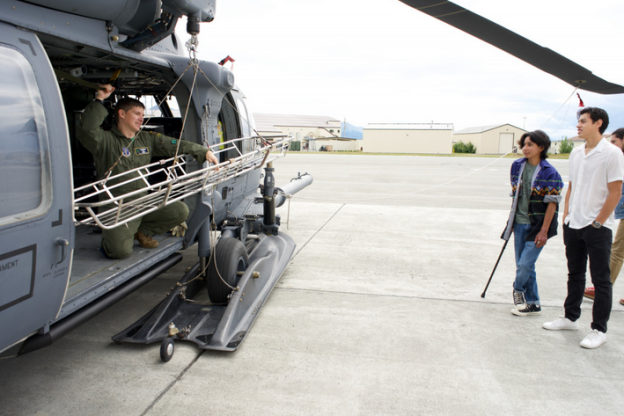
Following weeks of recovery, Alaska avalanche survivor Schutt, with several family members, visited the 176th Wing July 9 to share his story, tour the aircraft involved in the rescue, and thank his rescuers.
Following Schutt’s fall, National Park Service contacted the Alaska Rescue Coordination Center at 6:20 p.m. to notify them of the incident and request a hoist-capable aircraft be on standby. Snow conditions and steep terrain on Donoho made it impossible for the National Park Service A-Star helicopter to reach the injured hiker, and at 8:05 p.m. the NPS requested Air National Guard sup-port.
“The patient lost footing and rolled hundreds of feet down a snow-covered slope near Donoho Peak in Wrangell-St. Elias National Park and Preserve,” said NPS Ranger and incident commander Stephens Harper. “The fall triggered a snow slide, which then carried the patient over a cliff into a ravine.”
Schutt’s father, Aaron, was boarding a plane bound for Minnesota when he got the phone call no parent wants to receive. He was told the fall was “not a survivable incident.”
“Which is what you don’t want to hear as a parent,” he recalled.
Wrangell Mountain Air, a private charter company, spotted Schutt, confirmed his location, and re-layed GPS coordinates to the National Park Service who then relayed the information to the AK RCC.
With coordinates in hand, the AK RCC contacted the 176th Wing who dispatched a 210th Rescue Squadron HH-60G Pave Hawk helicopter, a 211th Rescue Squadron HC-130J Combat King II and a 212th Rescue Squadron Guardian Angel team comprising pararescue personnel (PJs).
First responders from Kennicott Wilderness Guides, who are also Wrangell-St. Elias National Park and Preserve Search and Rescue Team members, hiked a couple of miles to the ravine. They pro-vided emergency medical care while on the phone with the National Park Service Alaska Region medical director who is also an emergency room physician for Alaska Regional Hospital.
The NPS helicopter flew to the area but was unable to land safely, so they air-dropped medical supplies to the first responders and notified Harper of the need for a hoist and litter to safely move the patient off of the mountain.
The danger on the mountain didn’t dissolve when help arrived.
“While on the phone with [the doctor], they heard the snow shifting above them and moved the patient to higher ground before a second snow slide traveled down the ravine,” Harper said.
Maj. Ben Leonard, 210th RQS HH-60 rescue pilot, said the crew was training for the week at Eielson Air Force Base, about 300 miles north of their home base of Joint Base Elmendorf-Richardson. Leonard said the training proved helpful during the real-world rescue after Master Sgt. Tim Ching, HH-60 special missions aviator, completed 23 simulated hoists during four hours of training.
“In particular that week, we had done a ton of hoist training, especially high-angle hoist training, which is the scenario you ended up in later that week.,” he said. “In the days prior, we had flown a lot as a crew, and Tim had done what I would call a record number of live hoists in very challeng-ing scenarios with the PJs.”
Once on-scene, the Air National Guard pararescue team of Senior Master Sgt. Bryan Dalere and Sen-ior Airman Nathan Graber hoisted down to Schutt’s location where they provided additional medi-cal support and stabilized him for hoist to the helicopter. Looking through the window, HH-60 res-cue pilot Maj. Jake Ring said he marveled at the cliff fall Schutt survived.
“I remember looking up and thinking that has to be at least 80 feet,” he said.
The Pave Hawk crew transported Alaska avalanche survivor Schutt to the McCarthy Airport where he was transloaded to a Guardian Flight AirMedCare air ambulance and taken to Alaska Regional Hospital in Anchorage.
This rescue involved coordination between multiple agencies, including the 176th Wing, Alaska Air National Guard, Wrangell St. Elias National Park and Preserve Search and Rescue Team, National Park Service Fire Management in Fairbanks, National Park Service A-Star Helicopter, Wrangell Mountain Air, Guardian Flight, and Kennicott Wilderness Guides.
“It was the people, including Peter, with his will to live,” Aaron said in crediting the save. “His friend who was with him called for help immediately, and they got down to him within an hour and did all the right things on the ice – kept him as comfortable as possible, kept him alert, and continued to talk to his mother.”
During the July 9 visit, Schutt’s family toured a 211th RQS HC-130 as well as the HH-60 that res-cued him. Maj. Stephen Ludwig, 176th Wing Exercise and Planning officer and Combat King pilot, coordinated the event and gave Schutt a detailed rundown of the HC-130 flight deck.
“It’s always great, working in the RCC and working here, having survivors come back and share their stories, and to put a face to [a rescue,]” Ludwig said.
After recalling the events of May 26, Aaron expressed his appreciation of the multi-agency team that rescued his son.
“We’re just very thankful to all of you and what you do on a daily basis.,” he said.
Alaska avalanche survivor meets and thanks Arctic Guardian rescue teamAlaska avalanche survivor meets and thanks Arctic Guardian rescue team

avalanche-center.org