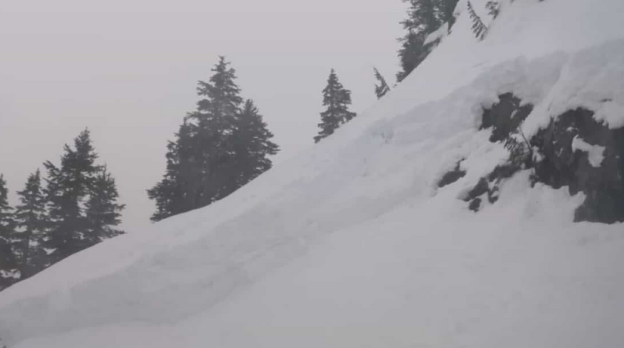
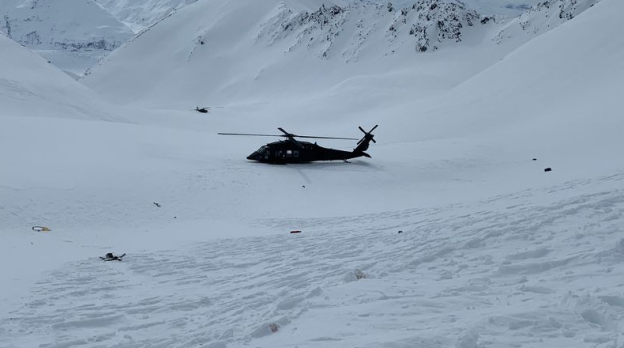
Eaglecrest Ski Area, AK, confirmed a large inbounds avalanche in a closed area of the resort. Crews using beacons, probes, dogs, and RECCO equipment searched the scene but found nobody trapped. The resort had received 25″ of fresh snow in the previous five days. The slide, in the East Bowl Chutes, was seven feet deep and ran for 100 yards.
“At 10:10 am on January 26th, Eaglecrest Ski Patrol received a report of an avalanche in closed terrain in the East Bowl Chutes. Upon investigation, ski patrol found a large avalanche approximately 6 to 7 feet deep and approximately 75 yards wide and approximately 100 yards long. A preliminary avalanche transceiver search was immediately launched, which was followed by a secondary transceiver search. Our RECCO detection equipment was then dispatched for the search. Alaska SEADOGS, Juneau Mountain Rescue, and the Alaska State Troopers were notified and called on scene. SEADOGS performed a search with two dogs. The Ski Patrol staff probed through debris and catchment spots in an abundance of caution to be sure that no one was entrapped despite this portion of the mountain being closed for the day. Eaglecrest has just gone through a very active week of weather, with inches of rain and snow-water equivalent moisture over the last 7 days. The mountain had extremely limited terrain open today off the top of the mountain as we were allowing the snowpack to adjust to all of the additional weight and drain.”
– Eaglecrest report
Eaglecrest has seen 211″ of snow this season and has a 136″ base. Much of the upper mountain was closed at the time of the slide to protect the fragile snowpack.
Inbounds Avalanche at Eaglecrest Ski Area, AK. Credit: Resort
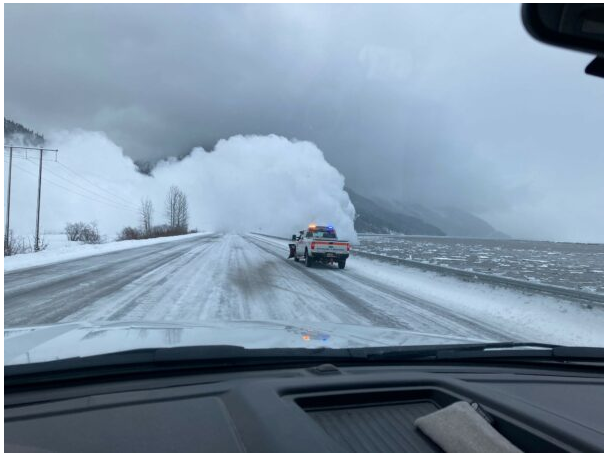
A Seward Highway avalanche closed the road for much of the day Friday. It was between Bird Creek and the Portage turnoff. The avalanche severed the only road access between Anchorage and the Kenai Peninsula for more than eight hours.
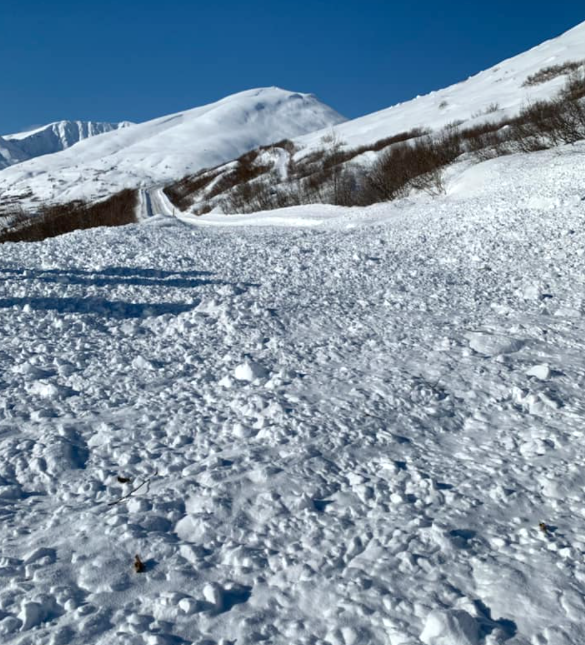
The Seward Highway avalanche hit at Mile 91.5 and the debris on the roadway was up to 15 feet high in spots, said a spokesperson for the DoT. The highway reopened around 2 p.m. but drivers should remain cautious.
“Travel is going to be wet and slick and bumpy. They’ve cleared all the snow but it’s definitely not down to dry highway measures by any means.”
Crews set off artillery to trigger 20 other avalanches along the highway on Friday. Also on Friday, several snow slides closed the Old Glenn Highway near the Old Knik River Bridge.
Farther north, snow slides near Summit Lake closed the Richardson Highway from mile 186 to 218.
The Hatcher Pass Avalanche Center also warned of very dangerous avalanche conditions in the area. It issued an avalanche warning early Friday, and it says the Hatcher Pass Road will be closed at mile 11 through the weekend due to avalanche activity.
National Weather Service meteorologist Michael Kutz said Anchorage has been having one of the wettest years on record so far. Snowfall this February is nearly three times higher than average, and rainfall this year is more than four times above normal, Kutz said.
Seward Highway Avalanche
Rain and Snow in Anchorage
Rain and snow have been falling in Anchorage and other areas of Southcentral since the beginning of the week. Which has led to treacherous road conditions in parts of town. Areas of the Mat-Su have been hit with heavy snow. Power to thousands of homes has been knocked out.
As of Friday evening, about 300 homes still did not have power. The Mat-Su school district canceled in-person classes on Friday for the third day in a row due to road conditions and winter weather.
A week from graduating high school, Alaska avalanche survivor Peter Schutt was physically on top of the world as he climbed Donoho Peak near the Alaska/Canada border.
Unfortunately, Schutt’s adventure took a dangerous turn when an avalanche struck. Snow that was once a fixture on the frigid face of the mountain suddenly cut loose and turned into a freight train of cold, sugary crystals stampeding in rapid, unstoppable motion.
The avalanche pitched him over a 75-foot cliff on his tumble down 2,500 feet of the jagged mountain face. He remembers covering his head as best he could to prevent further injury.
After the avalanche Schutt’s friend and partner made his way down, contacted National Park Service via cell phone and provided cell phone GPS coordinates to aid the rescue response.
Alaska Air National Guardsmen of the 176th Wing partnered with multiple civil search and rescue partners to rescue Schutt during the May 26, 2021, ordeal.
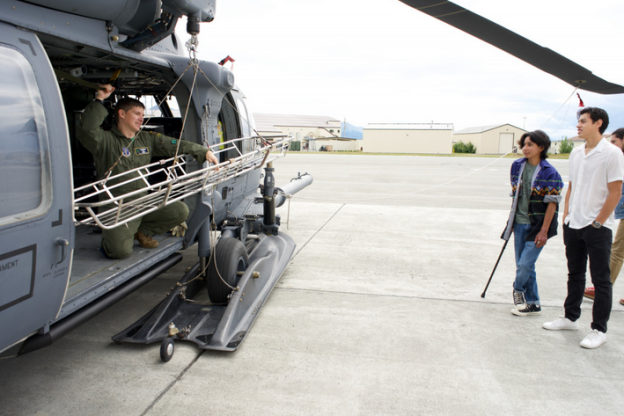
Following weeks of recovery, Alaska avalanche survivor Schutt, with several family members, visited the 176th Wing July 9 to share his story, tour the aircraft involved in the rescue, and thank his rescuers.
Following Schutt’s fall, National Park Service contacted the Alaska Rescue Coordination Center at 6:20 p.m. to notify them of the incident and request a hoist-capable aircraft be on standby. Snow conditions and steep terrain on Donoho made it impossible for the National Park Service A-Star helicopter to reach the injured hiker, and at 8:05 p.m. the NPS requested Air National Guard sup-port.
“The patient lost footing and rolled hundreds of feet down a snow-covered slope near Donoho Peak in Wrangell-St. Elias National Park and Preserve,” said NPS Ranger and incident commander Stephens Harper. “The fall triggered a snow slide, which then carried the patient over a cliff into a ravine.”
Schutt’s father, Aaron, was boarding a plane bound for Minnesota when he got the phone call no parent wants to receive. He was told the fall was “not a survivable incident.”
“Which is what you don’t want to hear as a parent,” he recalled.
Wrangell Mountain Air, a private charter company, spotted Schutt, confirmed his location, and re-layed GPS coordinates to the National Park Service who then relayed the information to the AK RCC.
With coordinates in hand, the AK RCC contacted the 176th Wing who dispatched a 210th Rescue Squadron HH-60G Pave Hawk helicopter, a 211th Rescue Squadron HC-130J Combat King II and a 212th Rescue Squadron Guardian Angel team comprising pararescue personnel (PJs).
First responders from Kennicott Wilderness Guides, who are also Wrangell-St. Elias National Park and Preserve Search and Rescue Team members, hiked a couple of miles to the ravine. They pro-vided emergency medical care while on the phone with the National Park Service Alaska Region medical director who is also an emergency room physician for Alaska Regional Hospital.
The NPS helicopter flew to the area but was unable to land safely, so they air-dropped medical supplies to the first responders and notified Harper of the need for a hoist and litter to safely move the patient off of the mountain.
The danger on the mountain didn’t dissolve when help arrived.
“While on the phone with [the doctor], they heard the snow shifting above them and moved the patient to higher ground before a second snow slide traveled down the ravine,” Harper said.
Maj. Ben Leonard, 210th RQS HH-60 rescue pilot, said the crew was training for the week at Eielson Air Force Base, about 300 miles north of their home base of Joint Base Elmendorf-Richardson. Leonard said the training proved helpful during the real-world rescue after Master Sgt. Tim Ching, HH-60 special missions aviator, completed 23 simulated hoists during four hours of training.
“In particular that week, we had done a ton of hoist training, especially high-angle hoist training, which is the scenario you ended up in later that week.,” he said. “In the days prior, we had flown a lot as a crew, and Tim had done what I would call a record number of live hoists in very challeng-ing scenarios with the PJs.”
Once on-scene, the Air National Guard pararescue team of Senior Master Sgt. Bryan Dalere and Sen-ior Airman Nathan Graber hoisted down to Schutt’s location where they provided additional medi-cal support and stabilized him for hoist to the helicopter. Looking through the window, HH-60 res-cue pilot Maj. Jake Ring said he marveled at the cliff fall Schutt survived.
“I remember looking up and thinking that has to be at least 80 feet,” he said.
The Pave Hawk crew transported Alaska avalanche survivor Schutt to the McCarthy Airport where he was transloaded to a Guardian Flight AirMedCare air ambulance and taken to Alaska Regional Hospital in Anchorage.
This rescue involved coordination between multiple agencies, including the 176th Wing, Alaska Air National Guard, Wrangell St. Elias National Park and Preserve Search and Rescue Team, National Park Service Fire Management in Fairbanks, National Park Service A-Star Helicopter, Wrangell Mountain Air, Guardian Flight, and Kennicott Wilderness Guides.
“It was the people, including Peter, with his will to live,” Aaron said in crediting the save. “His friend who was with him called for help immediately, and they got down to him within an hour and did all the right things on the ice – kept him as comfortable as possible, kept him alert, and continued to talk to his mother.”
During the July 9 visit, Schutt’s family toured a 211th RQS HC-130 as well as the HH-60 that res-cued him. Maj. Stephen Ludwig, 176th Wing Exercise and Planning officer and Combat King pilot, coordinated the event and gave Schutt a detailed rundown of the HC-130 flight deck.
“It’s always great, working in the RCC and working here, having survivors come back and share their stories, and to put a face to [a rescue,]” Ludwig said.
After recalling the events of May 26, Aaron expressed his appreciation of the multi-agency team that rescued his son.
“We’re just very thankful to all of you and what you do on a daily basis.,” he said.
Alaska avalanche survivor meets and thanks Arctic Guardian rescue teamAlaska avalanche survivor meets and thanks Arctic Guardian rescue team
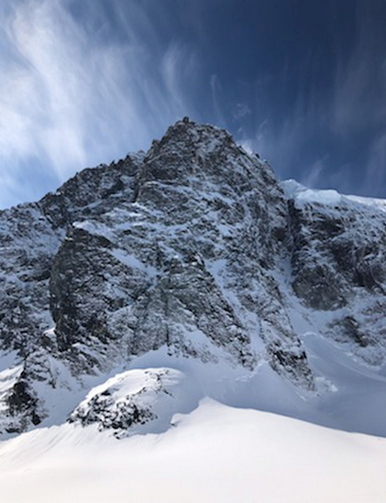
An Aleutian avalanche woke three climbers on Easter morning. They found they were tumbling down the Neacola Mountains in Southwest Alaska. Their tents were propelled down Mount Neacola in Lake Clark National Park and Preserve by an air blast from an avalanche above them.
The climbers had set up camp several days earlier. They were waiting for the weather to improve. The group planned to attempt to climb the roughly 9,350-foot Neacoloa peak via the north face. A route that has never been successfully climbed, according to the American Alpine Club. It has stymied mountaineers like the legendary Fred Beckey.
The climbers received a grant from the American Alpine Club to fund the north face attempt. The three have more than a decade of experience. Two work as avalanche instructors. They work together as climbing guides in New Hampshire. The team had traveled to Alaska planning to spend about 3 1/2 weeks on the mountain. They returned home to New Hampshire on Thursday but are keeping an eye on Alaska weather in hopes that conditions in the Neacola Mountains will improve enough in the next few weeks that they can return.
Amplified Aleutian Avalanche Risk
Heavy snowfall and high winds in recent weeks had amplified avalanche risk in areas of Lake Clark National Park that are normally not affected.
⚠️Safety alert! ⚠️ Field staff are reporting significant avalanche activity in the park. Please remain observant,...Posted by Lake Clark National Park & Preserve on Friday, April 2, 2021
Caught in Their Sleep
Just before 4:30 a.m. one of them woke up pressed against the front wall of his tent as it started to flip. “The immediate first thought was, oh no, I’m getting buried in an avalanche,” he said.
When the tents came to a rest roughly 300 feet away they were on top of the debris.
The men called out to one another and realized they were all safe.
One climber hit his head during the fall but the men were otherwise uninjured.
The three managed to prop one of their tents back up and sheltered until dawn.
Salvaged Food Supplies
When daylight broke, they worked their way around the glacier, hunting for the remainder of their food. They didn’t know how long they might be waiting, but it was clear that the weather was not going to improve enough for a plane to fly in that day.
The climbers estimated it would take six days total to climb the 4,500-foot north face. They managed to find enough food to feed them comfortably for a week.
Lucky Conditions for Flying Out
They messaged Doug Brewer, the pilot who had flown them into the range, on their InReach devices. He agreed to pick them up as soon as it was safe.
Brewer has been flying in the Neacola Mountains for decades and described the range as breathtaking but requiring a technically challenging flight through a narrow canyon around the incredibly steep Mount Neacola. He said there’s a limited window of time each day with enough light on the glacier to safely navigate, and only during low winds.
The Neacola Mountains are visited infrequently, even by climbers, said a spokeswoman for Lake Clark National Park. That’s partly because tackling the rugged terrain requires extreme skill, but also because the mountains — located in the northern portion of the national park — are in such a remote area.
This mountain range is relatively newly named. The first recorded climbers explored the area in the 1960s but it took several more decades for another set of climbers to publish findings.
The climbers were nervous staying in the aleutian avalanche area, but there didn’t seem be safer options. So they waited.
Blizzard conditions continued for much of Monday, but by Tuesday the skies were clearer.
The climbers attempted to stomp out a runway and Brewer and his son flew in, making an uphill landing on the glacier in their ski-equipped planes. The landing was rough because avalanche debris had obscured the runway area, Brewer said.
“It was still cold, probably zero, and it was a down-glacier wind about 15-20, so this was right on the edge of being able to get them out safely,” he said.
The climbers helped stomp out additional chunks of debris on the makeshift runway and turn the planes around.
A heli-ski avalanche near Matanuska Glacier killed a Fairbanks woman who was heli-skiing on Saturday. It was witnessed by four others in the group.
Erin Lee, 40, was rescued and taken to Mat-Su Regional Hospital and pronounced dead.
She was part of a group heli-skiing about 7½ miles from the Glenn Highway east of the Matanuska Glacier, said Austin McDaniel, a spokesman for the Alaska state troopers. It wasn’t immediately clear which mountain the avalanche occurred on. Troopers have not visited the exact site. McDaniel also noted that another group was heli-skiing in the same area Saturday.
Group was from Majestic Heli Ski
Lee was one of four guests in the Majestic Heli Ski group led by one guide that afternoon.
Majestic Heli Ski is based near Mile 115 of the Glenn Highway. Which is about halfway between Palmer and Glennallen. Majestic Heli Ski offers packages that include heli-skiing in the Chugach and Talkeetna mountains. Majestic Heli Ski has not made any statements about the heli-ski avalanche near Matanuska Glacier.
Two clients and a guide were at the bottom after finishing a run. Lee began skiing and an avalanche was triggered. One other skier was still at the top. All four watched the slide bury Lee. No other skiers were caught in the avalanche and there were no other injuries, according to McDaniel.
Group had safety gear
Lee was equipped with avalanche safety gear. Including an avalanche beacon, rescue probe, shovel, harness and avalanche airbag system. She did not deploy the avalanche airbag system during the avalanche.
The other skiers in the group were also equipped with safety gear, and the guide had communication equipment. According to the company’s website, Majestic Heli Ski clients receive training about hazards and also how to use the safety gear.
“It sounds like the witnesses, including the guide, were able to see what happened and they were able to go right to the area and use the beacon technology,” McDaniel said.
Lee was recovered from the heli-ski avalanche near Matanuska Glacier by the group. Then flown to the hospital in the Majestic Heli Ski helicopter. It was not clear exactly how long Lee may have been buried. McDaniel said about an hour passed from the time of the avalanche until the time Lee reached the hospital.
It’s not clear what triggered Saturday’s heli-ski avalanche near Matanuska Glacier. McDaniel said there is not currently a plan to investigate that.
“The availability of having witnesses see what happened is key in us making the decision on trying to track down an avalanche specialist to go out there and determine a little bit more closely what had happened,” McDaniel said.
Closest danger forecast was Considerable
The area where this happened is outside the direct forecast zones for the Hatcher Pass and Chugach National Forest avalanche centers. There was a forecast from the Hatcher Pass Avalanche Center, about 60 miles west. It rated the avalanche danger there on Saturday as considerable at all elevations.
New snow fell in much of the Matanuska-Susitna Borough last week. That caused some instability for avalanche conditions in the Hatcher Pass area. Numerous natural, human and remotely triggered avalanches were reported Friday. One crossed and closed a road, the avalanche center wrote.
Guides at Majestic Heli Ski “continuously gather data and evidence, take field observations, perform snowpack tests, monitor weather conditions and evaluate and forecast the snow stability and the avalanche hazard,” according to their website.
Avalanche deaths not a common occurrence, says State Trooper
All backcountry recreating has risks, McDaniel said But avalanche deaths are a less common occurrence. Lee was the fourth person in Alaska to die in an avalanche this season. In early February, three climbers died in an avalanche on a steep and challenging route of Bear Mountain near Chugiak.
Five men also died heli-skiing Saturday when their helicopter crashed above the Knik Glacier in the Chugach Mountains southeast of Palmer. One man who survived the crash remains in serious condition. That group consisted of the pilot, three guests and two guides from Tordrillo Mountain Lodge.
McDaniel said he and other officials with the state troopers could not recall any deaths other than the six Saturday that were related to heli-skiing in recent years. A Southeast Alaska Backcountry Skiing Adventures heli-ski guide was buried in an avalanche near Haines in 2014. He eventually died, following the death of another guide from the same company on a Haines-area heli-ski trip in 2013. An avalanche near Haines killed an Alaska Heliskiing company guide and a snowboarder in 2012.
A Heli-ski avalanche near Matanuska Glacier killed a skier from Fairbanks
A Hatcher Pass avalanche blocked the road but it reopened just before 4 p.m. Friday
A large, remotely triggered Hatcher Pass avalanche covered the road around 12 p.m. on Friday. Hatcher Pass Avalanche Center posted photos of the avalanche. They said that the road would likely be closed at the Gold Mint parking lot. The avalanche did not involve any people.
Increased Avalanche Danger had been predicted
On March 25, the HPAC warned of an increased avalanche danger due to nearly a foot of new snow. Persistent slabs and storm slabs were likely problems. Later that day three observations of small avalanches were reported.
“No one was caught or carried it was people skinning on the standard Marmot uptrack and triggered a smaller avalanche and then it stepped down to the deeper layers in the snowpack” said HPAC Board Chair Andy Dennis.
Road Cleared of Avalanche Debris
The Department of Transportation and State Parks were alerted to clear the road. It was closed at the turn near the Gold Mint parking lot. Throughout the winter numerous skiers have been caught in small avalanches. Nobody has been buried and there have been no fatalities in Hatcher Pass. Palmer Fire and Rescue did assist other agencies in a rescue in Hatcher Pass on March 21.
“As we come into spring I think we have a tricky snowpack, so any new load is potentially going to awaken the persistent slab problem. These cold temperatures have not allowed the snowpack to heal at all and really just trying to make sure people are heads up coming into the longer, warmer days. It’s going to be A little bit delayed in terms of kind of the snowpack stabilizing,” said Dennis. “We’ve got a couple crust layers that are going to, what we’re thinking is most likely going to prohibit fast healing.”
The avalanche occurred just after 12 p.m. and the road was cleared at around 6 p.m.
Sat, Feb. 27 – Juneau’s urban avalanche forecast is for “extreme” Juneau avalanche danger as of Saturday evening. There is a potential for “historic avalanches” in residential areas. City officials recommend that residents in the avalanche zone in downtown Juneau evacuate their homes.
The advisory also recommends that residents avoid avalanche paths including the Flume Trail. “People need to make their own safety decisions,” it stated. “But we feel that with the forecast for the next 24 – 48 hours natural avalanches are likely and of great size.”
The city and the Red Cross will open Centennial Hall as an emergency shelter. The doors opened at 8:00 p.m. on Saturday. COVID-19 mitigation measures are in place.
Juneau Avalanche Warnings were issued Friday
Juneau city officials said on Friday that there is a potential for “historic avalanches”. Depending on temperatures and how much snow falls, the city’s Urban Avalanche Advisory could be raised to an “extreme” Juneau avalanche danger, which is the highest level on the scale.
“I have never forecasted an extreme avalanche condition,” said Tom Mattice, the city’s emergency programs manager. He advised residents to be cautious, especially near the Behrends Avenue avalanche path.
Mattice says they’ve recently seen avalanches of snow four to six feet deep throughout the region. “In the urban environment, if we have a four foot deep avalanche that’s wide enough across the face of the Behrends path, (then) that’s more than enough to hit houses,” he said.
Widespread Activity and increased hazards
The Alaska Department of Transportation & Public Facilities has warned of increased avalanche hazard along Thane Road. Residents along the road should be prepared for an extended road closure if crews are unable to safely remove any avalanche debris.
The Coastal Alaska Avalanche Center says they’ve already seen widespread avalanche activity all around Juneau. They expect more avalanches over the weekend.
Rain Crust
A freezing rain crust has formed on top of recent snow that fell on a weak snow layer. The snow’s weakness can even be triggered from a flat spot. “And then, it’ll travel through that freezing rain crust and collapse the looser snow below and the denser snow above. So it can travel great distances. We’ve already seen avalanches that have traveled over a quarter mile just from propagating through the snowpack.”
They’re warning people heading out to the backcountry to use extreme caution. Even in terrain that is generally considered safe from any avalanches.
He says the unstable snowpack conditions could potentially last through the rest of the season.
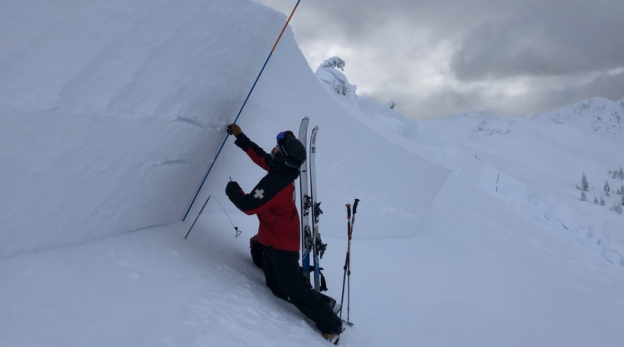
A ski patroller examines snow layers during avalanche mitigation. (Coastal Alaska Avalanche Center)