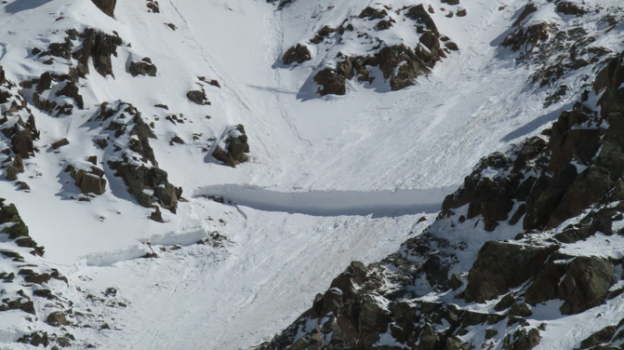
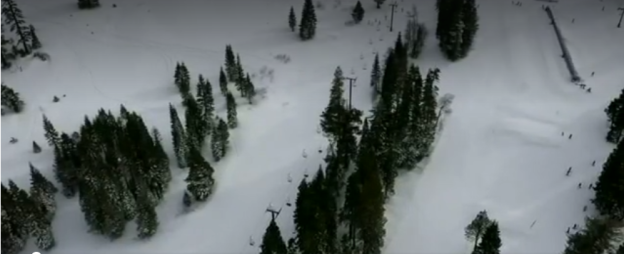
The explosive business of avalanche control keeps the ski area slopes safe for guests.
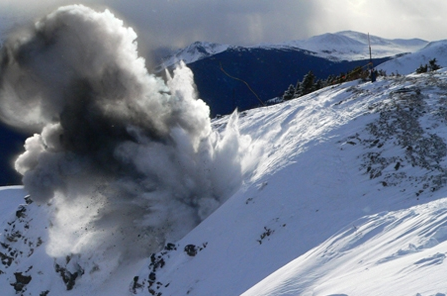
On many winter days explosions can be heard echoing across many ski areas. These are the sounds of avalanche mitigation.
Dutch Draw Avalanche
Last week an avalanche was reported in the Dutch Draw area of Park City, Utah between the lifts Peak Five and Ninety-Nine 90. According to Andy Van Houten, snow safety director of Park City Mountain, the avalanche occurred in the back country. “We worked with the Department of Public Safety helicopter,” he said. “It was established that nobody was involved. We had all of our witnesses accounted for, all is good.”
“There is no mitigation outside of the resort and so it’s 100% on the on the user, on themselves; we do worry about it from a rescue perspective but we do not do anything to mitigate that hazard,” Van Houten said.
Mitigation Methods
There are a few ways the ski patrol can mitigate avalanche risks. While the explosive business is the most dramatic two other methods are used as well. Ski cutting and compaction.
Ski cutting is where a patroller will ski intentionally across the top of a slope. This may trigger an avalanche as the slope is traversed. This method is used on smaller slides.
Another form of mitigation is called skier compaction.
“The best thing we can do is get this terrain open to public and get it skied,” Van Houten said. “That’s why we push so hard to get this terrain open, you know, in a timely fashion is that so we can get our guests up there to ski it and that’s what helps us, that kind of skis all the snow and it breaks up the layers that build up.”
Explosives
For bigger slopes there is the explosive business. There is a typically team of patrollers who go out in groups of two or three and carry explosives in their backpacks.
“It’s a cast booster, it’s about the size of a large can of soup and it’s a pentolite TNT combination,” Van Houten said. “It’s got 120-second fuse strain on it. It’s basically like a little cardboard tube and that’s it’s got a sparker in it. When we pull that, that’s what ignites the end of the fuse train. We either rope them, or we just throw them. And it’s like throwing a can of soup into the snowpack. It’s a good-sized shot. But we are usually pretty far away when it detonates and we kind of plug our ears and kind of turn our backs to it a little bit. So we’re not we’re not close to it by any means.”
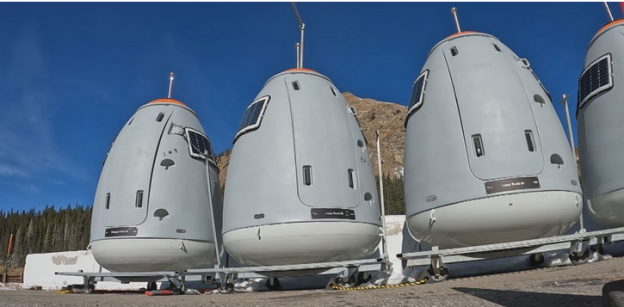
Avalanche mitigation spaceships will be used on Colorado mountain highways.
The egg-shaped devices lined in a row in the parking lot at the Eisenhower-Johnson Tunnels loom like spaceships getting ready for liftoff.
“Looks a little like the CDOT space force this side of the road,” said winter operations manager Jamie Yont. “These are our Gazex exploders, we have them for avalanche control around the west side of the Eisenhower Tunnel.”
The avalanche mitigation spaceships actually have no propulsion, they are taken up to mountain ridge tops by helicopter. There they are connected to towers from which a mixture of hydrogen and oxygen fill a chamber. The mixture can be remotely sparked to cause an explosion that triggers avalanches to keep roads safe.
CDOT has 16 spaceships: 12 at the Eisenhower-Johnson Tunnels, two on Berthoud Pass and two on Wolf Creek Pass.
They have been using the relatively new technology for a few years. They putting them in place in November and then bring them back down in May.
“It’s relatively new technology,” said Yont. “… we have had them for four or five winter seasons.”
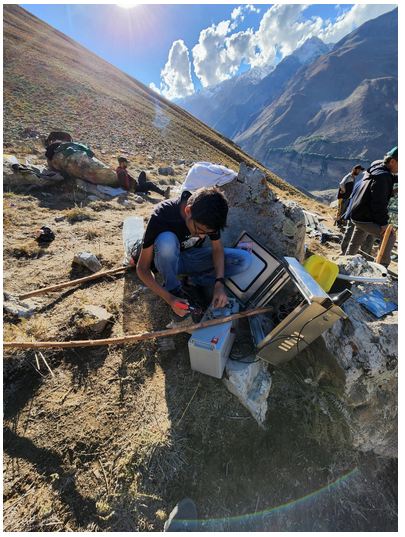
Tajikistan Avalanche Early Warning System – A Life-Saving System. Georgia Tech engineering student Mirza Samnani volunteered over 1,000 hours to develop early warning systems for avalanches in Tajikistan.
Samnani hiked over 9,200 feet — three times — to install two weather stations in the village of Manem in Tajikistan. This project has the potential to affect more than 1 million people in hundreds of villages in the high mountainous regions of Central and South Asia including Tajikistan, Afghanistan, and Pakistan that are prone to avalanches every winter. It can also be scaled to other parts of the world where avalanches pose a high risk.
Samnani was contacted by a member of Madad, a nonprofit organization that works to save lives within communities that are vulnerable to climate change. The group came across his previous work building life-saving robots for a hospital in his hometown of Mumbai, India, during the pandemic. Seeing his love for helping others and his engineering skills, they invited Samnani to join Madad.
High mountain regions in Central Asia, Karakoram, Hindu-Kush, and the Himalayas are prone to snow avalanches. Their frequency and intensity are expected to increase due to atmospheric warming. The lack of a village-level avalanche early warning system poses a significant challenge in warning communities for timely action to avert disaster. Currently, local volunteers manage weather monitoring posts, where they manually track temperature, rainfall, and snow depth.
The early warning system Samnani worked on has seven different sensors. They monitor weather and environmental conditions, including wind speed and direction, atmospheric pressure, temperature, humidity, rainfall, snowfall, solar radiation from the sun, solar radiation absorbed from the ground, snow depth, and seismic activity. These conditions help calculate the snowpack parameters and, based on the trigger threshold, the algorithm determines when to disseminate an alert or warning about a Tajikistan Avalanche.
The project faced uncertainty because of the rough terrain as well as strict regulations and policies in the region. Even after extensive testing, communication and power issues occurred, but these problems ended up serving as learning opportunities that ultimately improved the Tajikistan Avalanche system.
“This project presented me with a unique opportunity to utilize my engineering skills to develop a system to predict the risk of an avalanche. In just 10 months our engineering team took this project from concept to installation. I am excited for the data that we will receive from these pilot units in the upcoming months. I plan to continue to work with this project and other important projects that will help improve the quality of life for people living in poor or dangerous conditions,” Samnani said.
Currently, he and the group are collecting and monitoring the data being received from each warning system tower and studying the integrity and performance of the towers. In the next few years, more of these stations will be deployed to cover more than 600 high-risk villages in central and south Asia and eventually will incorporate sirens and text and phone alerts.
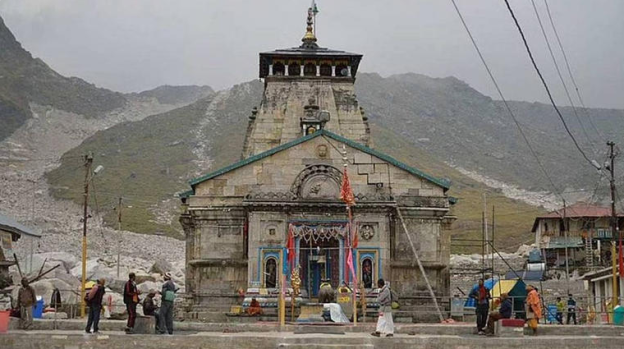
Kedarnath avalanches: An expert committee was formed by the Uttarakhand government to probe a series of Kedarnath avalanches in the past two months. They advised a complete ban on construction of buildings and temporary shelters on the “highly unstable and active debris slope above (the) Kedarnath temple”.
A report was submitted to the government which told the government in Uttarakhand to instead build concrete wedges and mounds on the higher slopes above the temple. This would reduce the momentum of avalanches originating about 5-6 km above the shrine.
Three Kedarnath avalanches were reported from the hills surrounding the shrine in Uttarakhand’s Rudraprayag district, between 22 September and 2 October. All were reportedly at a distance of 3-4 km from the temple site.
Last year, on 23 April, a temporary shelter housing labourers working for the Border Road Organisation (BRO) killing 16 people. A few months later, on 2 October, seven mountaineers lost their lives in an avalanche near mount Trishul.
In 2013, flash floods and landslides in the Kedarnath area wreaked havoc, killing many.
The expert committee report also mentions other avalanches from further back. One was in October 1998, which killed 27 pilgrims. Another happened on 23 June, 2008, when 20 people, including eight pilgrims, were severely injured. More than 100 lives have been lost in avalanches in the higher hills of the Chardham region in the past 10 years, according to the report.
On 1 October, following two of the past months’ three avalanches, the Uttarakhand government constituted an expert committee to undertake geological, glaciological, and geomorphic investigations around Kedarnath.
The five-member panel included the executive director of Uttarakhand State Disaster Management Authority (USDMA) Piyoosh Rautela, Wadia Institute of Himalayan Geology scientists Manish Mehta and Vinit Kumar, and Indian Institute of Remote Sensing’s C.M. Bhatt and Pratima Pandey — were tasked with ascertaining the causes of recurring avalanches in the area, assess risk factors and suggest remedial measures.
In its report, the panel recommended a “complete ban” on construction of any form on the highly unstable and active debris slope. Including scree fans (fan-shaped rock fragments). Construction activities at such heights may “lead to changes in direction and slopes of the unconsolidated materials” between the avalanche sites and the shrine.
The report also recommended slope modification and structural changes on the slopes.
“Benching of the slope at different elevations along the steep gradients of snow drift or channels to the north of Kedarnath temple would reduce overall slope angle and retard the velocity of downward movement of snow and debris mass” added the report.
It was also suggested that concrete wedges be constructed along the mid-slope of avalanche chutes to prevent and divert the forces, for “total protection from avalanche hazard”. The design, size and number of these structures would be decided after detailed field studies.
Kedarnath avalanches – Origin in glaciers
According to the report, the three recent Kedarnath avalanches originated 6 kilometers above the temple. From the peaks of the Companion Glacier adjacent to the Chorabari Glacier.
The town of Kedarnath is located on the outwash plains of Chorabari and Companion glaciers. The channels of the Mandakini river originate from Chorabari and Saraswati. It flows down from Companion glacier, encircling the plane terminating towards the south of the temple — the meeting point of the two rivers.
According to the report, “These streams (Mandakini and Saraswati) are observed to actively erode their banks. Avalanche is a major threat in the higher altitude regions.”
The Chorabari lake burst triggered a devastating 2013 flash flood.
Three recent Kedarnath avalanches and others in the past came from the accumulation zone of the Companion Glacier.
Deposition zones of these avalanches are located 5 km uphill of the Kedarnath temple. The avalanche activity poses little or no threat to the temple township. Appreciable snowfall was experienced over high-altitude areas in September. The accumulation of heavy snow on top of the ridges facilitated avalanche events to the north of Kedarnath.
The report emphasized that “presence of several avalanche chutes in the accumulation zone of the Companion Glacier suggests that the glacier is mainly avalanche-fed and avalanches are common for that glacier.”
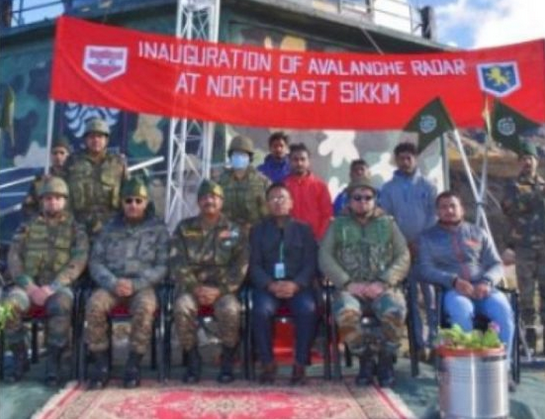
Gangtok: The Indian Army and the Defense Geoinformatics and Research Establishment (DGRE) have jointly installed the Avalanche Monitoring Radar, first of its kind in India, in north Sikkim, defence officials said on Friday. Besides being used for detection of avalanches, this Sikkim avalanche radar can also be employed to detect landslides.
Defence spokesman Lt. Col Mahendra Rawat said that the radar was inaugurated by Tri Shakti Corps commander, Lt Gen Tarn Kumar Aich, at one of the forward posts of the army at an altitude of 15,000 feet in north Sikkim.
The Sikkim avalanche radar has the capability to detect avalanches within three seconds of their triggering and will assist in saving valuable life of troops and civilians as also vehicles in super high altitude areas, he said.
Lt. Col Rawat said that the avalanche radar was made operational by Defense Research and Development Organisation’s wing DGRE, which is involved in forecasting and mitigation of avalanche hazards faced by Indian Army in the Himalayan region.
He said that this radar uses a series of short micro wave pulses which are scattered at the target and can detect an avalanche in less than three seconds.
The radar, which can permanently scan the targeted slope for avalanche release and track its path and its size in case it is triggered, can “see” through snow, fog as well as in the night, making it an all weather solution and covers an area of two sq/km obviating the requirement to place additional instruments in dangerous avalanche prone areas.
The radar is also linked to an alarm system enabling automatic control and warning measures in case an avalanche is triggered. Images and videos of the event are automatically recorded for future analysis by the experts.
Pragativadi News Service Sep 24, 2022
Special Radar Installed In Sikkim To Detect Landslides, Avalanche
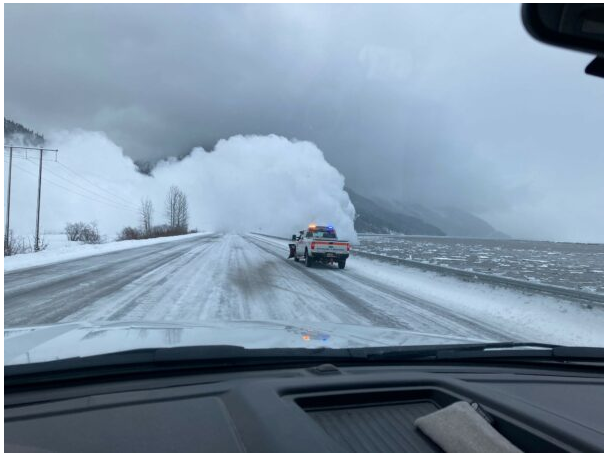
A Seward Highway avalanche closed the road for much of the day Friday. It was between Bird Creek and the Portage turnoff. The avalanche severed the only road access between Anchorage and the Kenai Peninsula for more than eight hours.
The Seward Highway avalanche hit at Mile 91.5 and the debris on the roadway was up to 15 feet high in spots, said a spokesperson for the DoT. The highway reopened around 2 p.m. but drivers should remain cautious.
“Travel is going to be wet and slick and bumpy. They’ve cleared all the snow but it’s definitely not down to dry highway measures by any means.”
Crews set off artillery to trigger 20 other avalanches along the highway on Friday. Also on Friday, several snow slides closed the Old Glenn Highway near the Old Knik River Bridge.
Farther north, snow slides near Summit Lake closed the Richardson Highway from mile 186 to 218.
The Hatcher Pass Avalanche Center also warned of very dangerous avalanche conditions in the area. It issued an avalanche warning early Friday, and it says the Hatcher Pass Road will be closed at mile 11 through the weekend due to avalanche activity.
National Weather Service meteorologist Michael Kutz said Anchorage has been having one of the wettest years on record so far. Snowfall this February is nearly three times higher than average, and rainfall this year is more than four times above normal, Kutz said.
Seward Highway Avalanche
Rain and Snow in Anchorage
Rain and snow have been falling in Anchorage and other areas of Southcentral since the beginning of the week. Which has led to treacherous road conditions in parts of town. Areas of the Mat-Su have been hit with heavy snow. Power to thousands of homes has been knocked out.
As of Friday evening, about 300 homes still did not have power. The Mat-Su school district canceled in-person classes on Friday for the third day in a row due to road conditions and winter weather.
Jan 20 – British Columbia is rolling out the artillery and bombs for avalanche bombing. There have been closures on some major roads for the first time in decades as the province grapples with record snowfall and rain.
The province, third-largest by population, uses helicopter avalanche bombing, remote-triggered explosives, and howitzers to keep roads open. But nonetheless critical routes to Vancouver are being disrupted by avalanche control.
Extreme weather, including November’s torrential precipitation, a deep freeze in late December and an early January thaw, has weakened the snowpack. Mountain slopes are more prone to avalanches that can release without warning.
Avalanche bombing requires closing sections of roads while teams use explosives to pre-emptively trigger slides, which prevents the snowpack from becoming deep and unstable.
Record amounts of control actions
A section of Highway 1 through Fraser Canyon northeast of Vancouver needed avalanche control for the first time in 25 years.
On Highway 99 north of Vancouver avalanche control actions are three times the seasonal average. Some paths have produced avalanches big enough to hit the highway for the first time in over a decade.
Avalanche bombing in Allison Pass further south on Highway 3 has also been above average.
These highways were all damaged in November by floods. A busy avalanche control season is putting further strain on resources. The Coquihalla Highway near Hope just reopened on Wednesday. And record snow along with avalanche risk delayed repairs to Highway 1 through the Fraser Canyon.
Rogers Pass
Further east avalanche teams in Rogers Pass, which runs below 135 slide paths in Glacier National Park, are dealing with more snow than usual. Control missions are also above average.
Approximately 3,000 vehicles traverse Rogers Pass every day in winter. A major Canadian Pacific rail line runs along the highway although it has a long tunnel under the top of the pass.
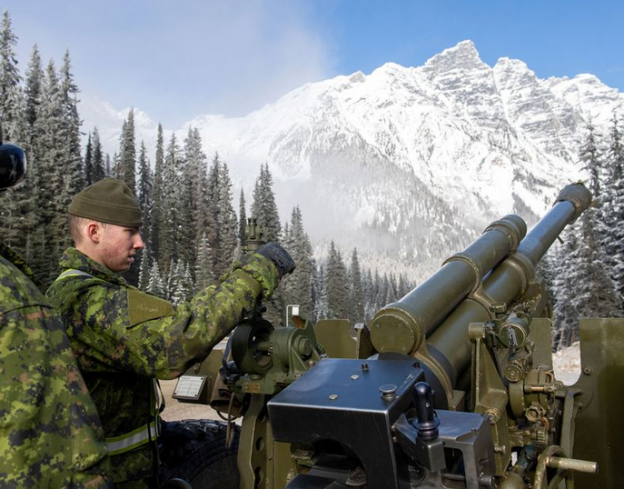
Rogers Pass avalanche bombing involves artillery soldiers who are stationed in Rogers Pass in winter. They use a howitzer to fire shells into loaded avalanche paths along the highway.
“Our goal is to bring down as much snow as we can and bring the hazard down to a point where it’s safe to open the highway,” said Jim Phillips, acting avalanche operations coordinator for Parks Canada.
The Rogers Pass program has been running since the highway opened in 1961. Before that, and before they built their tunnel, CP trains ran a high risk of deadly snow slides. One killed 62 railway workers in 1910.
So far this winter the team has fired 333 howitzer rounds, produced 197 controlled avalanches and closed the highway for 43 hours over seven separate days.
Helicopter Avalanche Bombing
Phillips said his team also uses heli-bombing and remote-trigger systems to set off detonations, and spends C$600,000 ($480,346) a year on explosives alone.
“It’s a balancing act. You want to keep traffic moving and minimize closures, but also minimize risk to people using the transportation corridor,” he added.
Avalanche control is typically needed until late April or early May.
November 22, 2019. MCpl PJ Letourneau/Canadian Forces. Avalanche bombing in Rogers Pass.
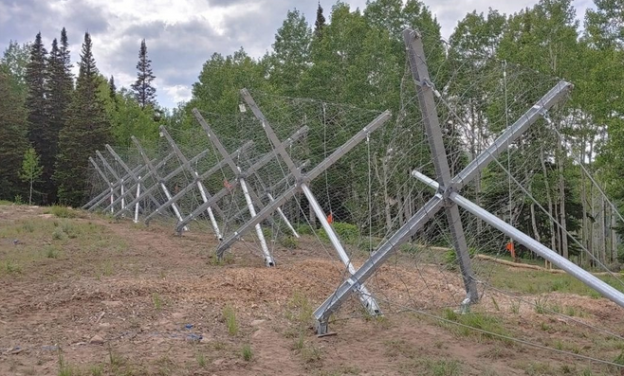
Avalanche fences are being installed in Park City, Utah despite a petition to halt the construction. However, the petition appears to be to irrelevant now, since the construction of the avalanche barriers are underway.
Iron Mountain Associates plans to install 214 avalanche fences. The avalanche fences are three to four meters tall and under construction in The Colony neighborhood. The avalanche barriers aim to prevent an avalanche from hitting the driveway of two specific homes.
An out-pour of community outrage has ensued since the county approved the project in 2020. Despite the community opposition, the construction of the fences is now underway.
While avalanche fences are effective, professionals feel there are better options. Alternatives exist which do not cause as much harm to wildlife and do not create extreme visual degradation.
Jake Hutchinson formerly managed the ski patrol avalanche mitigation program at The Canyons Resort (now Canyons Village at Park City) for over ten years. Hutchinson created the avalanche atlas currently used as a model for Canyons Village at Park City and The Colony. He claims that the avalanche modeling for the fences is based on insufficient data…. just what came from him and a couple of years of doing some measurements.
The Colony has long been concerned about avalanche mitigation. “Originally they proposed Gazex exploders up there, which are still a big nuisance and eyesore, but far less of an impact than permanent fences.”
Concerned citizens looked for a public comment period as an opportunity to express their concerns. The project’s approval under a Specially Planned Area (SPA) agreement surprised some residents. Hutchinson says, “We were watching for public comment period… and they slipped it through under the SPA agreement… The SPA doesn’t specifically have anything about avalanche fences or mitigation.”
The SPA agreement contains lengthy regulations for preserving sensitive lands and open spaces, wilderness protection, ordinances to minimize the visual impact of developments, and recreational access regulations.
Summit County resident and opponent to the avalanche fences, Seth Dromgoole, sent an email to the County Council to outline several conflicts found in the SPA agreement. Dromgoole states, “My interpretation of the Amended SPA (dated 1999) reveals multiple areas where this project may conflict with the agreement. Potential conflicts arise in the language surrounding viewshed, open space designation, and wildlife.”
Dromgoole also raised the concern, “The LIP [Low Impact Permit] for this project should not have been approved without public comment…The Dream Peak Avalanche Control Mitigation Fencing certainly creates unsightly conditions.”
Both Hutchinson and Dromgoole assert that there are more appropriate alternatives to avalanche mitigation than the installation of over 200 fences.
“Avalanche fencing is not industry standard for this use. The industry standard for fencing is to protect permanently inhabited structures and major roadways, not driveways. Avalanche fencing is excessive for what is essentially a shared driveway for two houses,” Dromgoole says.
Hutchinson is adamant that using Remote Avalanche Control Systems (RACS) such as Gazex is an adequate solution to potential avalanche activity in the area. “If they fire the RACS at 3 am, and then the road is cleared and opened, no one ever knows.”
Hutchinson believes that avalanche fences were proposed as an ultimate convenience for high-dollar property owners. “The reason for the fences is that they didn’t want a single moment of inconvenience for the homeowners,” he explains.
The main objection is that residents and visitors will suffer from visual impairment, restricted access to wilderness, and loss of wildlife through animal deaths.
Dyer Corp owner Russ Dyer has said that studies have shown that installing the barriers with 3 feet of space between each one allows for wildlife to pass through them and coexist safely.
But Hutchinson elaborates on the adverse effects of avalanche fences on wildlife. “They put fences near the Tombstone lifts in the early 2000s….. The first couple of years after they put those fences in… we were up there pulling dead animals out of those fences in the summertime, fairly consistently… big bull elk, deer, and other animals…. These [fences] will have a similar impact on wildlife, especially because these are about ten times the extent of what is near Tombstone right now,” he explains.
Dromgoole states, “The avalanche fencing will create a permanent scar on the landscape, will result in the destruction of viewshed for thousands of Summit County residents.”
The 200 plus fences will be visible across long distances. “If you are out riding your bike in Round Valley and look up there, it will look like rows and rows of fences,” says Hutchinson. He warns the community. “This is one of those things that people are going to look up there one day and wonder, ‘oh, how did that happen?’… Once they put the fences in, they will permanently impact the landscape.”
Neither Iron Mountain Associates nor Dyer Corp have responded to press inquiries.
A petition to halt the construction of the avalanche fences continues, but it appears to be to irrelevant now since the construction of the avalanche barriers are underway.
Avalanche testimony by Colorado Avalanche Information Center boss Ethan Green in a criminal case could hinder the function of the agency, according to the state Attorney General.
Defendant Provided his video
Evan Hannibal provided his helmet video of the avalanche he triggered above Interstate 70 last March. The avalanche buried a service road and destroyed an avalanche mitigation installation protecting I-70. He thought the Colorado Avalanche Information Center (CAIC) would use his submission to help educate others.
But Summit County prosecutors used the video for a criminal case. They seek restitution for the damaged avalanche mitigation device.
Hannibal and Tyler DeWitt are charged with reckless endangerment. Restitution of $168,000 is sought for the destroyed avalanche mitigation device.
Adverse impact of video
Hannibal has argued that the charges could convince others to stop giving information to the CAIC. Colorado Attorney General Phil Weiser, as attorney for the state avalanche center, has agreed. He argues against the plan to call avalanche center director Ethan Greene as an expert witness. He states it “could have an unintended adverse impact on the CAIC’s ability to gather important information.”
Weiser’s office has filed motions to quash subpoenas requiring Greene and forecaster Jason Konisberg to testify as expert witnesses.
Novel Avalanche Case
It is a novel case in several ways.
Backcountry travelers have never before faced criminal charges over an avalanche in Colorado. Summit County Court Judge Ed Casias recently rejected the pair’s argument that their rights were violated when the helmet video was provided to police as evidence of a crime.
Now Weiser has stepped in, asking Judge Casias to reject having state employees testify.
“There is genuine concern that if CAIC employees appear as an expert witness it could adversely impact their ability to gather information from persons involved in an avalanche,” the motion filed by Weiser’s office reads. “The more involved CAIC is, the more it looks like they are working with law enforcement, resulting in a chilling effect on CAIC’s mission.”
Too busy for avalanche testimony in court
Weiser also argued that the subpoenas are “unduly burdensome, unreasonable and oppressive.” Because it takes them away from avalanche investigations and forecasting.
James Moss is an attorney with over 30 years experience in recreation law. Moss thinks the loss of avalanche testimony by Greene and Konisberg could hinder the case. Moss thinks that without them the district attorney will have a hard time explaining the CAIC report. Or to explain why the avalanche mitigation device was placed in that particular location.
But more important, Moss says, is the threat to the CAIC mission. Which includes educating the public on avalanche risks.
“The motion states clearly that this is going to screw up avalanche research and reporting in Colorado forever,” said Moss. He has no role in the case but urges backcountry travelers to avoid talking with the CAIC. “You never report to CAIC from here on out, period,” Moss said.
The avalanche in question in the case with avalanche testimony
AP – Two Alpine Meadows avalanche lawsuits have been filed by the widow and a friend of a dead skier. They accuse the resort of negligently rushing to open the unsafe slopes for a busy holiday weekend.
Cole Comstock, 34, of Blairsden, California, was killed. His close friend Kaley Bloom was seriously injured. They were caught in an avalanche on an Alpine Meadows ski run on Jan. 17, 2020. Nobody else was seriously hurt.
Two Alpine Meadows avalanche lawsuits filed
The two Alpine meadows avalanche lawsuits were filed in Placer County Superior Court by Bloom and by Cole’s widow. They seek unspecified damages from Alpine Meadows. The allegations include negligence, gross negligence and breach of contract. Raymond’s lawsuit also alleged the resort was to blame for her late husband’s death.
The resort had closed the previous day following several days of heavy snow and high winds that dramatically increased avalanche risks, the lawsuits claimed. The National Weather Service in Reno reported wind gusts up to 116 mph the night before the avalanche.
Alpine Meadows “premature opening” that Friday “was in response to public and economic pressure to open that particular lift and callous disregard for the dangerous combination of conditions,” according to Bloom’s lawsuit. He says he suffered severe and ongoing injuries.
Avalanche Control work done
The avalanche happened after avalanche control work was performed, the resort said in a statement. Such work involves the use of explosive detonations. They intentionally trigger avalanches while guests are not in the area.
“While we cannot comment on ongoing litigation, January 17, 2020 was a devastating day for our team at Squaw Valley Alpine Meadows, and we continue to share our deepest sympathies with the family and friends of those affected,” Alex Spychalsky, a spokeswoman for both of the neighboring resorts, said in an emailed statement.
Raymond’s lawsuit says Alpine Meadows “should not have opened the ski run under the circumstances.”
Most skiers who buy ski resort passes must sign release forms. Those warn that winter activities “can be dangerous and involve the risk of injury or death.”
But Raymond’s lawsuit said the resort increased the risks beyond those normally assumed by skiers. Cole and Bloom believed they were skiing on a run that was safe because avalanche control had been performed.
Reopening the runs after they’d been closed the day before “created a false and reckless illusion of safety,” the lawsuit said. “Inadequate and/or incomplete mitigation measures did not decrease or mitigate the risks, but instead further increased the risk and turned a dangerous area into a deadly one.”
Raymond’s lawsuit notes that most ski fatalities occur outside of ski resorts. In-bounds avalanche deaths are rare.
Experienced Skier
Comstock was an experienced skier. He grew up in the Sierra Nevada and skied both in-bounds and out-of-bounds. Depending on the conditions of the day and information from the resort and the ski patrol, his widow said in the lawsuit.
Raymond was on the other side of the mountain when she got a phone call from friends. Telling her there had been an avalanche. She went to wait for her husband beneath a chairlift.
That’s when she saw the ski patrol pulling a stretcher with someone covered with snow and blood. They stopped and began administering CPR to the victim. Then she recognized her husband’s maroon ski boots and realized it was him.
She said blood spewed from his mouth with each push on his chest as the ski patrol team took turns at CPR for 45 minutes.
“Eventually they stopped as she watched them pull the white sheet over him. Her last image of her husband was a broken and already dead body,” the lawsuit said.
Seven people were killed in an avalanche at Alpine Meadows in 1982.
Two Alpine Meadows lawsuits were filed after a guest died in an avalanche.