A mistrial in the Colorado Avalanche case against two snowboarders has been declared.
The two snowboarders are facing charges in Summit County for an avalanche they triggered last spring. Evan Hannibal, 26, and Tyler DeWitt, 38, appeared in Summit County District Court Thursday for what was supposed to be day one of their trial, but only half of those summoned for jury duty appeared.
Now they will have to wait until June for their day in court. The judge had to declare mistrial in the colorado avalanche case.
“I’m disappointed for a lot of reasons,” said Judge Edward Casias. “I’m disappointed for the parties not being able to address this the way they should have today. Both the People and Mr. Hannible and Mr. Dewitt were entitled to a jury trial of 6.”
Jason Flores-Williams, attorney for the defendants said about half of the 40 summoned showed up.
“…and when we started questioning jurors about what they knew about the case, if they had any biases, it became pretty clear that we weren’t going to be able to get 6 impartial jurors,” said Flores-Williams.
Judge Casias thanked those who did show up and had some words for those who didn’t.
“It’s an important case. Every case is important,” he said. “There are very few civic responsibilities we ask of you. Jury service and voting really are the two that we ask you to be engaged in with your community and some of the people that were summonsed chose not to and I will address that with them and probably the community at large.”
Eisenhower Tunnel Avalanche and Damage
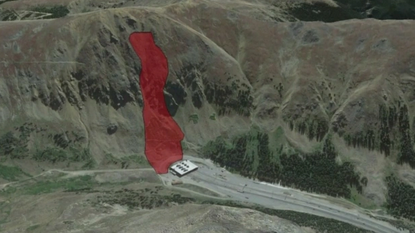
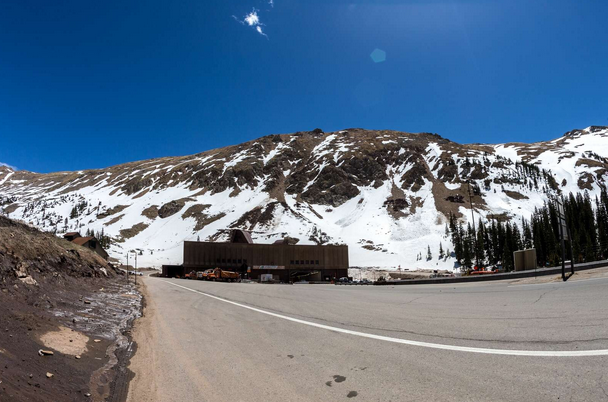
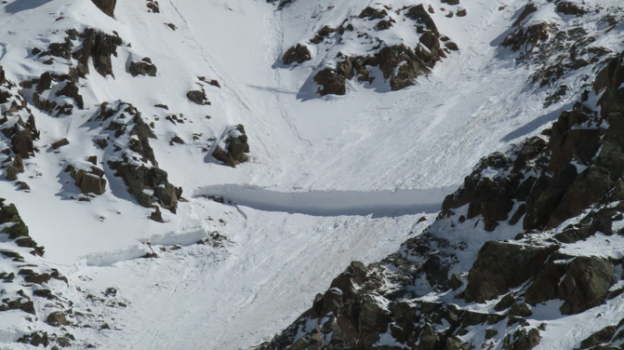
Hannibal and DeWitt were snowboarding on March 25 when they triggered an avalanche just above the Eisenhower Tunnel.
“The avalanche put debris on the road that was over 400 feet wide and 20 feet deep,” said Ethan Greene, Director of the Colorado Avalanche Information Center.
The pair reported the slide to the CAIC and handed over GoPro video to go with the report. They never realized it would be used in a court case against them.
They now face a misdemeanor for reckless endangerment and may have to pay some restitution for damage caused.
The trial has been rescheduled for June 7, 8, and 9.
A Mistrial in Colorado Avalanche Case was declared.
Avalanche investigators from the Colorado Avalanche Information Center (CAIC) must testify in the trial of Evan Hannibal and Tyler DeWitt according to Judge Casias. He dismissed a motion from the Attorney General’s Office to void subpoenas to keep them off the witness stand.
On March 25 DeWitt and Hannibal were snowboarding above the Loop Road at the Eisenhower/Johnson Memorial Tunnels. They triggered an avalanche. Nobody was injured but it covered more than 400 feet of the roadway up to 20 feet deep and damaged a remote avalanche-control installation.
The District Attorney charged both snowboarders with misdemeanor counts of reckless endangerment.
Much has been made of the avalanche center’s role. The center contacted the defendants after the avalanche to collect information to put together a report on the incident. The defendants voluntarily supplied information. Which was later shared with the Summit County Sheriff’s Office.
The defense attorney Jason Flores-Williams fought to suppress the report as evidence. He argued that it represented a violation of the defendants constitutional rights because they were never informed the information could be used against them. Judge Casias ruled there were no violations. The avalanche center employees weren’t acting as law enforcement agents in their investigation and there was no formal search or seizure.
The avalanche center was directly involved the case a few days later. Subpoenas for their avalanche investigators were issued. They required the center’s Director Ethan Greene and forecaster Jason Konigsberg to testify as expert witnesses. On Feb. 26 the Attorney General filed a motion to quash the subpoenas on the grounds that such testimony could have an “unintended adverse ‘chilling’ impact on the CAIC’s ability to gather important information from people involved in avalanches.”
On Tuesday Assistant Attorney General Jeff Fugate defended the office’s stance. He claimed that forcing the men to testify would harm future efforts to gather information following an avalanche. It could create a situation where backcountry users would no longer view the CAIC as impartial.
“The center is very aware of conversations taking place in the backcountry community. And advice being widely shared that people should no longer speak to the CAIC if they are involved in an avalanche,” Fugate said. “…That’s the exact opposite message the center has worked hard to implement in Colorado. People should be willing to share information with the center without hesitation or reservation because the more information the center has, the better it can educate the public about avalanche safety.”
“The agency has fulfilled their role by sharing this information. However, appearing as an expert for the prosecution takes them outside of this informational or educational role. It leaves the wrong impression or the misunderstanding that the CAIC is now ‘on a side.’ That’s something this agency just wants to avoid at all costs.”
Fugate said the fear wasn’t that community members would stop reporting avalanches altogether. But they may report an avalanche and refuse to provide any follow-up interviews, photos or videos.
Fugate continued to say that the subpoenas for the avalanche investigators were unnecessary. They say prosecutors could find other avalanche experts who weren’t working for the state to serve as witnesses.
In response Deputy District Attorney Stephanie Cava called the assertions speculative. She said her office often deals with situations like this. She compared the situation to someone getting in a car crash, calling the police and still potentially getting a ticket.
She also said that some fears were driven by inaccurate news reporting. She singled out a recent story from The Colorado Sun. Which mistakenly called the case the state’s first criminal case involving an avalanche. She claims there were three cases that went to trial in Summit County in 2014 after a fatal avalanche. While those cases did not receive the same news coverage Cava claimed it did not impact avalanche reporting. She noted that field reporting to the avalanche center nearly doubled from 2014 (1,392) to 2020 (2,771).
Cava also says that reports her office seeks a set amount of restitution in the case were false. Any restitution amounts will be decided if the men are convicted. She noted that the most recent plea offer her office made to the defendants was rejected. It involved the defendants pleading guilty to reckless endangerment, performing 120 hours of public service and paying $25,000 in restitution.
Cava also said that prosecutors are given wide latitude to call witnesses. Quashing them in this case could create a bad precedent in the district. She claims that witnesses from state agencies frequently testify without compromising their impartiality.
“When a (Colorado Bureau of Investigation) forensic scientist comes and testifies in a DUI case, they don’t get up there and speak on behalf of the people,” Cava said. “… (They) don’t get up there and say, ’That person was drunk.’ They say, ‘Well this is the test that I did, this is how I did it and, based on that information, you could see these sorts of signs.’ They don’t give a conclusory opinion.”
Casias noted that avalanche investigators Greene and Konigsberg would be reluctant witnesses and that the case potentially could have impacts on future avalanche reporting. But he said the district attorney’s office didn’t err in issuing the subpoenas.
As expert witnesses, Casias said the men would be asked only to share their objective findings from their investigation.
“They don’t get to sit here and say this person is guilty or not guilty of any criminal conduct,” Casias said. “… Their expertise and their knowledge is providing an objective determination of what caused the avalanche to go.”
Avalanche testimony by Colorado Avalanche Information Center boss Ethan Green in a criminal case could hinder the function of the agency, according to the state Attorney General.
Defendant Provided his video
Evan Hannibal provided his helmet video of the avalanche he triggered above Interstate 70 last March. The avalanche buried a service road and destroyed an avalanche mitigation installation protecting I-70. He thought the Colorado Avalanche Information Center (CAIC) would use his submission to help educate others.
But Summit County prosecutors used the video for a criminal case. They seek restitution for the damaged avalanche mitigation device.
Hannibal and Tyler DeWitt are charged with reckless endangerment. Restitution of $168,000 is sought for the destroyed avalanche mitigation device.
Adverse impact of video
Hannibal has argued that the charges could convince others to stop giving information to the CAIC. Colorado Attorney General Phil Weiser, as attorney for the state avalanche center, has agreed. He argues against the plan to call avalanche center director Ethan Greene as an expert witness. He states it “could have an unintended adverse impact on the CAIC’s ability to gather important information.”
Weiser’s office has filed motions to quash subpoenas requiring Greene and forecaster Jason Konisberg to testify as expert witnesses.
Novel Avalanche Case
It is a novel case in several ways.
Backcountry travelers have never before faced criminal charges over an avalanche in Colorado. Summit County Court Judge Ed Casias recently rejected the pair’s argument that their rights were violated when the helmet video was provided to police as evidence of a crime.
Now Weiser has stepped in, asking Judge Casias to reject having state employees testify.
“There is genuine concern that if CAIC employees appear as an expert witness it could adversely impact their ability to gather information from persons involved in an avalanche,” the motion filed by Weiser’s office reads. “The more involved CAIC is, the more it looks like they are working with law enforcement, resulting in a chilling effect on CAIC’s mission.”
Too busy for avalanche testimony in court
Weiser also argued that the subpoenas are “unduly burdensome, unreasonable and oppressive.” Because it takes them away from avalanche investigations and forecasting.
James Moss is an attorney with over 30 years experience in recreation law. Moss thinks the loss of avalanche testimony by Greene and Konisberg could hinder the case. Moss thinks that without them the district attorney will have a hard time explaining the CAIC report. Or to explain why the avalanche mitigation device was placed in that particular location.
But more important, Moss says, is the threat to the CAIC mission. Which includes educating the public on avalanche risks.
“The motion states clearly that this is going to screw up avalanche research and reporting in Colorado forever,” said Moss. He has no role in the case but urges backcountry travelers to avoid talking with the CAIC. “You never report to CAIC from here on out, period,” Moss said.
The avalanche in question in the case with avalanche testimony