Tag Archives: ski area

Above average Sierra snowpack prompts avalanche awareness

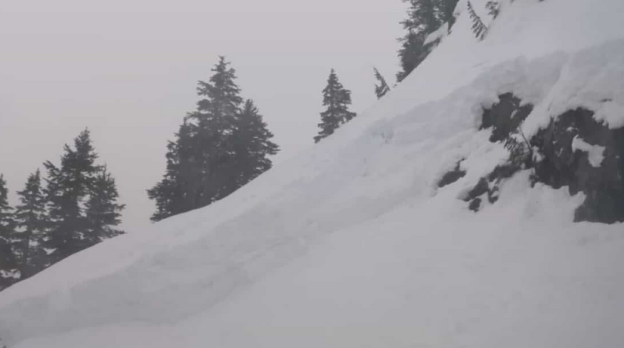
Above average Sierra snowpack for the month of February continues, with California at 190% of normal snowpack for this time of year. With all this snow, the ski patrol team at Heavenly Ski Resort in South Lake Tahoe is urging skiers to be extremely cautious of avalanche danger.

In 2023, the Sierra Avalanche Center has reported two avalanches where a person was either caught, buried, or injured in an avalanche. One of the two incidents took place outside the ski area boundary at Heavenly. Avalanches that take place inbounds are rare.

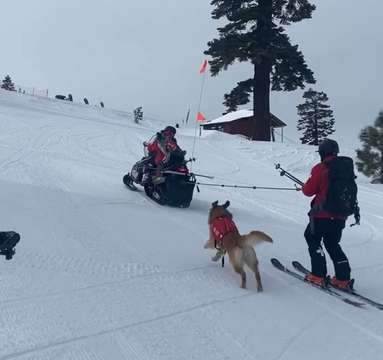
Ryan McPartland is the Ski Patrol Assistant Director at Heavenly Ski Resort. He has been on the ski patrol team for 25 seasons. For the last seven years, he’s had Yuba, his seven year old rescue dog by his side. Before that, McPartland also raised Yuba’s dad.

The legacy of patrol pups is nothing knew for the resort, which started the Heavenly Avalanche Rescue Dog or HARD team back in the late 1980’s. Today, Yuba is one of seven rescue dogs at Heavenly.

Avalanche dogs can search up to two football fields in 30 minutes, while it might take a human about 4 hours to conduct the same search. Making the role of an avalanche dog at a big resort like Heavenly that much more invaluable. McPartland explained,

People get excited by the above average Sierra snowpack, and they should. But they also need to know the risks.

The risk of an avalanche go up significantly once you exit the ski area boundary. McPartland warns. There is no ski patrol there to help you, so it’s very important that you have the training that you’re exposing yourself to a higher level of risk — and you know how to deal with it.

If you do decide to leave the ski area boundary, and ski in the backcountry, there are three things you are going to need:

  • An avalanche transceiver
  • An avalanche probe
  • A shovel

An avalanche transceiver can locate you from an isolated location underneath the snow. The avalanche probe will help with finding how deep under the snow you are, and the shovel that allows the rescuer to chop the snow up, and find you.

Above average Sierra snowpack prompts avalanche awareness

Inbounds Avalanche – Search Finds Nobody

Eaglecrest Ski Area, AK, confirmed a large inbounds avalanche in a closed area of the resort. Crews using beacons, probes, dogs, and RECCO equipment searched the scene but found nobody trapped. The resort had received 25″ of fresh snow in the previous five days. The slide, in the East Bowl Chutes, was seven feet deep and ran for 100 yards.

“At 10:10 am on January 26th, Eaglecrest Ski Patrol received a report of an avalanche in closed terrain in the East Bowl Chutes. Upon investigation, ski patrol found a large avalanche approximately 6 to 7 feet deep and approximately 75 yards wide and approximately 100 yards long. A preliminary avalanche transceiver search was immediately launched, which was followed by a secondary transceiver search. Our RECCO detection equipment was then dispatched for the search. Alaska SEADOGS, Juneau Mountain Rescue, and the Alaska State Troopers were notified and called on scene. SEADOGS performed a search with two dogs. The Ski Patrol staff probed through debris and catchment spots in an abundance of caution to be sure that no one was entrapped despite this portion of the mountain being closed for the day. Eaglecrest has just gone through a very active week of weather, with inches of rain and snow-water equivalent moisture over the last 7 days. The mountain had extremely limited terrain open today off the top of the mountain as we were allowing the snowpack to adjust to all of the additional weight and drain.”

– Eaglecrest report

Eaglecrest has seen 211″ of snow this season and has a 136″ base. Much of the upper mountain was closed at the time of the slide to protect the fragile snowpack.

Inbounds Avalanche at Eaglecrest
Inbounds Avalanche at Eaglecrest Ski Area, AK. Credit: Resort

An explosive business – Avalanche control

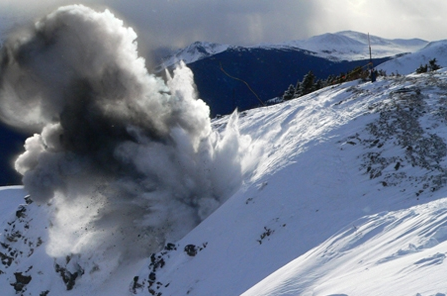
The explosive business of avalanche control keeps the ski area slopes safe for guests.

On many winter days explosions can be heard echoing across many ski areas. These are the sounds of avalanche mitigation.

Dutch Draw Avalanche

Last week an avalanche was reported in the Dutch Draw area of Park City, Utah between the lifts Peak Five and Ninety-Nine 90. According to Andy Van Houten, snow safety director of Park City Mountain, the avalanche occurred in the back country. “We worked with the Department of Public Safety helicopter,” he said. “It was established that nobody was involved. We had all of our witnesses accounted for, all is good.”

“There is no mitigation outside of the resort and so it’s 100% on the on the user, on themselves; we do worry about it from a rescue perspective but we do not do anything to mitigate that hazard,” Van Houten said.

Mitigation Methods

There are a few ways the ski patrol can mitigate avalanche risks. While the explosive business is the most dramatic two other methods are used as well. Ski cutting and compaction.

Ski cutting is where a patroller will ski intentionally across the top of a slope. This may trigger an avalanche as the slope is traversed. This method is used on smaller slides.

Another form of mitigation is called skier compaction.

“The best thing we can do is get this terrain open to public and get it skied,” Van Houten said. “That’s why we push so hard to get this terrain open, you know, in a timely fashion is that so we can get our guests up there to ski it and that’s what helps us, that kind of skis all the snow and it breaks up the layers that build up.”

Explosives

For bigger slopes there is the explosive business. There is a typically team of patrollers who go out in groups of two or three and carry explosives in their backpacks.

“It’s a cast booster, it’s about the size of a large can of soup and it’s a pentolite TNT combination,” Van Houten said. “It’s got 120-second fuse strain on it. It’s basically like a little cardboard tube and that’s it’s got a sparker in it. When we pull that, that’s what ignites the end of the fuse train. We either rope them, or we just throw them. And it’s like throwing a can of soup into the snowpack. It’s a good-sized shot. But we are usually pretty far away when it detonates and we kind of plug our ears and kind of turn our backs to it a little bit. So we’re not we’re not close to it by any means.”

Avalanche Control - An Explosive Business
Avalanche Control – An Explosive Business

North Caucasus Avalanche – Up To 12 People Feared Buried

A North Caucasus avalanche struck a skiing area in the region of Karachai-Cherkessia. Russian authorities say as many as 12 people may have been buried under snow.

Russia’s Emergency Ministry said on January 18 that the avalanche hit the area around the resort town of Dombai. On Mussa-Achitara mountain at around 1:30 p.m. local time.

Rescue work to locate and extract those trapped by the avalanche is under way.

The wall of snow buried two ski equipment rental stands and damaged a cafe.

Dombai is a popular skiing resort in the North Caucasus.

A North Caucasus avalanche struck a skiing area in the  region of Karachai-Cherkessia
On the scene at an avalanche in the North Caucasus

Avalanche Risk Discussion Spurred by Fatal Dutch Draw Accident

The second avalanche death in two years in the same location, and at least the fourth in total, has spurred an Avalanche Risk Discussion.

The Avalanche

On Friday, January 8, Clinton, Utah man was killed in an avalanche on the Park City ridgeline in Dutch Draw. It’s a popular backcountry skiing area that is easily accessible from a chairlift at Park City Mountain. It’s the fourth fatal accident in Dutch Draw in the past 15 years. And the second year in a row in which someone has been killed in an accident on the steep run known as Conehead. The tragic accident has raised concerns in the community about how prevent avalanche accidents among people who are not aware of the dangers.

The victim and his girlfriend exited the backcountry access gate atop the Ninety-Nine 90 Express. Then they hiked up the ridge before dropping in to snowboard down a run called Conehead. The victim went first, and when he was about halfway down his girlfriend followed. Then an avalanche occurred. The woman was not caught in the slide.

Rescue personnel responded to the accident when the woman called 911 immediately after the avalanche. But due to risks of additional avalanches they were unable to proceed until after 2:00 p.m. Both riders had some experience in the backcountry, but neither were carrying avalanche rescue equipment at the time of the accident.

A patroller said a self-rescue of the victim in this accident may have been possible with properly equipped and trained partners. They also said this accident was predictable due to recent avalanche activity in the area and the overall state of the snowpack. Which features a considerable avalanche risk on a persistent weak layer of snow.

The Avalanche Risk Discussion

This area is a readily accessible backcountry area. Because of this easy access the area in Dutch Draw and Square Top further north are very popular. And since these areas are visible from chairlifts they are also appealing to people who may not have the experience and equipment required to safely ski and snowboard there.

Park City Mountain, however, is not able to limit access based on a person’s qualifications due to liability concerns. The private property resort borders National Forest. And the forest service encourages, but does not require, access gates. The gate is marked with stern warnings about the dangers inherent to leaving the resort boundary. However, to many people this signage is just one more warning. Others mark inbounds dangers, closed terrain, and other hazards.

Some people have argued more should be done to warn skiers who may be unaware of the dangers posed by backcountry terrain. They could put resort personnel near the gate to inform people of the risk. Or require checking out with ski patrol and carrying an avalanche beacon, shovel and probe. A check-out procedure is used at some other resorts.

While the avalanche risk discussion is ongoing the Park City Mountain Resort has not indicated decisions to date.

fatal avalanche site - forest service
The Park City accident site which has spurred an avalanche risk discussion. Note all the other tracks which are visible in this popular area.

Arctic Avalanche Kills Three People at Russian Ski Resort

Three bodies were found by search and rescue teams after an arctic avalanche hit a ski resort in Siberia

The three victims are reportedly members of the same family. Their eldest son survived and was taken to hospital. Other buildings were struck, but the bad weather meant most were empty at the time.

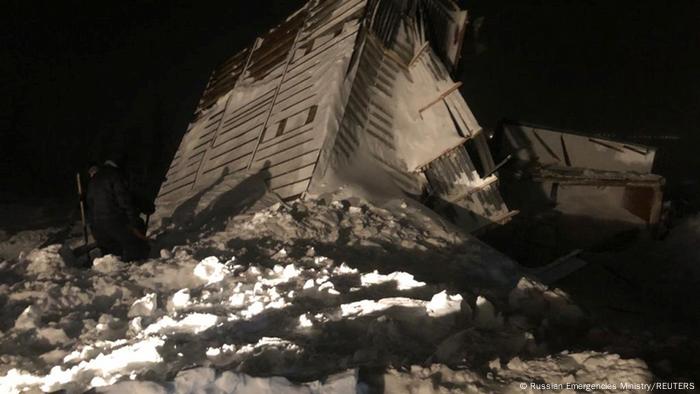
A view shows the accident scene after an avalanche hit a ski resort in the Siberian city of Norilsk
The scene after and arctic avalanche near Norilsk

A total of three people died in an avalanche that struck the Otdelnaya Gora ski resort in northern Russia overnight, investigators said on Saturday.

Authorities were notified at 00:30 a.m. local time (1730 UTC, Friday) of the avalanche near Norilsk — the world’s northernmost city.

Rescuers recovered the bodies of a 45-year-old man, named as Vladimir Popov, his 38-year-old partner and their 18-month-old child.

The couple’s eldest son, a 14-year-old boy, was found alive and “taken to the hospital with serious injuries,” including frostbite.

What do we know so far?

Between four and six huts at Otdelnaya Gora were buried by the snow, according to Russian media reports.

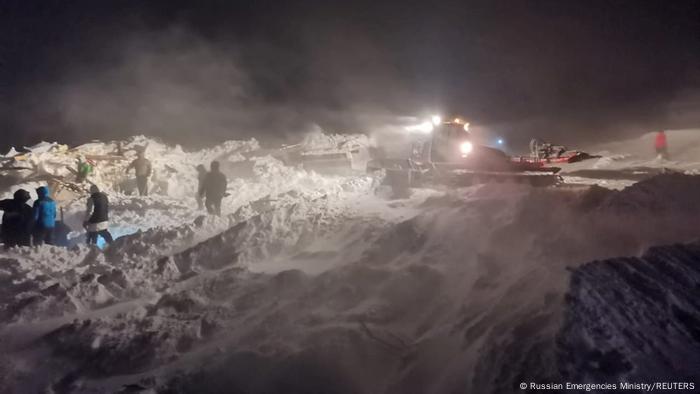
A search and rescue operation involving more than 200 people and 29 vehicles was launched.

Rescuers and volunteers take part in a search operation after an avalanche hit a ski resort
Search operation after an avalanche near Norilsk in northern Siberia

On Saturday morning the emergencies ministry branch in Siberia’s Krasnoyarsk region, which includes Norilsk, announced via Instagram that all of the missing people had been found.

It said it was calling off the search and rescue mission.

Two people made their own way to safety, according to Russian media reports.

A 14-year-old boy was taken to hospital with severe injuries

Most buildings unoccupied

All of the buildings were unoccupied at the time of the avalanche except for one, reported news agency AFP, citing volunteer rescuer Maxim Inikhov.

“We have a very strong blizzard so there were very few people vacationing today at the ski resort,” Inikhov told Rossiya-24 television.

Two people walked out of the avalanche alive, reported Russian media

Risk of more arctic avalanches

Siberian Norilsk often experiences huge snowstorms, including blizzards last month where wind speeds reached up to 27 meters per second.

The emergency services has warned that there is a threat of further avalanches.

The regional department of the Investigative Committee of the Russian Federation opened a criminal case into deaths by negligence as a result of safety violations.

Silver Mountain avalanche marks one year anniversary

January 7 marks one year since the tragic Silver Mountain avalanche in Idaho. Three skiers were killed and four others were buried in the snow of the avalanche and survived.

The avalanche was unintentionally triggered by skiers. It ran over 900 feet down the slope and fell about 450 vertical feet.

One of the four survivors said he is still feeling some of the emotions that he felt this time last year.

“Still really grateful, grateful to be here, grateful that there were people that saw me, grateful that so many people that day came out to risk their own lives to find me,” said Bill Fuzak, survivor of the Silver Mountain Avalanche.

But Fuzak was lucky. Three others died.

“I definitely look at the world a little different now,” said Fuzak.

Fuzak is an avid skier but said that day changed him.

“I don’t trust myself as much anymore, I’m constantly looking around and being a little more aware of what’s going on,” said Fuzak.

Through it all, Fuzak is still skiing.

He has 30 ski days in this season already, starting in October.

Fuzak said it was nerve racking getting back out for the first time. But he added that  it takes time, and it’s getting better.

He said if he can offer any advice, the biggest thing to keep you safe on the mountain, is education.

“Knowledge is power, knowledge can help save you,” said Fuzak.

He said he is constantly checking avalanche reports and sending them to friends to help educate them.

He and his wife are even taking more refresher courses. They encourage everyone to get avalanche training.

And one more tip: “Don’t go alone, have someone there, because they won’t know where you are if something does happen,” said Fuzak.

Silver mountain avalanche
Rescue after Silver Mountain Avalanche
Silver Mountain Avalanche - Jan 2020
Silver Mountain Avalanche

Avalanche Survivor Shares Story

An avalanche survivor is talking about being buried by snow to encourage others to be safe while in the mountains.

A year ago Ryan Mitchell had a life changing experience. He and some friends were snowboarding at Steamboat Resort when an avalanche was triggered above them.

Area was closed, but access not blocked

Mitchell was one of eight people who were in a closed area. Although the area was closed they did not duck any ropes to access it. They traversed in above Big Meadow, which was open, and below the chutes. It is believed they triggered the avalanche from below. Several people were caught in the slide but only Mitchel was completely buried. Another person was buried up to their waist.

“Just a normal day”

“It was just a normal day. We were actually planning to go out and build a jump out in Steamboat,” said Mitchell. “I was out in front and my buddy Dane cut across, and all of a sudden there was a loud boom.”

They tried to outrun the slide but he and a friend were buried. “It hit me in the back of my board and I just went in.”

His friend extricated himself and was able to tell the other friend where Mitchell was last seen. Having some avalanche training, they started digging. A skier who witnessed the whole thing went to get ski patrol. Ryan was buried for 8 minutes. He had to come to terms with what could have been the end of his life.

“I was like, ‘Man, this is it.’ Everything went through my brain. The last conversations I had with everybody that I feel like I ever had a conversation with.”

Recovered before ski patrol arrived

Miraculously, he says his friends found him just as ski patrol was arriving. “I guess my buddies were saying they took my arm out and it just flopped and I was just blue.”

Mitchell was taken to a hospital and was not injured. When he was released he went for chicken wings to celebrate. He is telling his story now as an avalanche survivor because he has seen stories about avalanches trapping and killing people.

Keep enjoying the mountains, safely

He wants people to know that enjoying the mountains is still a good thing. Just make sure you go with people who have avalanche training.

“Keep doing what you love to do and just keep pushing man. I’m thankful that I had good people around me. Good friends that knew what they were doing and when times got tough, they didn’t panic.”

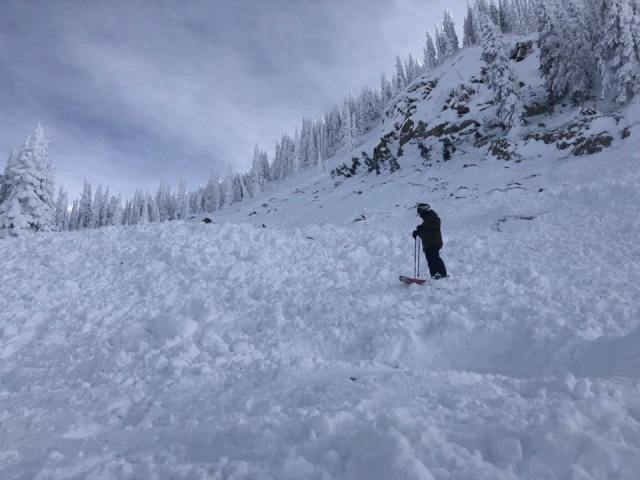
photo of avalanche debris