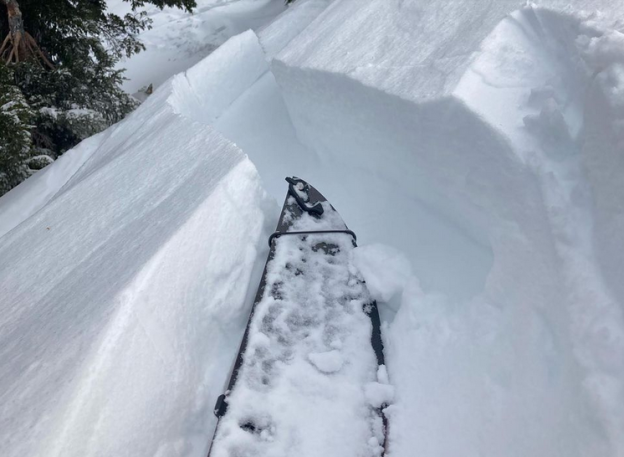
On winter mornings, the Forest Service Avalanche Center for the Sierra publishes the avalanche forecast for the day. This is useful information for anyone traveling in the backcountry.
Often a draft of the forecast is started the afternoon before after a day of skiing. It may be updated early in the morning with the benefit of that day’s weather forecast and any late arriving snow or avalanche observations. The snow and avalanche data is built on observations from Sierra Avalanche Center field staff who spend their days skiing. It is augmented with observations, photos and videos shared to the Sierra Avalanche Center website by the public.
The Forest Service Avalanche Center would not exist without community donations, despite being a government operation. Northstar, Heavenly, and Kirkwood have consistently directed significant support to the Sierra Avalanche Center through their donation of lift tickets to the Forest Service.
Northstar, Heavenly, and Kirkwood resorts have been the avalanche center’s largest business supporters for multiple years. This money goes back into supporting the Avalanche Center field staff, paying for skiing and observing, equipment, the website, and our ongoing efforts to increase avalanche awareness by promoting the center.
The Sierra Avalanche Center staff and volunteer board thanks to Northstar, Heavenly, Kirkwood and the Vail Resorts EpicPromise Team for their continued support.
(*) It should be noted that these large ski operations depend on Forest Service permits for their use of public lands.
Above average Sierra snowpack for the month of February continues, with California at 190% of normal snowpack for this time of year. With all this snow, the ski patrol team at Heavenly Ski Resort in South Lake Tahoe is urging skiers to be extremely cautious of avalanche danger.
In 2023, the Sierra Avalanche Center has reported two avalanches where a person was either caught, buried, or injured in an avalanche. One of the two incidents took place outside the ski area boundary at Heavenly. Avalanches that take place inbounds are rare.
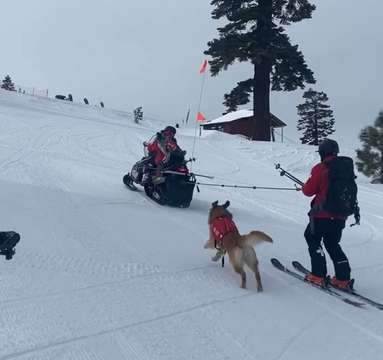
Ryan McPartland is the Ski Patrol Assistant Director at Heavenly Ski Resort. He has been on the ski patrol team for 25 seasons. For the last seven years, he’s had Yuba, his seven year old rescue dog by his side. Before that, McPartland also raised Yuba’s dad.
The legacy of patrol pups is nothing knew for the resort, which started the Heavenly Avalanche Rescue Dog or HARD team back in the late 1980’s. Today, Yuba is one of seven rescue dogs at Heavenly.
Avalanche dogs can search up to two football fields in 30 minutes, while it might take a human about 4 hours to conduct the same search. Making the role of an avalanche dog at a big resort like Heavenly that much more invaluable. McPartland explained,
People get excited by the above average Sierra snowpack, and they should. But they also need to know the risks.
The risk of an avalanche go up significantly once you exit the ski area boundary. McPartland warns. There is no ski patrol there to help you, so it’s very important that you have the training that you’re exposing yourself to a higher level of risk — and you know how to deal with it.
If you do decide to leave the ski area boundary, and ski in the backcountry, there are three things you are going to need:
An avalanche transceiver
An avalanche probe
A shovel
An avalanche transceiver can locate you from an isolated location underneath the snow. The avalanche probe will help with finding how deep under the snow you are, and the shovel that allows the rescuer to chop the snow up, and find you.
Above average Sierra snowpack prompts avalanche awareness
The Sierra Avalanche Center (SAC) is not a typical public service found in just any town. Although the Forest Service does have many such centers throughout the western US.
Nearly every day of the winter paid public forecasters grab their gear and head to the mountains for a day of skiing.
Sierra Avalanche Center Board of Directors President James Brown was once buried by an avalanche himself while ski touring in Canada. The snowpack conditions there are much different and more complex than in the Sierra.
A couple of forest service employees established SAC in 2004. Brandon Schwartz now works as the lead forecaster as a Forest Service employee.
The priority and purpose of SAC is to produce the avalanche forecast every winter morning, which includes two basic components. The avalanche danger — low, moderate, considerable, high, or extreme — and then what avalanche problem or problems backcountry users are likely to encounter that day.
The forecasters’ jobs are to assess avalanche hazards by traveling through the snow-covered backcountry.
Brown stated that SAC has come a long way since its first inception, when those who wanted the forecast would have to call a number. These days, backcountry users can get a quick glimpse of the forecast by following SAC on Instagram, Facebook, or Twitter, or by visiting their website to view the full and in-depth avalanche forecast.
“The avalanche community in general has come a really long way from making avalanche decisions based on colloquialisms …” Brown said. “… people used to say, as long as you don’t ski 24 hours after a storm, you’re OK. There is a certain grain of truth to that, especially in the Sierra, but that’s obviously not a good decision-making tool.”
In order to fund themselves the Forest Service Sierra Avalanche Center holds regular events and seeks donations.
Those interesting in supporting the US Forest Service avalanche center can donate, or attend events held in support of the avalanche center, such as a clinic being held 6 to 9 p.m. Dec. 17 at Palisades Tahoe. The event will host influential skiers and snowboarders in the community — such as Michelle Parker, Jeremy Jones, and Elyse Saugstad — who will be speaking about avalanche safety. Donations will be accepted.
December 8, 2021
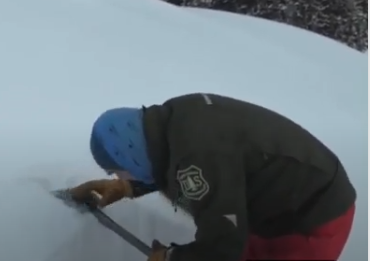
A Forest Service forecaster takes a break from a day of skiing to examine the snow.
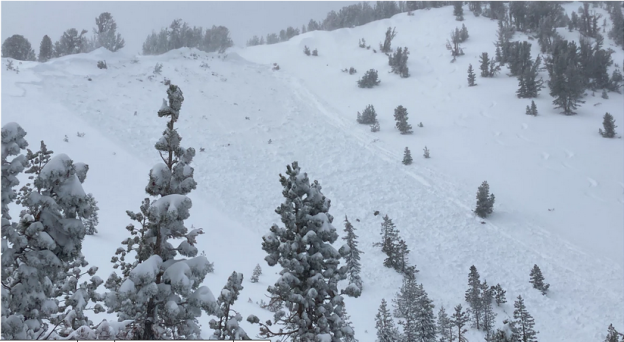
By the end of Friday the Sierra Avalanche Center had received numerous reports of Tahoe avalanches.
“Perfect Day” leads to many avalanches
Friday started as a perfect winter day. About a foot of new snow fell overnight. In the morning the sky cleared. Then by the end of the day the Sierra Avalanche Center had received many avalanche reports. Some happened naturally but many were caused by skiers and snowboarders.
In the morning the Sierra Avalanche Center posted its forecast. The center stated the obvious – that storm slabs in the new snow were a big concern. They rated the avalanche danger as “considerable,” meaning that skiers and snowboarders were likely to trigger avalanches.
Reports of Tahoe avalanches continued through the weekend. There were no fatalities but multiple people were buried in avalanches. At least one person was seriously injured.
New storm snow problem, different from Utah and Colorado
In the United States avalanches have killed 25 people so far this season, including 18 just in February. The snowpack across the mountain west has been riddled with inherent dangers since the beginning of the winter. In Colorado and Utah those persistent dangers are still playing a role in avalanches. The Sierra Nevada’s snowpack is generally faster to resolve those weaknesses. The avalanches on the holiday weekend were simply from new snow. According to the Sierra Avalanche Center the main issues are things like storm slabs and wind slabs.
Slew of Tahoe Avalanches
At Castle Peak, atop Donner Summit, a snowboarder jumped off a rock and was engulfed in snow.
Another skier-triggered avalanche near Carson Pass buried a person for about five minutes. The victim survived but had severe injuries.
At Mount Tallac the El Dorado County Sheriff’s Office dispatched a search and rescue team in a helicopter to respond to an avalanche triggered by a group of backcountry skiers. The response ended when authorities confirmed that no one had been caught in the avalanche.
“I would say any time you’re caught in a slide and you walk away, it’s lucky,” said Andrew Oesterreicher, a volunteer and board member with Tahoe Nordic Search and Rescue (TNSAR). “You don’t ever want to rely on that luck.”
An anonymous skier reported an avalanche on Flagpole Peak. After their first run they decided the snowpack was “bomber” and solid. So they skied a more aggressive line next.
“Clearly, it was a stupid mistake getting caught up with powder fever,” the skier reported. A few turns down the line a storm slab of new snow slid down the mountain, along with the skier.
TNSAR didn’t get any calls to respond to incidents over the weekend, Oesterreicher said. If they are dispatched it usually means the situation is tragic.
“The brutal reality is, typically, by the time we’re responding to an avalanche situation, it’s pretty much a recovery at that point,” Oesterreicher said. “Just because it takes our team so long to get to the scene.”
U.S. Forest Service, Sierra Avalanche Center
The Sierra Avalanche Center works to prevent accidents by issuing daily forecasts. The U.S. Forest Service hires three full-time avalanche forecasters who backcountry ski and then write reports. The Sierra Avalanche Center fundraises on behalf of the U.S. Forest Service to cover much of the payroll and related expenses. There are also three part-time paid observers who go skiing to check on conditions.
Due to the pandemic the center lost two fundraising sources they rely on to fund the Forest Service. The loss adds up to about $100,000, which is about a quarter of their annual budget.
Two people were caught in Tahoe avalanches in the backcountry over the weekend, on Saturday December 26. One was a skier and the other a snowmobiler. Both escaped serious injuries.
Carson Pass – Skier
Two skiers on Saturday afternoon were ascending Nipple Peak near Carson Pass when one accidentally triggered a slide.
The skiers were ascending opposite sides of a bowl above treeline when a slab gave way and caught the skier. The skier deployed his airbag and his head was just underneath the surface when the slide ended at the bottom in the trees.
The other skier was out of the path and avoided the slide.
Carson Pass avalanche, skier locations marked in red and blue
Little Truckee Summit – Snowmobiler
The other avalanche was in the Tahoe National Forest in the Little Truckee Summit region.
A snowmobiler was cognizant of the avalanche forecast as his group worked its way into the Webber Lake area. But they were rerouted due to “wind-scoured ridges and exposed rock.”
“We were side-hilling and in a momentary lapse of judgment, or the fact that we were just moving along too fast, I popped out of the trees onto an exposed face. I immediately recognized the hazard, but immediately saw the snow fracture above me and propagate across the ridge.”
The snowmobiler had little choice and attempted to outrun the slide. But he was caught while dropping into the treeline.
The rider was thrown from the sled and buried up to the helmet against a tree. The avalanche was about 280 feet in length.
The group witnessed the event and was there about a minute later to provide assistance. The rider was uninjured and recovered the machine that was buried in about 6 feet of snow.
Little Truckee Summit avalanche which caught a snowmobiler
Conditions
The Tahoe avalanches took place on steep slopes of 40 degrees or more. Officials are advising users to choose slopes that are 30 degrees or less.
“Whumpfing, shooting cracks, recent avalanches, and unstable snow pit test results are all indications of unstable snow in the area,” said a statement. “Do not underestimate potential avalanche size, potential run out distance, or the hazard from connected terrain above or to the side. Think bigger avalanche than expected.”