Above average Sierra snowpack for the month of February continues, with California at 190% of normal snowpack for this time of year. With all this snow, the ski patrol team at Heavenly Ski Resort in South Lake Tahoe is urging skiers to be extremely cautious of avalanche danger.
In 2023, the Sierra Avalanche Center has reported two avalanches where a person was either caught, buried, or injured in an avalanche. One of the two incidents took place outside the ski area boundary at Heavenly. Avalanches that take place inbounds are rare.
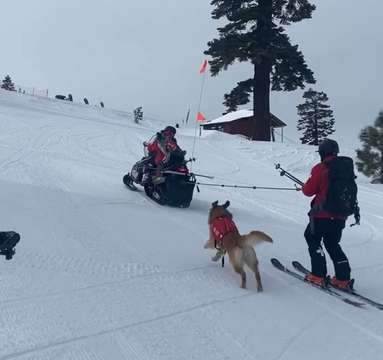
Ryan McPartland is the Ski Patrol Assistant Director at Heavenly Ski Resort. He has been on the ski patrol team for 25 seasons. For the last seven years, he’s had Yuba, his seven year old rescue dog by his side. Before that, McPartland also raised Yuba’s dad.
The legacy of patrol pups is nothing knew for the resort, which started the Heavenly Avalanche Rescue Dog or HARD team back in the late 1980’s. Today, Yuba is one of seven rescue dogs at Heavenly.
Avalanche dogs can search up to two football fields in 30 minutes, while it might take a human about 4 hours to conduct the same search. Making the role of an avalanche dog at a big resort like Heavenly that much more invaluable. McPartland explained,
People get excited by the above average Sierra snowpack, and they should. But they also need to know the risks.
The risk of an avalanche go up significantly once you exit the ski area boundary. McPartland warns. There is no ski patrol there to help you, so it’s very important that you have the training that you’re exposing yourself to a higher level of risk — and you know how to deal with it.
If you do decide to leave the ski area boundary, and ski in the backcountry, there are three things you are going to need:
An avalanche transceiver
An avalanche probe
A shovel
An avalanche transceiver can locate you from an isolated location underneath the snow. The avalanche probe will help with finding how deep under the snow you are, and the shovel that allows the rescuer to chop the snow up, and find you.
Above average Sierra snowpack prompts avalanche awareness
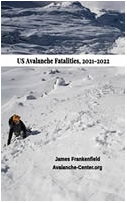
Description: Every year a multitude of people venture out into the snow to go snowshoeing, skiing, snowboarding, snowmobiling or climbing. Many are not fully informed of the dangers and the necessary risk management practices. This book sheds light on the fatalities that occurred last year and what went wrong in order to help others learn and improve their own margin of safety.
FOR IMMEDIATE RELEASE On sale now ISBN: 979-8371006769 <a href="https://<a href='http://www.avalanche-center.org/book/' rel='nofollow'>www.avalanche-center.org/book/https://www.avalanche-center.org/book/
Fatal Avalanches in the US: 2021-2022 reviews in detail all of the fatal snow avalanches of the season. They are summarized collectively, each is described, and noteworthy factors are discussed. Finally, the common factors and problems behind these tragic events are discussed. This information is invaluable for helping skiers, snowboarders, snowmobilers, climbers, and others avoid such incidents in the future.
This 1st edition reviews the 17 avalanche fatalities between October 1, 2021 and September 30, 2022 in clear terms with simple and clear snowpack diagrams and no technical obfuscation. The focus is on understanding what went wrong and how risk management could have been improved.
“While it remains our right to venture forth into avalanche terrain it also remains our responsibility to manage our own risk, to our own acceptable level. Hopefully these experiences of others will contribute in some way to that. “ – James Frankenfield, Author
Fatal Avalanches in the US: 2021-2022: A Review of the Season’s Fatal Avalanches is a must-have book for anyone recreating outdoors in winter. It can be found both in Paperback and Kindle form on Amazon at <a href="https://<a href='http://www.amazon.com/dp/B0BQY4RNZV' rel='nofollow'>www.amazon.com/dp/B0BQY4RNZVhttps://www.amazon.com/dp/B0BQY4RNZV
ABOUT THE AUTHOR – James Frankenfield is a snow and avalanche professional with decades of experience as a skier/climber, snow scientist and engineer and mountain safety educator. He earned his M.Sc. in Physics in 1990 by studying seasonal snow and avalanches and has done scientific work in the field. In 1993 he started Avalanche-Center.org on USENET and a university gopher server and manages this project on the web to this day. He has climbed, soloed and guided alpine climbs throughout the western US, soloed a section of the Northville-Placid trail in winter in 1984, and has soloed multi-day glacier ski tours in the Alps. His website is snowman-jim.org
###
CONTACT: The Avalanche Center (Avalanche-Center.org) 877-604-0166 snowavalanche-center.org
Sidecountry vs. backcountry. In both areas accidents can happen. Skiing and snowboarding, even at a ski resort, is never without risk. Understanding avalanche safety, having the proper gear, and knowing how to use it matter. If recent avalanches have taught us anything it’s that not all areas are safe. There are no universal truths to avalanches. Even areas that traditionally are safe can quickly become deadly in the right conditions.
There are several common misconceptions about avalanches and what areas are typically safe from them. The belief that the sidecountry is safer than the backcountry is certainly one of them. These out-of-bounds areas are often easily accessible from a resort. A person can use a lift to go up the mountain, leave the boundary of the resort, and skiing down adjacent to it. Ski patrol will go into these areas, but they don’t have the same jurisdiction as they do within the resort.
Sidecountry vs. backcountry “As soon as you leave a resort gate, you are leaving the controlled environment of the ski resort,” Chad Brackelsberg of the Forest Service said. “Therefore, you are responsible for your own safety, meaning you have to be able to assess the avalanche risk, and you have to be prepared to be your own rescue party. Ski Patrol does not have jurisdiction to do a rescue there. Generally, suppose you are in an accident, avalanche accident, or just an injury in the side country. In that case, ski patrol must first get permission from the sheriff’s department to function as search and rescue. Just because you can access that terrain from a ski lift or you can see it from a ski lift does not mean that it is the same as in the resort. It is the same as hiking to a slope in the backcountry.”
Problems can arise when skiers go into the sidecountry or backcountry without avalanche safety knowledge, rescue gear, or training, and are completely unprepared in the case of an emergency. It would be easy to put a pack together with a beacon, shovel, and probe, and think you have all the essential avalanche gear, but preparedness goes well beyond that.
Do you have a first aid kit means to provide first aid and to provide a rescue? Do you have a way to evacuate a person? Do you have extra water, food, and gear? You have to have enough gear to keep you warm and comfortable and not get hypothermia for an extended period of time. Then consider the emergency gear you might need. Such as a bivy sack, a way to start a fire, a hot drink, additional clothing layers, and other things.”
Checking avalanche reports for current conditions before you head out is also important. This year’s conditions in Utaj have been unique. Avalanches are occurring in forested areas, lower elevations, and all compass aspects of a slope.
Some believe that the presence of trees can deter an avalanche but this isn’t always the case.
Trees can sometimes act as anchors but any slope that has trees that are wide enough facing to ski has enough spacing for an avalanche. So the presence of trees does not necessarily indicate a safe slope.
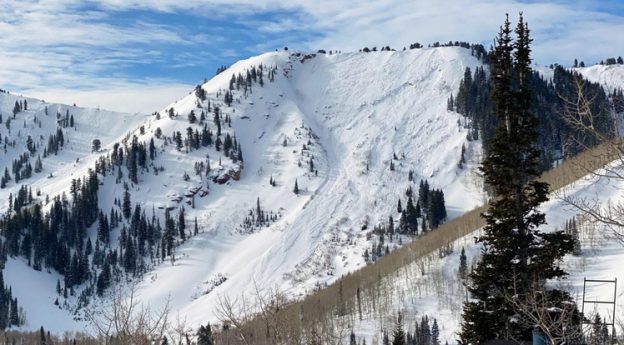
Sidecountry vs. backcountry – Squaretop sidecountry in Utah
It appears that Silverton Avalanche School was dropped from the lawsuit by the Marshall family, along with their guide. Neither party has commented so a settlement amount was most likely agreed on.
The family of Peter Marshall, who died in an avalanche during an AIARE advanced avalanche safety class with the Silverton Avalanche School, has dropped the school and teacher from their lawsuit. It appears that a settlement was reached. A complaint remains open against Backcountry Access, their owner K2 Sports, and K2 owner Kohlberg & Company.
Settlement Reached with Silverton Avalanche School?
Two years after the death Marshall’s wife and daughter sued San Juan Search and Rescue, the Silverton Avalanche School and the school’s guide, Zachary Lovell, in a wrongful death lawsuit. Last month the family dropped its claims against the county, school and guide. Attorneys for the Marshall family have not returned calls or responded to emails and representatives from the county and school declined to comment, indicating a settlement amount was most likely agreed upon.
The Fatal Avalanche Accident and the Allegations
The family had argued that the school and guide had misled Marshall into taking the class by “falsely presenting” that school staff “possessed deep operational experience in avalanche terrain.” The family also claimed the school and guide displayed gross negligence.
Marshall had been participating in the Silverton Avalanche School Level 2 American Institute for Avalanche Research and Education (AIARE) class on Jan. 5, 2019. He was swept down a slope in an avalanche that caught five other skiers. Four were not buried. Another was buried but was able to extricate himself. When the skiers freed Marshall from the debris, he was not breathing.
The Colorado Avalanche Information Center (CAIC) report pointed to several mistakes during the advanced class, including a group of skiers gathered on a slope steep enough to slide, those skiers misjudging the steepness of that slope and a failure to recognize clear avalanche hazards. The guide triggered the first avalanche, which swept the whole group down the slope. A second avalanche buried Marshall under several feet of snow.
Remaining Complaint Against Backcountry Access and K2 Sports
The family of the 40-year-old Longmont skier is still suing K2 Sports and its subsidiary Backcountry Access, which makes an air bag backpack that was not deployed when rescuers found Marshall buried in more than 8 feet of avalanche debris. “Peter Marshall attempted to trigger his Float 32 avalanche air bag system but it did not fully deploy or inflate,” according to the complaint filed in Boulder District Court.
Marshall’s Backcountry Access Float 32 pack was not inflated. Colorado Avalanche Information Center investigators said in their report that the air bag backpack “was functioning properly,” with “the trigger out of the pack strap, but the bag was not deployed.”
K2 Sports, owned by private equity firm Kohlberg & Company, denied the allegations in a response filed this month. The K2 lawyers cited 16 facts they believe eliminate liability in their motion to dismiss the case.
Previous Float Pack Problems
The complaint notes that Backcountry Access recalled “substantially similar” Float packs due to a problem that could lead to a failure to deploy. The U.S. Consumer Products Safety Commission reported the recall of 8,200 Float 18 packs on Nov. 26, 2013. They warned that the trigger assembly can fail “resulting in the air bag not deploying, posing a risk of death and injury in the event of an avalanche.”
The complaint by the Marshall family argues Backcountry Access “should have known insufficient changes were made to the design of avalanche air bags manufactured after the recall to prevent such failures.” The lawsuit argues that Backcountry Access should have been aware of “safer alternative designs,” such as a remote or automatic triggering or inflation system.
Another skier in the group was wearing an avalanche air bag and attempted to use it when he was swept off his feet. It also failed to inflate. “Later, he determined that he assembled the trigger mechanism incorrectly,” reads the CAIC report. It did not identify the brand of air bag used by that skier.
A 2014 study showed 60% of avalanche accidents involving skiers with un-inflated air bags were because the skier never pulled the trigger. That study also showed 12% of so-called non-inflation incidents were due to user error, including assembling the trigger mechanism incorrectly.
Site of the fatal avalanche during a Level 2 AIARE course behind the lawsuit against Silverton Avalanche School (settled) and Backcountry Access.
According to the US Forest Service, a skier was killed in an avalanche Saturday, December 11, in Silver Basin, a closed area of Crystal Mountain, Washington, that ski patrol had not mitigated for avalanche hazard. Six skiers from the same party were caught in the slide. The Pierce County Medical Examiner’s Office has identified the deceased as Robert “Bob” Weisel, 66, of Issaquah, Washington. This is the U.S.’s first avalanche fatality of the 2021/22 season.
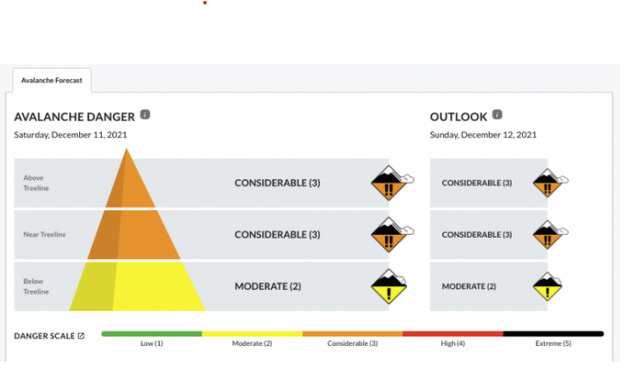
After a long dry spell that has plagued much of the continental United States this winter, Crystal Mountain reported receiving 12 inches of snow in 24 hours with winds up to 100 mph at the summit Saturday. The Friday evening advisory rated the avalanche hazard as considerable near and above tree line. “Look for storm slabs to develop on Saturday at all elevation bands as the West South is targeted by a potent winter storm,” it warned. It reported of the newly forming storm slab, which was resting atop another recent storm layer and a crust from late November. They advised those entering the backcountry to “choose conservative terrain and realize that early season conditions still exist.”
Silver Basin, where the fatality occurred, is a north- through east-facing slope at approximately 6,500 feet that is marked as a black diamond when open. According to a preliminary report, the six individuals were traveling uphill when they triggered a large avalanche. Another party of two in the area that witnessed the avalanche reported it to Crystal Mountain Ski Patrol at 10:50 a.m. and assisted in the rescue. Four skiers were partially or fully buried, three of whom were successfully recovered. The fourth skier was found unconscious and did not respond to resuscitation efforts. All skiers involved were carrying avalanche equipment and several had taken a recent avalanche course.
A statement from Crystal Mountain following the fatality read, “As snow continues to fall, Crystal Mountain Ski Patrol reminds backcountry skiers to research uphill travel policies and check the avalanche forecasts before heading into the backcountry.”
February 26, 2021 – SNOQUALMIE PASS, Wash. — A volunteer ski patroller started an “Are You Beeping?” project to help save lives in the Cascade mountains.
A snowy year in the Cascades
It has been an especially snowy February in the mountains of western Washington. There have been feet of snow falling in a matter of days. Significant storm systems have forced closures at the passes. And raised the avalanche danger for the backcountry.
On Friday Snoqualmie Pass got another foot of snow overnight. This brought the season total to 396 inches, or 33 feet. The evidence of that is clear. There are mounds of snow reaching the top of light poles, and walls of ice taller than semi-trailers.
Stevens Pass closed for a period Friday after avalanche debris covered US 2.
So it’s no doubt that avalanches are on Scott Waller’s mind. He’s a volunteer ski patroller with King County Search and Rescue. He started a project to improve avalanche safety a decade ago.
The “Are you beeping?” Project
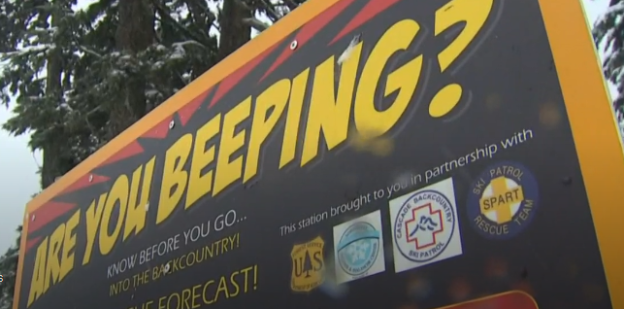
Waller’s project “Are You Beeping?” installs avalanche beacon test sites and signage at resort gates and forest trailheads before users enter risky terrain. It’s a chance for explorers to turn on their avalanche beacons. The signs also include information about avoiding risky terrain and unstable snow conditions.
Waller sees it as a friendly reminder to be prepared.
“It’s amazing how people will intend to put on their avalanche transceiver. But then they forget it in their car,” he said.
Some ski resorts have purchased the signs at cost, and some are funded by non-profit donations.
On Friday he installed a new one on the Pacific Crest Trail near the Alpental exit off I-90. Which is a popular snowshoeing and touring destination. It was funded by Ski Patrol Rescue Team (SPART). Which is a volunteer group that works with King County Search and Rescue. Two more check stations will be installed at Alpental’s backcountry gates this weekend.
Saving Lives
It’s tough to know if the signs have saved lives, Waller said, but that’s the goal.
“That’s the hope,” he said. “It’s hard to measure, or quantify it. But know I’ve sat at trailheads putting these up all over. And it’s amazing how someone will show up, they’re a backcountry skier, and they forgot to turn it on. Yeah, it happens. Just reminding them.”
Maurice Kervin has spent 65 days snowboarding so far this season. Friday is a day he won’t forget. On that day the snowboarder was caught in an avalanche.
“Friday was beautiful. It was golden. We had actually been planning all week to ski this line,” he said.
Recent AIARE Course
Kervin had recently completed a Level 1 safety course through the American Institute for Avalanche Research and Education (AIARE).
All week he and his friends had been watching the avalanche forecast and felt conditions were improving.
“Everyone was actually really excited that the avalanche danger level had actually gone down,” said Kervin. He wasn’t as sure about the forecast, adding, “I was very concerned. I was like, ‘I don’t know guys.'”
Nervous about the day
Kervin and his riding partner hiked toward a spot called No Name near Loveland Pass. They continued to check conditions on their way. And they tested patches of snow for stability. Although the results didn’t show any signs of instability he felt nervous before dropping in.
“I remember telling my buddy ‘I don’t know man. I’m kind of nervous about this run, and if it goes it’s probably going to go big,'” said Kervin.
Kervin think he made it a third of the way down when everything changed. Then the snowboarder was caught in the avalanche.
Caught in an Avalanche
“I cut into a thin patch of snow in some cliff bands. At that point it released below me and the whole slab started to go underneath me. I looked up and around and I saw the snow start coming down from above,” said Kervin.
The avalanche happened quickly and swept him off his feet.
“I definitely wasn’t in control at all, the avalanche was in control. I never had a doubt in my mind that I was going to get buried. My biggest concern was that I was going to hurt myself in some way and make it difficult getting off the mountain,” said Kervin.
He deployed the avalanche airbag in his backpack.
“So I freed my hands, I pulled the bag and I started to do backstroke and kick my feet up to stay on top of the snow, basically just to make myself as big and less dense as possible,” said Kervin.
Kervin was carried about 1,000 feet before he came to a stop on the snow surface. In his video you can hear his air bag fill up. Then seconds later his board hits a large rock where he went over a cliff.
“I was very calm through the whole thing. I think that’s very important thing to be in such a situation. Often times when people panic they make poor decisions or don’t make any decisions at all,” said Kervin.
Role of Training and an Airbag
He made it out with only a dislocated finger. He’s been skiing and riding in the backcountry for about 10 years and completed a Level 1 safety course through AIARE. Despite that, he did not avoid the recognized risk. But Kervin believes the airbag and his training likely saved his life. “I knew what we were doing, and the possibilities that I had feared came true,” said Kervin. He called 911 to report the avalanche but did not require assistance from a rescue team.
He was skiing again the very next day but he wants his story to be an cautionary tale for others who might be venturing into the backcountry, some for the first time.
Silverton Avalanche School is the beneficiary of the second annual Know the Snow Rando Race. The race at Purgatory raises money for the Know the Snow Fund which supports avalanche classes.
This year’s race was dedicated to the memory of Bert Perry and Jeff Paffendorf, Durango community members and experienced backcountry enthusiasts who recently died in an avalanche outside of Silverton.
Dr. Jeff Paffendorf, an experienced skier, died on Dec. 10 along with Albert Perry. They were caught in an avalanche they triggered on the north face of the Battleship, which is near Silverton.
Their accident shows just how unstable the snowpack was. It is important for backcountry skiers to be as knowledgeable as possible about the conditions they will face.
Wind blown snow was deposited on the slope where Paffendorf and Perry skied. It accumulated on an unstable base layer. The Colorado Avalanche Information Center had reported that the avalanche danger was considerable that day.
In 2020, the race raised more than $10,000 and provided 19 scholarships for skiers to attend avalanche education courses with Silverton Avalanche School. The funds fully paid for Level 1 and Level 2 avalanche courses at Silverton Avalanche School.
Peter Marshall died in an avalanche during an avalanche safety class near Red Mountain Pass in 2019. In an avalanche lawsuit his family names the school, the guide, and Backcountry Access.
The slide swept six skiers down a slope. All of them were part of a Level 2 American Institute for Avalanche Research and Education (AIARE) class. Which was offered by the Silverton Avalanche School.
Site of the 2019 avalanche which caught six participants in an AIARE Level 2 avalanche class taught by Silverton Avalanche School.
The family is suing the guide, school and local rescue group. And also the maker of an avalanche airbag and its private equity firm owner. This lawsuit marks the second recent legal action involving avalanches based on reports by the Colorado Avalanche Information Center (CAIC).
Lawsuit defendants
The wrongful death lawsuit names Silverton Avalanche School, San Juan County Search and Rescue and guide Zachary Lovell. It alleges a litany of failures, fraud, misrepresentation, negligence and consumer protection law violations.
The lawsuit also charges Boulder-based Backcountry Access (BCA) with making a defective Float 32 avalanche airbag. It says the airbag did not inflate after Marshall “attempted to trigger” the balloon-like backpack. The lawsuit also names Kohlberg & Company, the private equity firm that acquired BCA and parent company K2 Sports.
“The defendants, each of them, acted willfully, wantonly, and recklessly, without regard for the consequences or the rights and safety of Peter Marshall or of others,” reads the lawsuit. It argues the school, guide and airbag maker “created substantial and unreasonable risks of serious injury and death to participants” in the avalanche class. “Defendants were grossly negligent and that gross negligence was a cause of the injuries, damages, and losses suffered by plaintiffs and the heirs of Peter Marshall.” The CAIC report noted several mistakes that led to the avalanche. The group was skiing together on a slope that was steep enough to avalanche. They misjudged the steepness, aspect and avalanche danger on the slope they skied. And they failed to recognize the potential for triggering avalanches on nearby slopes.
Allegations against the school and guide
The avalanche was triggered by the guide. It also caught Marshall and carried him to the bottom of the slope. A second avalanche on an adjacent slope buried Marshall in several feet of snow. Lovell and the students searched for Marshall. He was uncovered after 50 minutes.
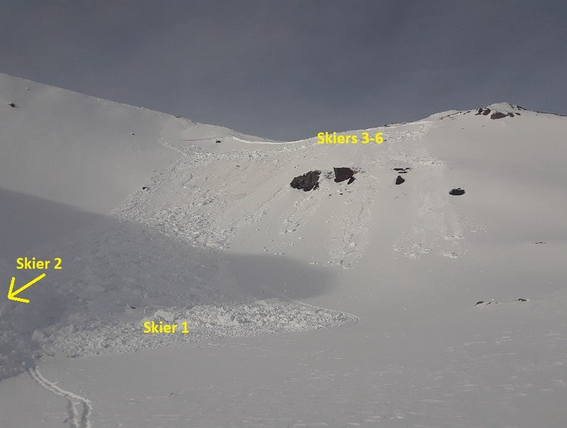
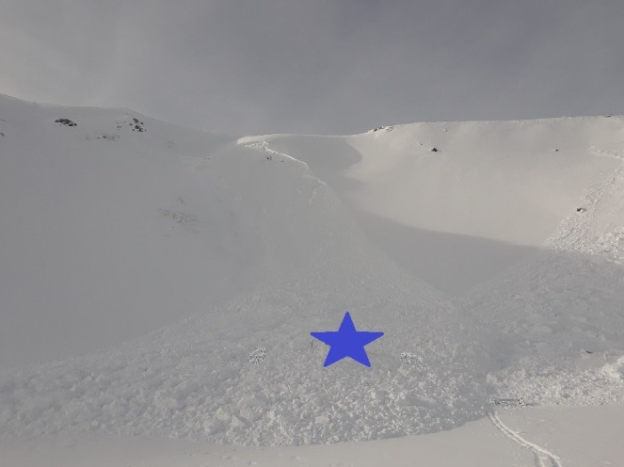
The 2019 avalanche which caught six participants in an AIARE Level 2 avalanche class taught by Silverton Avalanche School. The original snow slide is off the edge on the right, the debris and star are where the second avalanche buried and killed a student.
In the 12 days before the slide, the avalanche center logged 72 avalanches in the North San Juans and noted “considerable” danger. The lawsuit says Silverton Avalanche School staff and instructors agreed not to travel in avalanche terrain that weekend with students.
During those discussions, school staff “expressed concern that defendant Lovell seemed inclined to travel in more complex and bigger terrain. Despite the fragile snowpack and concerning avalanche conditions,” reads the lawsuit.
The lawsuit cites several dozen failures by both the school and Lovell. Those include charges of negligence. Like failing to communicate the day’s avalanche forecast. And allowing instructors to lead students “into, through and below” avalanche terrain. The lawsuit also says the school and Lovell “falsely represented” training and qualifications. The lawsuit notes that BCA in October 2013 recalled some of Float airbags.
Second Lawsuit to rely on CAIC reports
The lawsuit marks a second recent case where a CAIC report supports legal action. In October Summit County prosecutor Bruce Brown levied a $168,000 fine against two snowboarders who triggered an avalanche above the Eisenhower-Johnson Memorial Tunnels in March. The slide buried a service road and destroyed remote avalanche mitigation devices. The two snowboarders gave video to CAIC avalanche investigators. They thought their interviews and perspective would help others avoid future avalanche accidents. A motion filed by the snowboarders’ attorney in November to suppress the video argued the criminal charges stemming from an avalanche could pose a slippery slope for backcountry skiers who traditionally have worked cooperatively with the avalanche center in detailing avalanche accidents.
“The backcountry community needs to know if CAIC is not an ally in their efforts to improve best avalanche practices, but (operates) merely as an extension of law enforcement,” the motion reads. “This is a posture that needs to be clarified for all parties, because if CAIC is seen as a revolving door to police and prosecutor there will be a chilling effect.”
Skiers activities that often lead them to backcountry locations with limited services. Monday morning (12/28) Forest Service avalanche experts warned of possible avalanche activity when visiting these areas. They recommend doing some avalanche testing before using steep slopes.
“We have a block of harder snow over a section of weak sugary facets of the ground, so we have something over nothing,” said Dave Zinn, avalanche expert. “This is the recipe for an avalanche, all you need now is a steep slope and a trigger.”
Triggers can be caused either by nature — rain, snow, sun, wind — or by human activity.
“The danger is moderate, but it’s sort of that scary moderate because human triggered avalanches remain possible,” said Zinn. “If we trigger them, they could be large — and definitely big enough to injure, bury or kill an individual.”
“Really watch out for those signs of instability — like shooting cracks. Do some avalanche testing – dig stability tests, do an extended column test, see if you get stable results,” said Zinn. “And if you don’t see (stable results), find a different slope.”
Previous reports from 2017 to 2019 showed six-of-ten accidents occurred in January and February. Five of which, resulted in a death. It is not listed what caused these avalanches were deaths occurred but leads experts to continue to urge people to test they go.


 avalanche-center.org