Tag Archives: AIARE

Snowboarder caught in avalanche carried 1,000 feet, deployed airbag

Maurice Kervin has spent 65 days snowboarding so far this season. Friday is a day he won’t forget. On that day the snowboarder was caught in an avalanche.

“Friday was beautiful. It was golden. We had actually been planning all week to ski this line,” he said.

Recent AIARE Course

Kervin had recently completed a Level 1 safety course through the American Institute for Avalanche Research and Education (AIARE).

All week he and his friends had been watching the avalanche forecast and felt conditions were improving.

“Everyone was actually really excited that the avalanche danger level had actually gone down,” said Kervin. He wasn’t as sure about the forecast, adding, “I was very concerned. I was like, ‘I don’t know guys.'”

Nervous about the day

Kervin and his riding partner hiked toward a spot called No Name near Loveland Pass. They continued to check conditions on their way. And they tested patches of snow for stability. Although the results didn’t show any signs of instability he felt nervous before dropping in.

“I remember telling my buddy ‘I don’t know man. I’m kind of nervous about this run, and if it goes it’s probably going to go big,'” said Kervin.

Kervin think he made it a third of the way down when everything changed. Then the snowboarder was caught in the avalanche.

Caught in an Avalanche

“I cut into a thin patch of snow in some cliff bands. At that point it released below me and the whole slab started to go underneath me. I looked up and around and I saw the snow start coming down from above,” said Kervin.

The avalanche happened quickly and swept him off his feet.

“I definitely wasn’t in control at all, the avalanche was in control. I never had a doubt in my mind that I was going to get buried. My biggest concern was that I was going to hurt myself in some way and make it difficult getting off the mountain,” said Kervin.

He deployed the avalanche airbag in his backpack.

“So I freed my hands, I pulled the bag and I started to do backstroke and kick my feet up to stay on top of the snow, basically just to make myself as big and less dense as possible,” said Kervin.

Kervin was carried about 1,000 feet before he came to a stop on the snow surface. In his video you can hear his air bag fill up. Then seconds later his board hits a large rock where he went over a cliff.

“I was very calm through the whole thing. I think that’s very important thing to be in such a situation. Often times when people panic they make poor decisions or don’t make any decisions at all,” said Kervin.

Role of Training and an Airbag

He made it out with only a dislocated finger. He’s been skiing and riding in the backcountry for about 10 years and completed a Level 1 safety course through AIARE. Despite that, he did not avoid the recognized risk. But Kervin believes the airbag and his training likely saved his life. “I knew what we were doing, and the possibilities that I had feared came true,” said Kervin. He called 911 to report the avalanche but did not require assistance from a rescue team.

He was skiing again the very next day but he wants his story to be an cautionary tale for others who might be venturing into the backcountry, some for the first time.

A snowboarder was caught in an avalanche.
Snowboarder caught in avalanche
Silverton Avalanche School Avalanche

Avalanche Lawsuit names Silverton Avalanche School, guide and BCA

Peter Marshall died in an avalanche during an avalanche safety class near Red Mountain Pass in 2019. In an avalanche lawsuit his family names the school, the guide, and Backcountry Access.

The slide swept six skiers down a slope. All of them were part of a Level 2 American Institute for Avalanche Research and Education (AIARE) class. Which was offered by the Silverton Avalanche School.

Site of a fatal avalanche during an AIARE Level 2 avalanche class.
Site of the 2019 avalanche which caught six participants in an AIARE Level 2 avalanche class taught by Silverton Avalanche School.

 The family is suing the guide, school and local rescue group. And also the maker of an avalanche airbag and its private equity firm owner. This lawsuit marks the second recent legal action involving avalanches based on reports by the Colorado Avalanche Information Center (CAIC). 

Lawsuit defendants

The wrongful death lawsuit names Silverton Avalanche School, San Juan County Search and Rescue and guide Zachary Lovell. It alleges a litany of failures, fraud, misrepresentation, negligence and consumer protection law violations. 

The lawsuit also charges Boulder-based Backcountry Access (BCA) with making a defective Float 32 avalanche airbag. It says the airbag did not inflate after Marshall “attempted to trigger” the balloon-like backpack. The lawsuit also names Kohlberg & Company, the private equity firm that acquired BCA and parent company K2 Sports. 

“The defendants, each of them, acted willfully, wantonly, and recklessly, without regard for the consequences or the rights and safety of Peter Marshall or of others,” reads the lawsuit. It argues the school, guide and airbag maker “created substantial and unreasonable risks of serious injury and death to participants” in the avalanche class. “Defendants were grossly negligent and that gross negligence was a cause of the injuries, damages, and losses suffered by plaintiffs and the heirs of Peter Marshall.” The CAIC  report noted several mistakes that led to the avalanche. The group was skiing together on a slope that was steep enough to avalanche. They misjudged the steepness, aspect and avalanche danger on the slope they skied. And they failed to recognize the potential for triggering avalanches on nearby slopes. 

Allegations against the school and guide

The avalanche was triggered by the guide. It also caught Marshall and carried him to the bottom of the slope. A second avalanche on an adjacent slope buried Marshall in several feet of snow. Lovell and the students searched for Marshall. He was uncovered after 50 minutes. 

Avalanche death in a Level 2 avalanche class
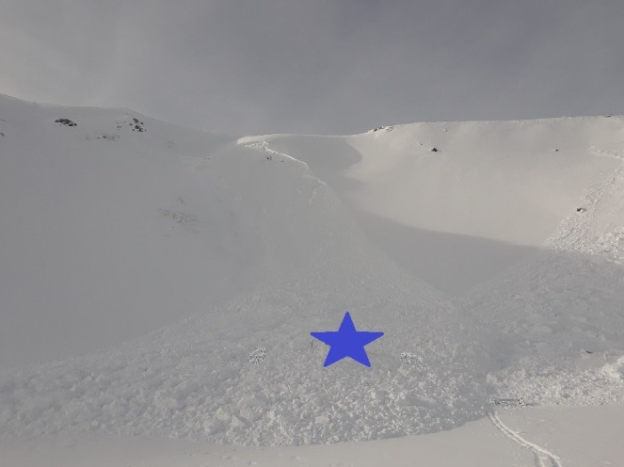
The 2019 avalanche which caught six participants in an AIARE Level 2 avalanche class taught by Silverton Avalanche School. The original snow slide is off the edge on the right, the debris and star are where the second avalanche buried and killed a student.

In the 12 days before the slide, the avalanche center logged 72 avalanches in the North San Juans and noted “considerable” danger. The lawsuit says Silverton Avalanche School staff and instructors agreed not to travel in avalanche terrain that weekend with students. 

During those discussions, school staff “expressed concern that defendant Lovell seemed inclined to travel in more complex and bigger terrain. Despite the fragile snowpack and concerning avalanche conditions,” reads the lawsuit. 

The lawsuit cites several dozen failures by both the school and Lovell. Those include charges of negligence. Like failing to communicate the day’s avalanche forecast. And allowing instructors to lead students “into, through and below” avalanche terrain. The lawsuit also says the school and Lovell “falsely represented” training and qualifications.  The lawsuit notes that BCA in October 2013 recalled some of Float airbags.

Second Lawsuit to rely on CAIC reports

The lawsuit marks a second recent case where a CAIC report supports legal action. In October Summit County prosecutor Bruce Brown levied a $168,000 fine against two snowboarders who triggered an avalanche above the Eisenhower-Johnson Memorial Tunnels in March. The slide buried a service road and destroyed remote avalanche mitigation devices. The two snowboarders gave video to CAIC avalanche investigators. They thought their interviews and perspective would help others avoid future avalanche accidents.  A motion filed by the snowboarders’ attorney in November to suppress the video argued the criminal charges stemming from an avalanche could pose a slippery slope for backcountry skiers who traditionally have worked cooperatively with the avalanche center in detailing avalanche accidents. 

“The backcountry community needs to know if CAIC is not an ally in their efforts to improve best avalanche practices, but (operates) merely as an extension of law enforcement,” the motion reads. “This is a posture that needs to be clarified for all parties, because if CAIC is seen as a revolving door to police and prosecutor there will be a chilling effect.”