Category Archives: snowmobiling

New Essential Reading for Winter Recreation: Fatal Avalanches in the US, 2021-2022

Press Release via Google News and PR*Urgent

Description: Every year a multitude of people venture out into the snow to go snowshoeing, skiing, snowboarding, snowmobiling or climbing. Many are not fully informed of the dangers and the necessary risk management practices. This book sheds light on the fatalities that occurred last year and what went wrong in order to help others learn and improve their own margin of safety.

FOR IMMEDIATE RELEASE
On sale now
ISBN: 979-8371006769
<a href="https://<a href='http://www.avalanche-center.org/book/' rel='nofollow'>www.avalanche-center.org/book/https://www.avalanche-center.org/book/

Fatal Avalanches in the US: 2021-2022 reviews in detail all of the fatal snow avalanches of the season. They are summarized collectively, each is described, and noteworthy factors are discussed. Finally, the common factors and problems behind these tragic events are discussed. This information is invaluable for helping skiers, snowboarders, snowmobilers, climbers, and others avoid such incidents in the future.

This 1st edition reviews the 17 avalanche fatalities between October 1, 2021 and September 30, 2022 in clear terms with simple and clear snowpack diagrams and no technical obfuscation. The focus is on understanding what went wrong and how risk management could have been improved.

“While it remains our right to venture forth into avalanche terrain it also remains our responsibility to manage our own risk, to our own acceptable level. Hopefully these experiences of others will contribute in some way to that. “ – James Frankenfield, Author

Fatal Avalanches in the US: 2021-2022: A Review of the Season’s Fatal Avalanches is a must-have book for anyone recreating outdoors in winter. It can be found both in Paperback and Kindle form on Amazon at <a href="https://<a href='http://www.amazon.com/dp/B0BQY4RNZV' rel='nofollow'>www.amazon.com/dp/B0BQY4RNZVhttps://www.amazon.com/dp/B0BQY4RNZV

ABOUT THE AUTHOR – James Frankenfield is a snow and avalanche professional with decades of experience as a skier/climber, snow scientist and engineer and mountain safety educator. He earned his M.Sc. in Physics in 1990 by studying seasonal snow and avalanches and has done scientific work in the field. In 1993 he started Avalanche-Center.org on USENET and a university gopher server and manages this project on the web to this day. He has climbed, soloed and guided alpine climbs throughout the western US, soloed a section of the Northville-Placid trail in winter in 1984, and has soloed multi-day glacier ski tours in the Alps. His website is snowman-jim.org

###

CONTACT: The Avalanche Center (Avalanche-Center.org)
877-604-0166
snowavalanche-center.org
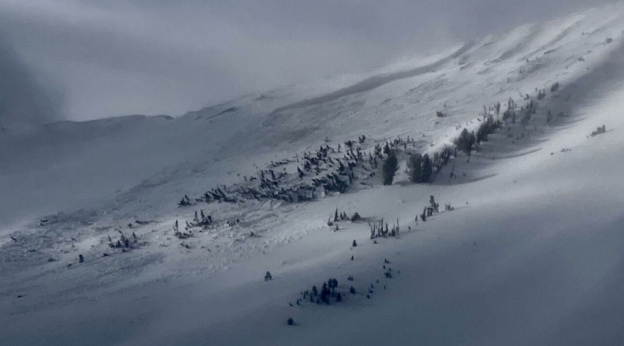
Avalanche forecasters trigger an avalanche

COOKE CITY — Avalanche forecasters trigger an avalanche: Even if you’re an expert, you can never be too safe in the backcountry. It’s something two avalanche forecasters learned firsthand last week after they triggered a slide near Cooke City.

Last Friday two Forest Service avalanche forecasters from the Gallatin National Forest Avalanche Center had a close call on Fisher Mountain.

“It’s incredibly terrifying,” said the director of the Gallatin National Forest Avalanche Center, Doug Chabot, on Wednesday.

The two forecasters had snowmobiled to an area on the mountain to dig some snow pits. “One of them rode and then the second person came, and when the second person was coming, he triggered the avalanche from below,” said Chabot.

The second rider was below the slope. “And he was able to propagate this fracture up the hill, which then caught him. Luckily the other guy, the first guy, he was safe,” Chabot said.

The first rider called for help on the radio and then rushed down to his colleague.

“And luckily he wasn’t buried. He had snow up to his thighs, but it was a really close call because it was a big avalanche,” said Chabot.

They were able to dig out the rider and his snowmobile, and thankfully no one was hurt but it’s a reminder that there are no rules when it comes to Mother Nature.

“December and January can be quite bad for avalanches in Montana. And the reason for that is, is we’re forming many weak layers in the snowpack right now,” Chabot said.

Chabot said the snowpack is relatively thin, usually only two to three feet thick in most places. Thin snowpacks can change really fast. At some point, the weak layer may break and that’s what triggers avalanches.

“But the ones that kill people in the United States are overwhelmingly, either the victim or someone in their party triggered the avalanche,” said Chabot. Like these guys.

Dec 15, 2022

Avalanche forecasters trigger an avalanche

Severe Avalanche Risk in BC backcountry

‘Your life is not worth that day of powder skiing’: Officials warn of severe avalanche risk.

This has been a deadly week in B.C.’s backcountry. On Monday two snow bikers were killed in an avalanche near Pemberton. Then on Thursday a backcountry skier fell into a tree well and died near Whistler.

“I’m taking some time off to let the snowpack settle out,” said Whistler skier Mike Douglas. “It’s gotten really really dangerous.”

When Douglas was touring with some friends in “safe manageable terrain” they released a slab.

This is a good week to stay out of the Whistler area backcountry. We discovered some very easily triggered soft slab sitting on a layer of surface hoar today. 50cm crown on 30 degree N slope at 1500m. Likely to get worse. Be careful. pic.twitter.com/it0I2OblZO
— Mike Douglas (@MikeDski) December 31, 2020

“We kicked off a small slab avalanche with about a 50 cm crown,” he said, “it kind of spooked us a little bit, like wow it’s actually even more touchy out here than we thought.”

Twitter photo during severe avalanche danger
Twitter, MikeDski

Avalanche Canada is warning this is not the time to be in the backcountry. They are reminding those who want to venture out, to check forecasts before going. There is a severe avalanche risk right now.

“We’re on the storm track right now,” said Ilya Storm. “Right now, in some ways, the decision making is easiest.”

Meaning just don’t go! Because the high avalanche risk rating means it’s natural avalanches are likely and human triggered are very likely.

“It is snowing heavily, the wind is blowing, you can see it, you can see the snow accumulate and there are obvious clues out there,” he said. “Snow hates rapid change. The rapid change is a person. A person on a snowmobile, a person on skis, that can be enough to tip the balance.”

Douglas said this is the time to ski in bounds.

“Your life is not worth that day of powder skiing,” he said.

Photo on an avalanche. There is severe avalanche risk now.
Avalanche Photo

Tahoe avalanches catch a skier and a snowmobiler

Two people were caught in Tahoe avalanches in the backcountry over the weekend, on Saturday December 26. One was a skier and the other a snowmobiler. Both escaped serious injuries.

Carson Pass – Skier

Two skiers on Saturday afternoon were ascending Nipple Peak near Carson Pass when one accidentally triggered a slide.

The skiers were ascending opposite sides of a bowl above treeline when a slab gave way and caught the skier. The skier deployed his airbag and his head was just underneath the surface when the slide ended at the bottom in the trees.

The other skier was out of the path and avoided the slide.

Carson Pass Tahoe avalanche photo, forest service
Carson Pass avalanche, skier locations marked in red and blue

Little Truckee Summit – Snowmobiler

The other avalanche was in the Tahoe National Forest in the Little Truckee Summit region.

A snowmobiler was cognizant of the avalanche forecast as his group worked its way into the Webber Lake area. But they were rerouted due to “wind-scoured ridges and exposed rock.”

“We were side-hilling and in a momentary lapse of judgment, or the fact that we were just moving along too fast, I popped out of the trees onto an exposed face. I immediately recognized the hazard, but immediately saw the snow fracture above me and propagate across the ridge.”

The snowmobiler had little choice and attempted to outrun the slide. But he was caught while dropping into the treeline.

The rider was thrown from the sled and buried up to the helmet against a tree. The avalanche was about 280 feet in length.

The group witnessed the event and was there about a minute later to provide assistance. The rider was uninjured and recovered the machine that was buried in about 6 feet of snow.

Little Truckee Summit Tahoe avalanche, forest service
Little Truckee Summit avalanche which caught a snowmobiler

Conditions

The Tahoe avalanches took place on steep slopes of 40 degrees or more. Officials are advising users to choose slopes that are 30 degrees or less.

“Whumpfing, shooting cracks, recent avalanches, and unstable snow pit test results are all indications of unstable snow in the area,” said a statement. “Do not underestimate potential avalanche size, potential run out distance, or the hazard from connected terrain above or to the side. Think bigger avalanche than expected.”

Wyoming Avalanche Kills Snowmobiler

An Elko, Nevada, snowmobiler died in a Wyoming avalanche on Friday. It is estimated that he was buried inverted under the snow for about 15 minutes.

Brandon Jones, 41, was snowmobiling away from his party late on Dec. 18 on “Suicide Mountain”. He triggered a medium-sized avalanche 24″ deep. He was able to deploy an airbag, which kept him near the snow surface with a leg sticking out.

“The balloon worked – it kept him up above. If someone would have seen it, he probably would have survived it, because they would have dug him out” said Lincoln County Coroner Dain Schwab.

When the other snowmobilers did recover him he lacked a pulse, was blue in the face, and wasn’t breathing. The man who found Jones suspected he had broken his neck. Schwab ordered a CT scan to see if this was a factor in the death. CPR was not administered, according to the coroner, who visited the scene the night of the accident.

“It was actually pretty dangerous just digging him out of there,” Schwab said. “We were up on the hillside under cornices that were unbroken.”

First Wyoming Fatality, in the Salt River Range

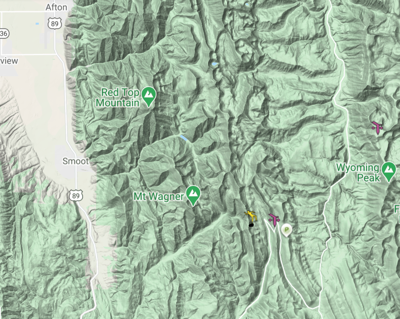
Jones and his group were snowmobiling in the Sheep Pass area, southeast of Afton at the far southern end of the Salt River Range. The slide occurred at nearly 10,000 feet on an eastern aspect.

The fatality marks the first lethal avalanche of the winter in Northwest Wyoming.

The Bridger-Teton Avalanche Center Director visited the site on Sunday to investigate. He determined the avalanche ran over the crusted snowpack that baked in the sun during the dry spell in late November and early December.

“We dug a snow pit near the site yesterday, and we feel confident that this was all the new snow that has fallen since Dec. 11,” he said. “The avalanche conditions are still dangerous up there. People should be careful.”

The avalanche danger on Monday morning was still deemed “considerable” at high elevations in the Salt and Wyoming ranges, according to the morning forecast.

Jones had a wife, Mary, and three kids, Blayde, Ebony and Slayde, according to a Facebook post by the Elko business Evolution Powersports. A funeral service has been scheduled for 11 a.m. Wednesday in Malad, Idaho.

As of December 22 this is one of 3 fatal incidents listed by the Avalanche Center, along with 3 others outside the US. There is also a link to the avalanche advisory for the day there.

Wyoming avalanche fatality location
The yellow symbol marks the site of the fatal Wyoming avalanche on Friday.