COOKE CITY — Avalanche forecasters trigger an avalanche: Even if you’re an expert, you can never be too safe in the backcountry. It’s something two avalanche forecasters learned firsthand last week after they triggered a slide near Cooke City.
Last Friday two Forest Service avalanche forecasters from the Gallatin National Forest Avalanche Center had a close call on Fisher Mountain.
“It’s incredibly terrifying,” said the director of the Gallatin National Forest Avalanche Center, Doug Chabot, on Wednesday.
The two forecasters had snowmobiled to an area on the mountain to dig some snow pits. “One of them rode and then the second person came, and when the second person was coming, he triggered the avalanche from below,” said Chabot.
The second rider was below the slope. “And he was able to propagate this fracture up the hill, which then caught him. Luckily the other guy, the first guy, he was safe,” Chabot said.
The first rider called for help on the radio and then rushed down to his colleague.
“And luckily he wasn’t buried. He had snow up to his thighs, but it was a really close call because it was a big avalanche,” said Chabot.
They were able to dig out the rider and his snowmobile, and thankfully no one was hurt but it’s a reminder that there are no rules when it comes to Mother Nature.
“December and January can be quite bad for avalanches in Montana. And the reason for that is, is we’re forming many weak layers in the snowpack right now,” Chabot said.
Chabot said the snowpack is relatively thin, usually only two to three feet thick in most places. Thin snowpacks can change really fast. At some point, the weak layer may break and that’s what triggers avalanches.
“But the ones that kill people in the United States are overwhelmingly, either the victim or someone in their party triggered the avalanche,” said Chabot. Like these guys.
An avalanche trapped bikers on Thursday, May 13. At about 6:30 pm Glacier National Park rangers responded to a report of three bikers who were trapped behind an avalanche near Triple Arches on Going-to-the-Sun Road.
Three bikers – a husband and wife along with a friend – traveling up the road encountered an avalanche across the road, turned around, and started back down. Soon after, they encountered a second avalanche in progress. The wife was ahead of her husband and friend and heard the avalanche. She warned her husband and friend to stop. The avalanche came down between them. So the avalanche trapped bikers – the woman’s husband and friend – on the uphill side.
The wife biked down to call for help. A ranger arrived at the site of the avalanche around 7:30 pm.
Afternoon sun and warming were to blame
“The sudden onset of sunny and warm weather on Thursday afternoon, combined with recent new snow from the previous weekend, created unstable surface snow conditions,” said USGS scientist Erich Peitzsch. “These conditions resulted in a wet, loose avalanche originating above the road in Triple Arches that deposited debris on the road.”
Park officials determined that they would wait until the sun was off the slope above, decreasing the chances for further slides, before starting rescue attempts.
Rescue began around 9:30 pm. Rangers belayed across the avalanche chute and belayed the bikers individually back across the chute. No injuries were sustained by the bikers; all three are from Bigfork.
Going-to-the-Sun Road is currently closed to vehicles at Avalanche Creek until the road opens to Logan Pass for the season. Due to continued avalanche conditions, hiker/biker access is currently not permitted past the Loop. Check the park website for updates.
Park officials remind visitors that snow can avalanche above Going-to-the-Sun Road in active avalanche terrain that often cannot be seen from the road. Avalanches are more likely to occur before or after sunny/warm weather, rainstorms, or snowstorms. Visitors are encouraged to start and finish their trip before the warmest part of the day. Do not stop under gullies or snowfields and turn around if there is a rapid increase in temperature.
An avalanche trapped bikers on Going-to-Sun Road in Glacier Park
An avalanche south of Cooke City carried three skiers down Republic Mountain, two were injured in the avalanche. One had to be evacuated by helicopter and another was temporarily unconscious and not breathing, according to a report.
“It’s super serious avalanche terrain,” said Doug Chabot, director of the Gallatin National Forest Avalanche Center.
In many ways, the skiers had done everything right. All six were carrying beacons and had rescue gear. They had radios to summons help.
Skiers checked with a 6 foot deep snowpit
However, they did not check the snowpack in the place they decided to ascend the mountain, Chabot said. They had dug a snowpit 2 meters deep to check the likelihood of an avalanche. “A hundred feet off to the side the snowpack changed,” he said, to an area with much less snow, only three feet.
“In terrain like that you have to be 100 percent sure” that the snowpack has no instabilities, Chabot added. All week long in its daily reports, the avalanche center had warned the snowpack was unstable and avalanches had been remotely triggered on even low-angle slopes. However, the Cooke City area had been standing out as a relatively more stable snowpack compared to other areas.
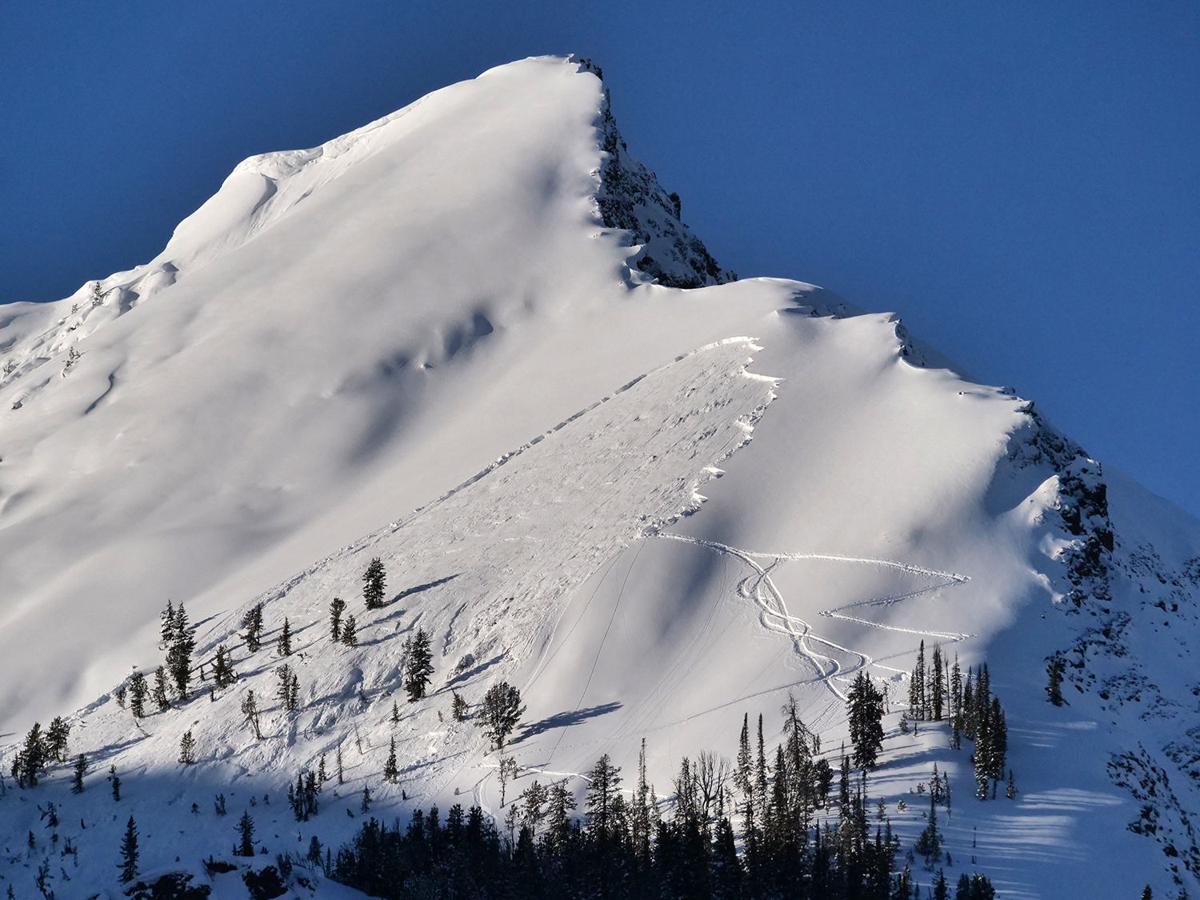
The avalanche broke about 1.5 to 2 feet deep approximately 250 feet above the skiers.
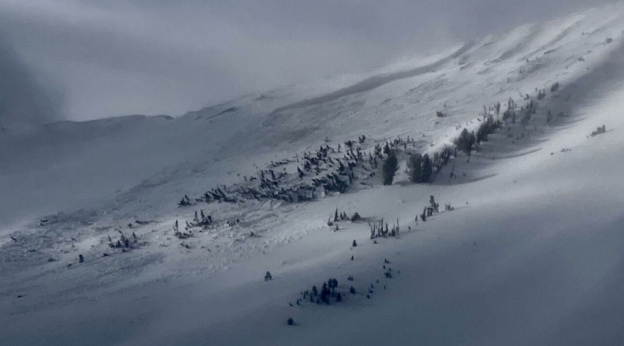
The avalanche
Recovery of the two injured in the avalanche
Three of the skiers were swept downhill. The avalanche was 200 feet wide and ran 700 feet down the mountain. It was a large avalanche, and it went through some ugly terrain.
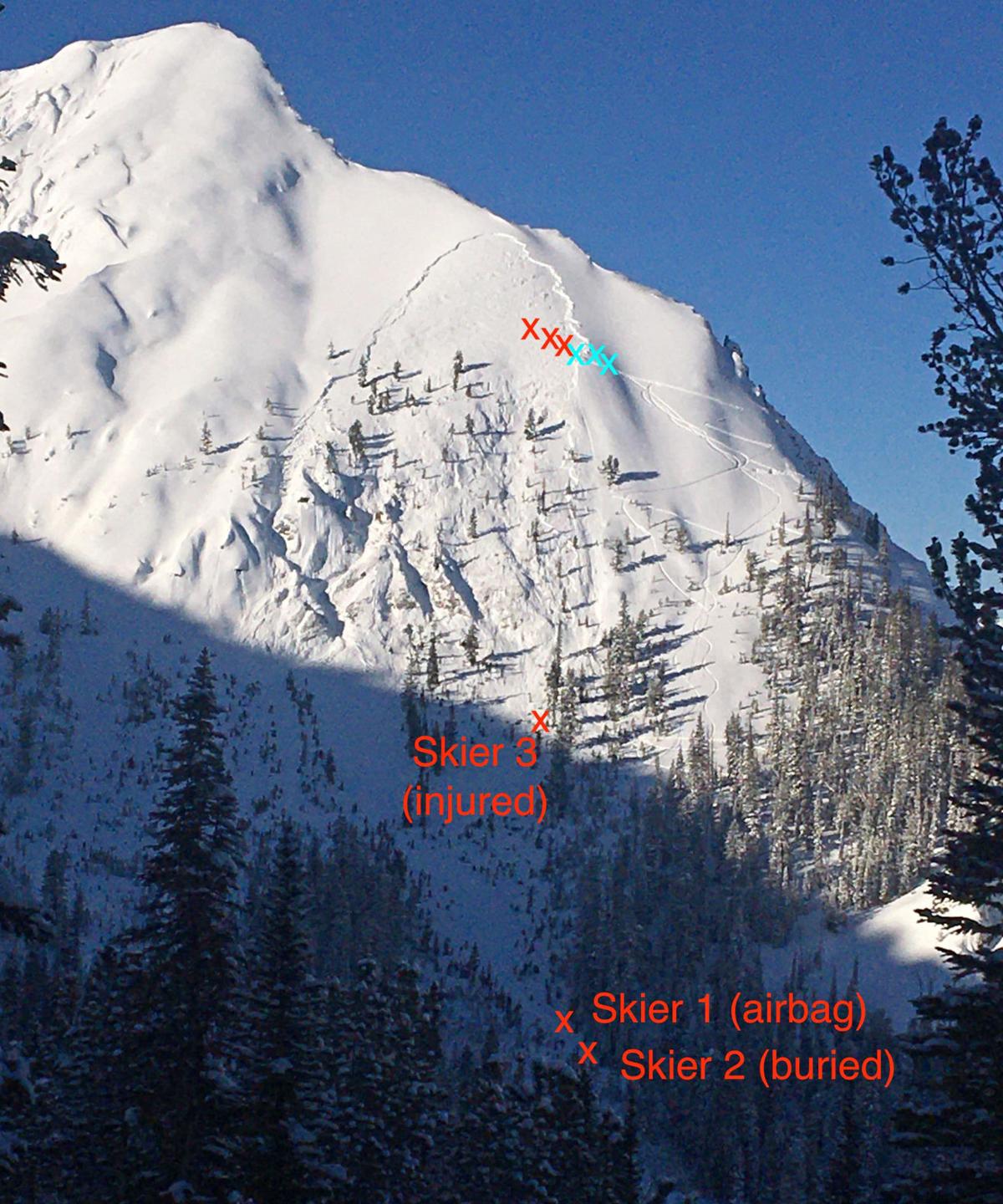
One skier deployed his airbag to keep from being buried. He was not injured in the avalanche. He quickly got up and began searching for his partners. One of the other skiers was found buried head down with his mouth packed full of snow. He freed that skier and cleared the airway so he was able to breathe on his own. That victim was able to ski out despite a leg injury.
Meanwhile, the three skiers who were not caught or injured in the avalanche found the third victim. He was buried higher on the mountain after being dragged across rocks. The trip caused injuries to his ribs and a collapsed lung.
Location of the skiers injured in the avalanche. Three were not caught despite being very close to the edge of it.
The Rescue
The skiers had two-way radios and were able to notify Park County Search and Rescue. Cellphones do not work in the remote area between Yellowstone National Park and the Absaroka-Beartooth Wilderness.
Two members of the search and rescue arrived and ascended 1200 feet then descended 400 to the avalanche zone. They brought medical and survival gear in case they had to spend the night.
The rescuers helped stabilize the injured skier and made a fire to stay warm while awaiting a helicopter to arrive from Jackson, Wyoming since Bozeman was too fogged in to fly.
The avalanche had occurred about noon. About 4 p.m. the helicopter arrived and long-lined the victim out. He was then flown to a regional hospital for care.
Snowpack is not improving
“It’s not going to get better anytime soon,” Chabot warned, because a weak layer of snow still sits underneath. As more snow falls that layer has a higher chance of failing under the increased weight.
“It’s different this year because it’s not taking a lot of snow”, Chabot said. “That makes it a little scarier.”
Monday is a holiday, Martin Luther King, Jr. Day. This might mean more people in the backcountry.
“Our fingers are crossed that people will continue to get lucky,” Chabot said. “But it’s a bit of a losing battle if you’re relying on luck.”
Chabot added that it will take time before the snowpack is stable, because right now even under moderate conditions people are triggering avalanches.
“You have to be really careful about where you’re headed,” Chabot said. “It’s a bit of a minefield.”
Skiers activities that often lead them to backcountry locations with limited services. Monday morning (12/28) Forest Service avalanche experts warned of possible avalanche activity when visiting these areas. They recommend doing some avalanche testing before using steep slopes.
“We have a block of harder snow over a section of weak sugary facets of the ground, so we have something over nothing,” said Dave Zinn, avalanche expert. “This is the recipe for an avalanche, all you need now is a steep slope and a trigger.”
Triggers can be caused either by nature — rain, snow, sun, wind — or by human activity.
“The danger is moderate, but it’s sort of that scary moderate because human triggered avalanches remain possible,” said Zinn. “If we trigger them, they could be large — and definitely big enough to injure, bury or kill an individual.”
“Really watch out for those signs of instability — like shooting cracks. Do some avalanche testing – dig stability tests, do an extended column test, see if you get stable results,” said Zinn. “And if you don’t see (stable results), find a different slope.”
Previous reports from 2017 to 2019 showed six-of-ten accidents occurred in January and February. Five of which, resulted in a death. It is not listed what caused these avalanches were deaths occurred but leads experts to continue to urge people to test they go.