Category Archives: canada

Canada fights rising risk with lots of avalanche bombing

Jan 20 – British Columbia is rolling out the artillery and bombs for avalanche bombing. There have been closures on some major roads for the first time in decades as the province grapples with record snowfall and rain.

The province, third-largest by population, uses helicopter avalanche bombing, remote-triggered explosives, and howitzers to keep roads open. But nonetheless critical routes to Vancouver are being disrupted by avalanche control.

Extreme weather, including November’s torrential precipitation, a deep freeze in late December and an early January thaw, has weakened the snowpack. Mountain slopes are more prone to avalanches that can release without warning.

Avalanche bombing requires closing sections of roads while teams use explosives to pre-emptively trigger slides, which prevents the snowpack from becoming deep and unstable.

Record amounts of control actions

A section of Highway 1 through Fraser Canyon northeast of Vancouver needed avalanche control for the first time in 25 years.

On Highway 99 north of Vancouver avalanche control actions are three times the seasonal average. Some paths have produced avalanches big enough to hit the highway for the first time in over a decade.

Avalanche bombing in Allison Pass further south on Highway 3 has also been above average.

These highways were all damaged in November by floods. A busy avalanche control season is putting further strain on resources. The Coquihalla Highway near Hope just reopened on Wednesday. And record snow along with avalanche risk delayed repairs to Highway 1 through the Fraser Canyon.

Rogers Pass

Further east avalanche teams in Rogers Pass, which runs below 135 slide paths in Glacier National Park, are dealing with more snow than usual. Control missions are also above average.

Approximately 3,000 vehicles traverse Rogers Pass every day in winter. A major Canadian Pacific rail line runs along the highway although it has a long tunnel under the top of the pass.

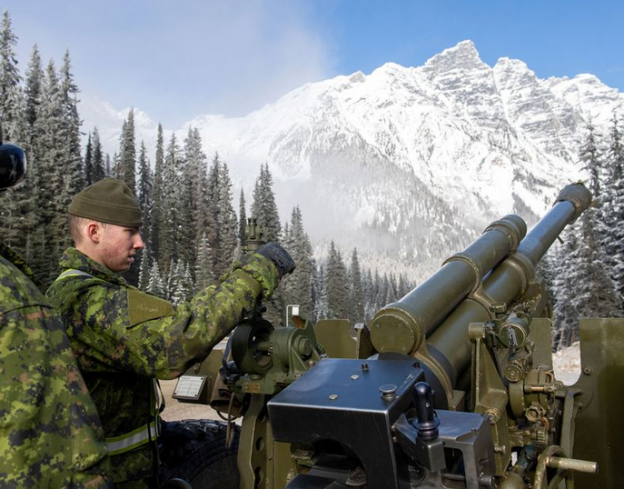
Rogers Pass avalanche bombing involves artillery soldiers who are stationed in Rogers Pass in winter. They use a howitzer to fire shells into loaded avalanche paths along the highway.

“Our goal is to bring down as much snow as we can and bring the hazard down to a point where it’s safe to open the highway,” said Jim Phillips, acting avalanche operations coordinator for Parks Canada.

The Rogers Pass program has been running since the highway opened in 1961. Before that, and before they built their tunnel, CP trains ran a high risk of deadly snow slides. One killed 62 railway workers in 1910.

So far this winter the team has fired 333 howitzer rounds, produced 197 controlled avalanches and closed the highway for 43 hours over seven separate days.

Helicopter Avalanche Bombing

Phillips said his team also uses heli-bombing and remote-trigger systems to set off detonations, and spends C$600,000 ($480,346) a year on explosives alone.

“It’s a balancing act. You want to keep traffic moving and minimize closures, but also minimize risk to people using the transportation corridor,” he added.

Avalanche control is typically needed until late April or early May.

Avalanche bombing in Rogers Pass. November 22, 2019. MCpl PJ Letourneau/Canadian Forces
November 22, 2019. MCpl PJ Letourneau/Canadian Forces. Avalanche bombing in Rogers Pass.

Waterton townsite avalanche – No injuries or structure damage

WATERTON PARK, AB – A Waterton townsite avalanche resulted in a close call in Waterton Lakes National Park in Canada.

This past weekend a class-4 avalanche roared down Bertha Peak. Which is just outside the small resort community.

The avalanche dumped 10 metres of debris on the Bertha Falls trail and stopped just ahead of Evergreen Avenue South. Entry to the town using that street past Cameron Falls is not recommended due to the risk of further avalanches.

Additionally, the Akamina Parkway is closed until further notice. Pedestrian access on Akamina and Red Rock parkways remains open. The parkway will reopen to vehicles when conditions improve.

Fortunately, no injuries were reported, and no structures were damaged. The risk of avalanches, and another townsite avalanche, has increased significantly in the park. This is due to large snow falls, extreme wind gusts and rising temperatures.

Jan 13, 2022 | 7:05 AM

Waterton, location of a townsite avalanche
Waterton, where a townsite avalanche occurred

Elk Survived an Avalanche after fortuitous rescue by an observer

An elk survived an avalanche after being rescued by a nearby observer.

Jesse Dahlberg was watching railroad avalanche control crews use explosives to start relatively small avalanches near Field British Columbia. He noticed a lone elk was in the path of one of the avalanches. He hoped the elk might outrun the snow. But it was engulfed as the avalanche came down around it.

“I didn’t know how big the avalanche was going to be so I was hoping for the best. When I saw it, I thought there’s no way that elk is going to survive.” Dahlberg told CBC. “That wall of snow caught up to that elk so fast and just blasted it.”

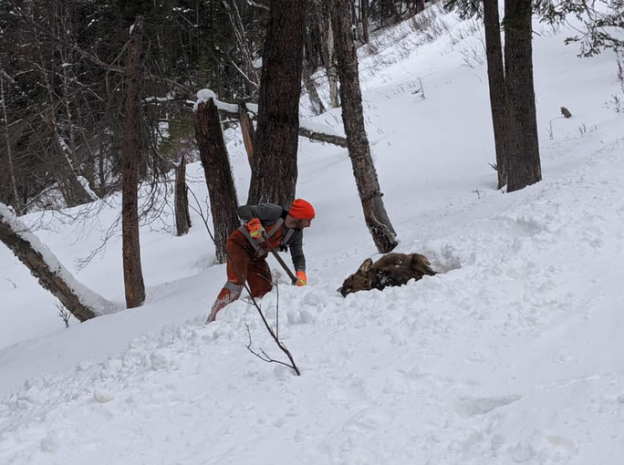
Dahlberg decided to go see if there was a chance the elk survived an avalanche. After parking close to where the elk was last seen he and a friend followed debris uphill. Miraculously, Dahlberg saw a portion of the animal’s face peering out from the snow. The elk was trapped and immobilized in the avalanche debris.

Once Dahlberg found that the elk was alive he knew they’d have to act quickly. He began digging with his handsand sent his friend back to the vehicle for a shovel. It took only 15 minutes to dig the elk’s back legs free. Then, with a little prompting, the critter was able to shake its way clear and climb out of the snow.

“I put my arms up and started cheering because I was so excited that it was alive,” Dahlberg said. “I was so happy.” Rather than take flight, the forest denizen calmly gazed at them as they left the scene as if saying a silent “thank you.”

Jesse Dahlberg has a video of the avalanche and some photos of the rescue on his facebook page.

An Elk survived and avalanche thanks to a rescue.
Jesse Dahlberg rescuing an elk that survived an avalanche.

Severe Avalanche Risk in BC backcountry

‘Your life is not worth that day of powder skiing’: Officials warn of severe avalanche risk.

This has been a deadly week in B.C.’s backcountry. On Monday two snow bikers were killed in an avalanche near Pemberton. Then on Thursday a backcountry skier fell into a tree well and died near Whistler.

“I’m taking some time off to let the snowpack settle out,” said Whistler skier Mike Douglas. “It’s gotten really really dangerous.”

When Douglas was touring with some friends in “safe manageable terrain” they released a slab.

This is a good week to stay out of the Whistler area backcountry. We discovered some very easily triggered soft slab sitting on a layer of surface hoar today. 50cm crown on 30 degree N slope at 1500m. Likely to get worse. Be careful. pic.twitter.com/it0I2OblZO
— Mike Douglas (@MikeDski) December 31, 2020

“We kicked off a small slab avalanche with about a 50 cm crown,” he said, “it kind of spooked us a little bit, like wow it’s actually even more touchy out here than we thought.”

Twitter photo during severe avalanche danger
Twitter, MikeDski

Avalanche Canada is warning this is not the time to be in the backcountry. They are reminding those who want to venture out, to check forecasts before going. There is a severe avalanche risk right now.

“We’re on the storm track right now,” said Ilya Storm. “Right now, in some ways, the decision making is easiest.”

Meaning just don’t go! Because the high avalanche risk rating means it’s natural avalanches are likely and human triggered are very likely.

“It is snowing heavily, the wind is blowing, you can see it, you can see the snow accumulate and there are obvious clues out there,” he said. “Snow hates rapid change. The rapid change is a person. A person on a snowmobile, a person on skis, that can be enough to tip the balance.”

Douglas said this is the time to ski in bounds.

“Your life is not worth that day of powder skiing,” he said.

Photo on an avalanche. There is severe avalanche risk now.
Avalanche Photo

Dramatic video of avalanche control near Revelstoke

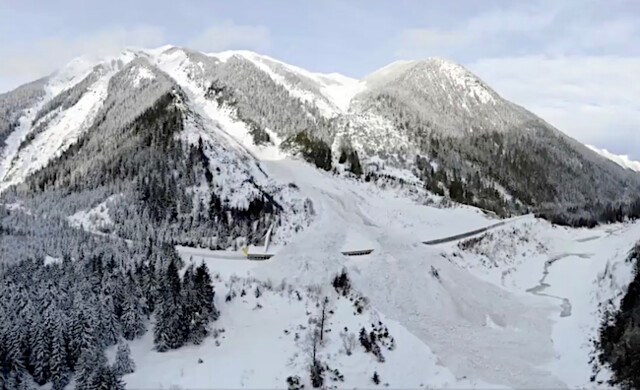
DriveBC has shared dramatic aerial video of avalanche control work along the Trans-Canada Highway near Revelstoke.

Avalanche control east of Revelstoke. Ministry of Transportation
Avalanches east of Revelstoke. Ministry of Transportation

The Ministry of Transportation’s Rocky Mountain District posted the avalanche control video to Twitter. It shows a slide being triggered and then thundering down a steep mountainside east of Revelstoke. The wave of snow careens down the slope and over a snow shed.

Avalanche risk considerable in East Kootenay

Avalanche Canada is reporting considerable avalanche risk in the alpine in the East Kootenay.

In the Lizard-Flathead, South Rockies and the Parks Canada ranges, Avalanche Canada reports: “It’s expected to be very warm and sunny Wednesday, alpine temperatures could be as warm as +6 C. The snowpack doesn’t like rapid changes like this. Cornice failures and even natural avalanches are possible as we head into the warm spell.”

For the Purcells, Avalanche Canada notes: “Things are looking hot up high for the next couple days. Naturally triggered wet loose avalanches are possible on all aspects and especially likely on solar aspects. Overhead hazards will be a primary concern.”

Travel and Terrain Advice

Be careful around freshly wind loaded features.

Extra caution for areas experiencing rapidly warming temperatures for the first time.

Minimize overhead exposure; avalanches triggered by warming or cornice fall may be large and destructive.

A moist or wet snow surface, pinwheeling and natural avalanches are all indicators of a weakening snowpack.