Category Archives: Switzerland

Avalanche Warnings in Switzerland Modified

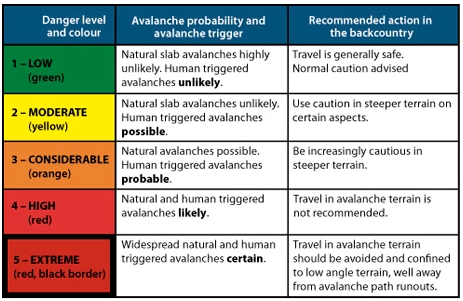
Avalanche Warnings in Switzerland to be modified starting this winter. The SLF is enhancing the precision by subdividing the danger levels. It will indicate whether the danger is towards the bottom end, in the middle or towards the top end of the reported level.

The SLF (Swiss Institute for Avalanche Research) says the new system will provide “users with more precise information for assessing the risk”.

The five danger levels themselves remain unchanged.

The Avalanche Warnings in Switzerland will have subdivisions of the danger levels to indicate where the danger is in the level:

  • Towards the bottom end (-)
  • More or less in the middle (=)
  • Towards the top end (+)

This subdivision is only applied for dry avalanches, and only starting at Level 2.

The purpose is to make it easier for users to interpret the Avalanche Warnings in Switzerland correctly.

Other national avalanche forecasting bodies are watching the change closely.

Avalanche Warnings in Switzerland
Avalanche warning scale

The SLF explains the new situation in a series of questions and answers:

Why this change?

The SLF has been hearing calls for a more precise representation of the avalanche danger for several years.

For those who engage in snow sports, Level 3 in particular spans a very broad spectrum.

The avalanche forecasters likewise have been wanting to pinpoint the danger with greater precision for some time.

These wishes have now been satisfied with the introduction of the subdivisions.

Why not simply add a danger level?

Additional danger levels would not be feasible in the international arena and would serve little purpose in any case.

According to avalanche forecaster Kurt Winkler, “One advantage of the new system is that it takes findings of psychological research into account.”

The human brain cannot differentiate more than five to seven defined classes.

The danger levels, which are clearly defined, are already aligned with this understanding and are thus being retained.

The classification reflects logical and therefore slow thought processes.

But we can also determine, without any difficulty, a relative ranking within the individual classes.

We make subdivisions of this kind intuitively and thus quickly.

Does the new approach work in practice?

The SLF’s avalanche forecasters have already been allocating subdivisions to all danger assessments over a period of six winters, but has refrained from publishing them.

This large data set was then statistically analyzed in order to review the new approach.

The analysis clearly showed that the differences between the danger level forecast in the avalanche bulletin and the observations reported from the field are much smaller when the subdivision forms part of the picture as well.

In addition, a clear correlation was shown to exist with objectively measurable factors that play a role in the formation of avalanches.

From one subdivision to the next one above, for example, the frequency of whumpfing sounds and of avalanches triggered by people increases and the snowpack stability test results deteriorate.

Since the experimental series also demonstrated that subdividing the danger levels is dysfunctional in the case of wet snow avalanches, subdivisions are not being reported when the snow is wet.

Where the graphical reduction method is being applied, the subdivisions can be taken into account by entering the diagram on the left or right side of the column representing the danger level and then using the diagonal color code.

What is the target audience for the subdivisions and how can they be useful?

Everyone can benefit from the additional information which is provided.

“Those who wish to avoid the most dangerous situations on a given winter’s day can simply stay away from regions where the danger level is 3+ or higher, for instance, and instead either choose to visit a region where the danger is lower or even make other plans for the day,” explains Kurt Winkler.

The subdivisions can be used quantitatively as well.

The calculation of the avalanche risk on the website skitourenguru.ch, for example, takes them into account.

The subdivisions can also be useful when applying the graphical reduction method.

For an approximate assessment, the danger level can still be used in such cases.

Alternatively, based on the subdivision, the user can enter the diagram on the left or right side of the column representing the danger level and then use the diagonal colour code.

Can the new subdivisions be disregarded?

Although, as with any forecast, incorrect assessments are possible, evaluations show that the subdivisions reflect the danger more accurately as a rule.

Disregarding the subdivision bars access to additional information that would facilitate a better assessment of the risk.

“In any event, it is essential to continue taking the danger level seriously,” concludes Kurt Winkler.

“A 3-minus remains a level 3 and indicates ‘considerable avalanche danger’ – it is not to be taken lightly or treated as though it were a 2.”
Artificial Intelligence for Avalanche Forecasting?

 Can we use Artificial Intelligence for Avalanche Forecasting?

Even the best forecasters only reach about 75% accuracy in their avalanche predictions.  After all, they are only human. One of the greatest challenges is in the fact that avalanche danger cannot be precisely measured or communicated. It is, therefore, a matter of expert assessment and opinion by humans.

Last season the Swiss Institute for Snow and Avalanche Research successfully tested a first-of-its-kind, artificial intelligence computer program to assist in its avalanche forecasts. The SLF is a world leader in the field of avalanche forecasting and pushes the boundaries of avalanche forecasting methods.

SLF human observers collect measurements from over 120 different remote automatic weather stations located across the Swiss Alps. They then analyze the data, make interpretations, and combine opinions into a single bulletin published at 5 pm each day.

SLF researchers tested the new AI model as a “second opinion” against the human-made forecasts. In many cases the model agreed, but sometimes it did not. The differences are then reviewed.

The new Artificial Intelligence for Avalanche Forecasting model was trained using more than two decades-worth of weather and forecast information. SLF researchers now estimate the program is about 75% accurate in its model predictions. SLF forecaster Frank Techel describes the Artificial Intelligence for Avalanche Forecasting:

The computer analyses the data in a different way than we do. That’s why it occasionally arrives at a slightly different conclusion. The computer forecast is very useful, especially for drawing exact boundaries between regions in which different danger levels prevail.”

The model, however, is limited to dry-snow avalanches.  The SLF is planning on introducing a new Artificial Intelligence for Avalanche Forecasting system capable of modeling wet-snow avalanches as well as snowpack stability next season.

Those interested in learning more about avalanche safety or science can visit the Avalanche Center (avalanche-center.org) and its affiliated Avalanche Institute for online courses.

Can we use Artificial Intelligence for Avalanche Forecasting?
Can we use AI for Avalanche Forecasting?

Swiss Avalanche Deaths Up 50% Over the 20-year Average This Winter

Swiss avalanche deaths are up this season. Significantly more people have been killed than the latest 20-year average. The majority of victims were off-piste skiers or snowboarders. The grim statistics come in a report by the Swiss Institute for Snow & Avalanche Research (SLF) and cover the period from 1st October 2020 to 30th March 2021.

27 people have died in avalanches and one person is still missing. The 20 year average is 18 Swiss avalanche deaths to the end of March. This shows an increase of 50%.

“All of the victims were winter sports enthusiasts in unsecured terrain,” the report states. 11 were backcountry ski touring or hiking and 16 were off-piste skiing or snowboarding.

Two people died in one accident, but for all other accidents, one person died.

The 4 Valleys area, which includes Verbier, was the worst hit with seven (26%) of the season’s avalanche deaths recorded there. One fatal accident was recorded in the Swiss Jura, where such incidents are very rare, with the last one dating back to 1991.

Overall 318 avalanches causing damage – material and bodily injury – were reported to the SLF Institute. Of these, 215 were triggered by people, rather than spontaneous slides, with 296 people being caught in them. The 20-year average for triggered avalanches is 113.

The 20-year average for the number of people caught is 177, meaning this winter roughly two-thirds more people were involved in some way.

There were also spontaneous slides, most of them in mid-December and late January.

Possible Reasons

Fragile old snow

Layers of metamorphosed snow close to the ground and weak layers in the centre of the snowpack. Most serious accidents had this cause, including the eight fatal avalanches from 15th to 18th January.

Abundant fresh snow

From December until the beginning of February and again in mid-March, the situation was critical for weeks because of a several episodes of snowfall. Constant snow and the formation of layers of windblown snow added to the problem of the old snow layer.

Large avalanches

The slides triggered in old snow were often large and sometimes very large.

Increase in off-piste accidents

More than half the fatal accidents were in the off-piste area. In multi-year statistics, there are more fatalities among backcountry tourers or hikers.

Five of the fatal avalanches happened when the avalanche risk was at level 4 (on a scale of 1 to 5).

The report also says there were slightly more accidents than average at the weekend, especially Saturdays, when more people are usually on the mountains.

“It is not known whether the coronavirus pandemic has an influence on mountain attendance date and the risky behavior of winter sports enthusiasts,” it says.

Swiss Avalanche deaths and reported avalanches

Swiss Avalanche victims rescued when their dogs bark for help

Two people caught in a Swiss avalanche were rescued after their dogs barked for help. The barking attracted the attention of nearby snowshoers who were able to dig them out.

The Swiss avalanche swept the pair off a hiking trail in the Avers Valley of south-western Switzerland. Near the Italian border and west of St Moritz. It occurred shortly after 3pm on Saturday.

“Their dogs, who were not buried by the masses of snow, drew attention to themselves by barking loudly,” a statement by REGA said.

“The dogs attracted the attention of a group of snowshoers who were some distance away in the same valley but had not witnessed the avalanche.”

About 15-20 minutes after the Swiss avalanche, the group was at the scene, where one of the avalanche victims’ hands was visible; the other person was buried entirely, Rega said. Both were dug out slightly injured and with mild hypothermia. Rega then flew them by helicopter to hospital.

Snowshoeing in Switzerland, file photo
Snowshoeing in Swizerland

Another “Miracle” Recovery as well

This occurred just two days after a man in France was recovered from under 2.5 meters of snow after more than 2 hours. Later that day (Thursday) in Tignes another man had an equally miraculous story.

A huge natural avalanche came down at 7.10pm. In darkness and poor weather the patrol carried out a search. The visibility was described as “very bad”.

Later that night at 11.45 the director of the patrol in Tignes, Frederic Bonnevie, returned. The weather had eased.

He heard a voice calling for help. A 35-year old local man had been caught in the slide, but his face was above the snow. He had been trapped in the snow and avalanche debris and unable to move. He had been buried for over four and a half hours.

Frederic Bonnevie and another pisteur dug him out and gave him first aid at the scene. The man was shaken but otherwise unharmed except for frostbite to his left ear.

That avalanche was 600m long and 200m wide. It had a vertical drop of 300m.

The Alps see Many Fatal Avalanches

There have been many fatal avalanches recently in the Alps. Some of the people caught were inexperienced, but professionals have also died.

The latest fatality was a massive slide in Verbier, Switzerland in which a local guide, out with clients, died. Verbier also had two other separate and fatal slides last week. One involved an experienced skier and the other an instructor, both locals.

On January 22nd a 23-year old Swedish skier died in the Savoleyres area of Verbier.

Last week there were five fatalities in France. Additional accidents occurred in France over the weekend.

There was at least one fatal avalanche in Italy.

Switzerland, where ski resorts are open, has had 16 avalanche deaths so far this winter.

Is this typical?

At the same period last season the total was 4. Last season saw seven total. But the season ended in mid-March due to coronavirus. In the 2018/19 season it was 21 total and in 2017/18 it was 27.

Weak Snow

The current deaths result from a highly unstable snowpack with weak layers at the bottom of the snowpack. It is not so much the amount of snow that has fallen, but rather its fragility.

“Underneath the wind slabs the bonding of the snowpack is unfavourable at high altitudes, in particular in the western part of the northern flank of the Alps, in Valais and in Grisons,” said a recent advisory from the Swiss Institute for Snow and Avalanche Studies.

Considerable Danger

There remains “considerable” (Level 3) danger across the whole of the Swiss Alps. This is the level which sees the most fatal avalanches.

“In these regions, distinct weak layers exist in the middle part and near the base of the snowpack in all aspects. Fatal avalanches can be triggered in these layers and release the entire snowpack, in particular in places where relatively little snow is lying. Remote triggering has been observed in central Valais and in Upper Engadine in particular. These weak layers are still to be found in the central and eastern parts of the northern flank of the Alps as well, but here they are mostly embedded deep and therefore unlikely to be released. On the southern flank of the Alps, the bonding of the snowpack is more favourable. Here, fractures are unlikely to occur deep in the snowpack.”

So it is quite dangerous in some areas.

Many areas affected

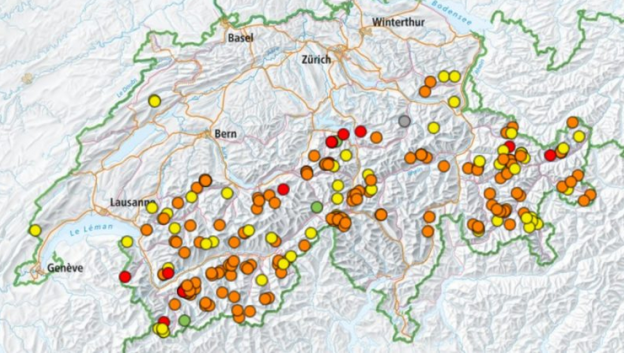
The fatalities in Switzerland have been across the country.

Map of swiss fatal avalanches
Fatal Avalanches in Switzerland

In France conditions are also highly unstable.

“While this is not unprecedented during the middle of a busy winter with a persistent unstable snowpack and moderate snowfalls coming down on top of the weak layer or layers, a lot of people are asking questions about why this is happening now, especially when there’s a lot less skiers out there…and many of the victims are experienced, or even professional,” said Henry Schniewind.

The latest snow is sitting on top of a very weak layer.

Some people claim that coronavirus is adding to the problem. In areas where the lifts are closed, like Italy and France, people are hiking up into the dangerous terrain.

No slopes have been kept safe by the resorts since lifts are closed.

Where resorts are open, Switzerland and Austria, there are not the numbers skiing off piste.

More snow is currently falling in the Alps on the already weak foundation.

Avalanche accident kills 1 in Switzerland

Dec. 8, 2020

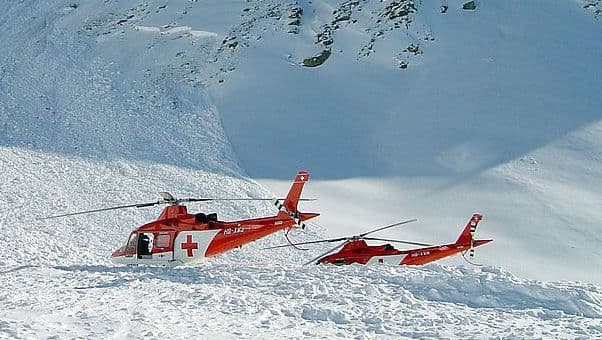
Swiss avalanche accident rescue
Stock image, SLF

BERLIN (AP) — An avalanche accident killed one skier in Switzerland.

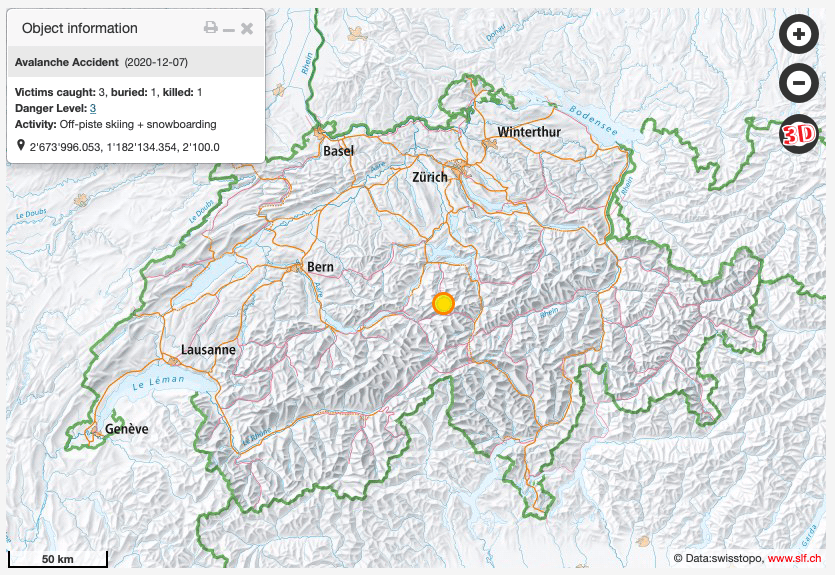
Authorities in the Swiss canton of Nidwalden said one off-piste skier among a group of five people was killed in an avalanche accident Monday in the Titlis area, south of Lucerne. Rescue teams were not able to resuscitate the 23-year-old Swiss citizen after he was rescued.

The victim died on the scene near the Titlis mountain. Two others, out of five, were also hit but managed to free themselves without serious injury.

The group was skiing off-piste when the avalanche struck at around 10.15am. An investigation into what triggered the avalanche is ongoing.

A 23-year-old German man was also injured in an avalanche accident Monday in Austria’s Hahnenkamm skiing region in Tyrol. He went skiing on a closed slope. He was taken by rescue plane to a hospital in Kempten in Bavaria.

In a broad swath of the Alps in Switzerland, authorities raised the avalanche warning level to 3 on a five-point scale. Exceptionally heavy snowfall was dumped over the weekend. Some higher elevations recorded between 50 and 80 centimeters (20-32 inches) of snow over the last three days.

Snow Pummels Austria, Italy, Germany and Switzerland

Several roads were still closed in Tyrol and some valleys were cut off from the rest of the country. Electricity provider Tinetz said 4,000 homes lost power after several electrical lines were snapped by snow or fallen trees, public broadcaster ORF reported.

Austria issued avalanche warnings Tuesday for the country’s mountainous east after days of heavy snow pummeled the region.

Northern Italy saw massive snowfall over the weekend and snow also hit parts of Germany and Spain as well.

“It’s true that it’s early for the season” to have so much snowfall, said Mikhael Schwander, a meteorologist with Swiss weather service MeteoSuisse. He said the higher the elevation that the snow fell, the greater the risk of avalanches — although that also depends on other factors including the temperature and the types of snow on the ground.

According to SRF Meteo there is an elevated avalanche threat throughout northern Ticino, including Centovalli, and in the southern valleys of Graubünden and the Upper Engadine. In these regions, it’s a Level 4 on the five-part danger scale.

Location of avalanche accident
Location map, from Swiss SLF

Related: