New avalanche nonprofit will provide financial aid for Forest Service
NH (Nov. 15, 2022) – Friends of Tuckerman Ravine and White Mountain Avalanche Education Foundation, both longtime nonprofits of Mt. Washington Valley, have merged. The merger will support and promote the Mount Washington Avalanche Center, a Forest Service operation.
Both groups have previously been critical to the success of the Forest Service center, bestowing financial support. This combined entity will enhance the ability to raise money.
“We are very excited about these organizations finally coming together after so many years. Both have the same goals, and now together, we can streamline our efforts to fund the Avalanche Center,” said Jake Risch, president of the new Avalanche Nonprofit – the Mount Washington Avalanche Center Foundation.
This fall, MWAC will host various events in support of the Forest Service :
The 12th annual Eastern Snow and Avalanche Workshop takes place on Nov. 17–18
Winter Backcountry Kickoff Party took place on Nov. 19, in Intervale, NH.
Can we use Artificial Intelligence for Avalanche Forecasting?
Even the best forecasters only reach about 75% accuracy in their avalanche predictions. After all, they are only human. One of the greatest challenges is in the fact that avalanche danger cannot be precisely measured or communicated. It is, therefore, a matter of expert assessment and opinion by humans.
Last season the Swiss Institute for Snow and Avalanche Research successfully tested a first-of-its-kind, artificial intelligence computer program to assist in its avalanche forecasts. The SLF is a world leader in the field of avalanche forecasting and pushes the boundaries of avalanche forecasting methods.
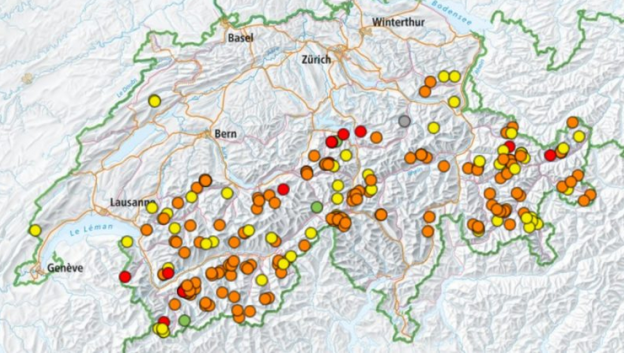
SLF human observers collect measurements from over 120 different remote automatic weather stations located across the Swiss Alps. They then analyze the data, make interpretations, and combine opinions into a single bulletin published at 5 pm each day.
SLF researchers tested the new AI model as a “second opinion” against the human-made forecasts. In many cases the model agreed, but sometimes it did not. The differences are then reviewed.
The new Artificial Intelligence for Avalanche Forecasting model was trained using more than two decades-worth of weather and forecast information. SLF researchers now estimate the program is about 75% accurate in its model predictions. SLF forecaster Frank Techel describes the Artificial Intelligence for Avalanche Forecasting:
“The computer analyses the data in a different way than we do. That’s why it occasionally arrives at a slightly different conclusion. The computer forecast is very useful, especially for drawing exact boundaries between regions in which different danger levels prevail.”
The model, however, is limited to dry-snow avalanches. The SLF is planning on introducing a new Artificial Intelligence for Avalanche Forecasting system capable of modeling wet-snow avalanches as well as snowpack stability next season.
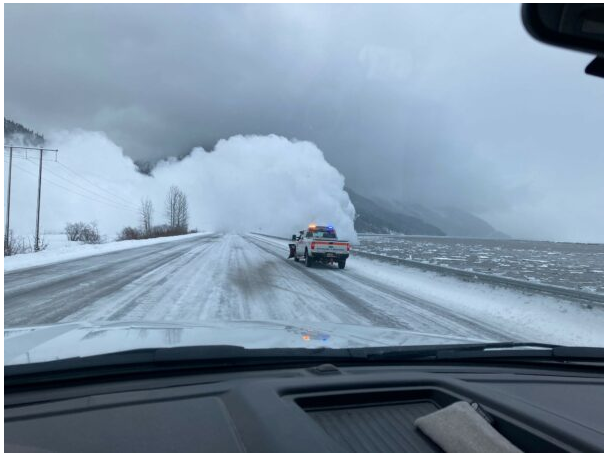
A Seward Highway avalanche closed the road for much of the day Friday. It was between Bird Creek and the Portage turnoff. The avalanche severed the only road access between Anchorage and the Kenai Peninsula for more than eight hours.
The Seward Highway avalanche hit at Mile 91.5 and the debris on the roadway was up to 15 feet high in spots, said a spokesperson for the DoT. The highway reopened around 2 p.m. but drivers should remain cautious.
“Travel is going to be wet and slick and bumpy. They’ve cleared all the snow but it’s definitely not down to dry highway measures by any means.”
Crews set off artillery to trigger 20 other avalanches along the highway on Friday. Also on Friday, several snow slides closed the Old Glenn Highway near the Old Knik River Bridge.
Farther north, snow slides near Summit Lake closed the Richardson Highway from mile 186 to 218.
The Hatcher Pass Avalanche Center also warned of very dangerous avalanche conditions in the area. It issued an avalanche warning early Friday, and it says the Hatcher Pass Road will be closed at mile 11 through the weekend due to avalanche activity.
National Weather Service meteorologist Michael Kutz said Anchorage has been having one of the wettest years on record so far. Snowfall this February is nearly three times higher than average, and rainfall this year is more than four times above normal, Kutz said.
Seward Highway Avalanche
Rain and Snow in Anchorage
Rain and snow have been falling in Anchorage and other areas of Southcentral since the beginning of the week. Which has led to treacherous road conditions in parts of town. Areas of the Mat-Su have been hit with heavy snow. Power to thousands of homes has been knocked out.
As of Friday evening, about 300 homes still did not have power. The Mat-Su school district canceled in-person classes on Friday for the third day in a row due to road conditions and winter weather.
Jan 20 – British Columbia is rolling out the artillery and bombs for avalanche bombing. There have been closures on some major roads for the first time in decades as the province grapples with record snowfall and rain.
The province, third-largest by population, uses helicopter avalanche bombing, remote-triggered explosives, and howitzers to keep roads open. But nonetheless critical routes to Vancouver are being disrupted by avalanche control.
Extreme weather, including November’s torrential precipitation, a deep freeze in late December and an early January thaw, has weakened the snowpack. Mountain slopes are more prone to avalanches that can release without warning.
Avalanche bombing requires closing sections of roads while teams use explosives to pre-emptively trigger slides, which prevents the snowpack from becoming deep and unstable.
Record amounts of control actions
A section of Highway 1 through Fraser Canyon northeast of Vancouver needed avalanche control for the first time in 25 years.
On Highway 99 north of Vancouver avalanche control actions are three times the seasonal average. Some paths have produced avalanches big enough to hit the highway for the first time in over a decade.
Avalanche bombing in Allison Pass further south on Highway 3 has also been above average.
These highways were all damaged in November by floods. A busy avalanche control season is putting further strain on resources. The Coquihalla Highway near Hope just reopened on Wednesday. And record snow along with avalanche risk delayed repairs to Highway 1 through the Fraser Canyon.
Rogers Pass
Further east avalanche teams in Rogers Pass, which runs below 135 slide paths in Glacier National Park, are dealing with more snow than usual. Control missions are also above average.
Approximately 3,000 vehicles traverse Rogers Pass every day in winter. A major Canadian Pacific rail line runs along the highway although it has a long tunnel under the top of the pass.
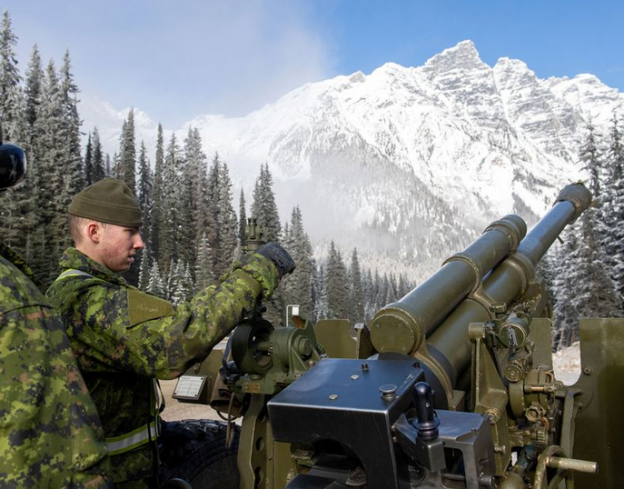
Rogers Pass avalanche bombing involves artillery soldiers who are stationed in Rogers Pass in winter. They use a howitzer to fire shells into loaded avalanche paths along the highway.
“Our goal is to bring down as much snow as we can and bring the hazard down to a point where it’s safe to open the highway,” said Jim Phillips, acting avalanche operations coordinator for Parks Canada.
The Rogers Pass program has been running since the highway opened in 1961. Before that, and before they built their tunnel, CP trains ran a high risk of deadly snow slides. One killed 62 railway workers in 1910.
So far this winter the team has fired 333 howitzer rounds, produced 197 controlled avalanches and closed the highway for 43 hours over seven separate days.
Helicopter Avalanche Bombing
Phillips said his team also uses heli-bombing and remote-trigger systems to set off detonations, and spends C$600,000 ($480,346) a year on explosives alone.
“It’s a balancing act. You want to keep traffic moving and minimize closures, but also minimize risk to people using the transportation corridor,” he added.
Avalanche control is typically needed until late April or early May.
November 22, 2019. MCpl PJ Letourneau/Canadian Forces. Avalanche bombing in Rogers Pass.
The Sierra Avalanche Center (SAC) is not a typical public service found in just any town. Although the Forest Service does have many such centers throughout the western US.
Nearly every day of the winter paid public forecasters grab their gear and head to the mountains for a day of skiing.
Sierra Avalanche Center Board of Directors President James Brown was once buried by an avalanche himself while ski touring in Canada. The snowpack conditions there are much different and more complex than in the Sierra.
A couple of forest service employees established SAC in 2004. Brandon Schwartz now works as the lead forecaster as a Forest Service employee.
The priority and purpose of SAC is to produce the avalanche forecast every winter morning, which includes two basic components. The avalanche danger — low, moderate, considerable, high, or extreme — and then what avalanche problem or problems backcountry users are likely to encounter that day.
The forecasters’ jobs are to assess avalanche hazards by traveling through the snow-covered backcountry.
Brown stated that SAC has come a long way since its first inception, when those who wanted the forecast would have to call a number. These days, backcountry users can get a quick glimpse of the forecast by following SAC on Instagram, Facebook, or Twitter, or by visiting their website to view the full and in-depth avalanche forecast.
“The avalanche community in general has come a really long way from making avalanche decisions based on colloquialisms …” Brown said. “… people used to say, as long as you don’t ski 24 hours after a storm, you’re OK. There is a certain grain of truth to that, especially in the Sierra, but that’s obviously not a good decision-making tool.”
In order to fund themselves the Forest Service Sierra Avalanche Center holds regular events and seeks donations.
Those interesting in supporting the US Forest Service avalanche center can donate, or attend events held in support of the avalanche center, such as a clinic being held 6 to 9 p.m. Dec. 17 at Palisades Tahoe. The event will host influential skiers and snowboarders in the community — such as Michelle Parker, Jeremy Jones, and Elyse Saugstad — who will be speaking about avalanche safety. Donations will be accepted.
December 8, 2021
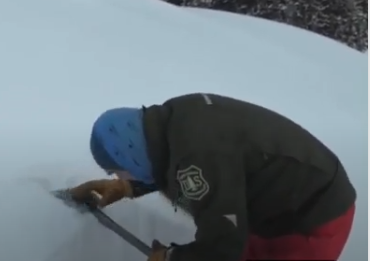
A Forest Service forecaster takes a break from a day of skiing to examine the snow.
WATERTON PARK, AB – A Waterton townsite avalanche resulted in a close call in Waterton Lakes National Park in Canada.
This past weekend a class-4 avalanche roared down Bertha Peak. Which is just outside the small resort community.
The avalanche dumped 10 metres of debris on the Bertha Falls trail and stopped just ahead of Evergreen Avenue South. Entry to the town using that street past Cameron Falls is not recommended due to the risk of further avalanches.
Additionally, the Akamina Parkway is closed until further notice. Pedestrian access on Akamina and Red Rock parkways remains open. The parkway will reopen to vehicles when conditions improve.
Fortunately, no injuries were reported, and no structures were damaged. The risk of avalanches, and another townsite avalanche, has increased significantly in the park. This is due to large snow falls, extreme wind gusts and rising temperatures.
Swiss avalanche deaths are up this season. Significantly more people have been killed than the latest 20-year average. The majority of victims were off-piste skiers or snowboarders. The grim statistics come in a report by the Swiss Institute for Snow & Avalanche Research (SLF) and cover the period from 1st October 2020 to 30th March 2021.
27 people have died in avalanches and one person is still missing. The 20 year average is 18 Swiss avalanche deaths to the end of March. This shows an increase of 50%.
“All of the victims were winter sports enthusiasts in unsecured terrain,” the report states. 11 were backcountry ski touring or hiking and 16 were off-piste skiing or snowboarding.
Two people died in one accident, but for all other accidents, one person died.
The 4 Valleys area, which includes Verbier, was the worst hit with seven (26%) of the season’s avalanche deaths recorded there. One fatal accident was recorded in the Swiss Jura, where such incidents are very rare, with the last one dating back to 1991.
Overall 318 avalanches causing damage – material and bodily injury – were reported to the SLF Institute. Of these, 215 were triggered by people, rather than spontaneous slides, with 296 people being caught in them. The 20-year average for triggered avalanches is 113.
The 20-year average for the number of people caught is 177, meaning this winter roughly two-thirds more people were involved in some way.
There were also spontaneous slides, most of them in mid-December and late January.
Possible Reasons
Fragile old snow
Layers of metamorphosed snow close to the ground and weak layers in the centre of the snowpack. Most serious accidents had this cause, including the eight fatal avalanches from 15th to 18th January.
Abundant fresh snow
From December until the beginning of February and again in mid-March, the situation was critical for weeks because of a several episodes of snowfall. Constant snow and the formation of layers of windblown snow added to the problem of the old snow layer.
Large avalanches
The slides triggered in old snow were often large and sometimes very large.
Increase in off-piste accidents
More than half the fatal accidents were in the off-piste area. In multi-year statistics, there are more fatalities among backcountry tourers or hikers.
Five of the fatal avalanches happened when the avalanche risk was at level 4 (on a scale of 1 to 5).
The report also says there were slightly more accidents than average at the weekend, especially Saturdays, when more people are usually on the mountains.
“It is not known whether the coronavirus pandemic has an influence on mountain attendance date and the risky behavior of winter sports enthusiasts,” it says.
An unusually high number of avalanches in Iceland have fallen across East Iceland, North Iceland, and the Westfjords in mid-January. This is from the Icelandic Met Office. There were 133 reports of avalanches in Iceland in 10 days. But the true number is likely higher. The Civil Protection Department has declared an uncertainty phase in the North Westfjords. And also North and East Iceland. Because the risk continues.
Westfjords, Northeast Iceland, and Eastfjords
Most of the 133 reports were from the Westfjords (52) and Northeast Iceland (41). The third-highest number were reported in the Eastfjords (24). “It is clear that many more avalanches have occurred without being recorded. Many fall off the beaten track, others occur without being seen, and not all avalanches are reported.” Of course heavy snowfall is the cause. The snow blanketing the slopes is considered unstable. However, the office reports that some avalanches have fallen in still weather.
Roads Closed
Avalanches in Iceland have fallen on several roads across the country. Causing closures while snow is cleared. The Road and Coastal Administration notifies travelers of road closures across the country. The Met Office reports on avalanche risk.
No people have been injured as a result of the events. Though one recent avalanche in Skagafjörður killed at least three horses and destroyed a shed. One avalanche on the Skarðsdalur skiing grounds in North Iceland caused significant damage to the facilities. A third near Eskifjörður, East Iceland, damaged a shooting range and may have damaged facilities in the area as well.
Avalanches in Iceland are nothing new. There were catastrophic avalanches in the villages Súðavík and Flateyri in 1995. Which killed 34 people and caused extensive economic damage. Those avalanches made it clear that a substantial number of people in several Icelandic towns and villages live in areas where avalanche risk is unacceptable.
During the past week backcountry skiers have triggered more than 10 avalanches in the San Juan Mountains of Colorado. Although nobody was seriously injured there have been some dangerous close calls.
There were six reports of skier-triggered San Juan avalanches in the Wolf Creek Pass area. And another five in the western San Juan Mountains. That’s just from reports people submitted to the CAIC.
On Monday a party of skiers near Wolf Creek Pass was caught in a relatively small avalanche that went up to the skiers’ knees. No one was injured.
On Tuesday near Wolf Creek Pass a skier was “knocked over and partially buried, head and one arm and ski out.” Another skier had to help the person extricate.
“No injuries or broken gear, so we were thankful for the somewhat gentle reminder that accidents can happen anywhere and it’s good to have partners that can rescue you in case of one,” the person who wrote the report said.
Skier caught in two avalanches
The skier was caught and carried about 100 to 130 feet and deployed an airbag. They were “pushed and knocked around but able to stay upright.”
The skier then came to a stop and got the airbag operational again. Attempting to ski down, the skier was caught in a second avalanche. They were carried another 100 to 130 feet and deployed the airbag again.
“Similar to (the first) slide … skier was caught, carried and knocked around but able to ski to right of deposition path just before being carried into trees,” according to the report.
Avalanche danger remains a concern across the state
A San Juan avalanche
People triggered at least 12 avalanches just on Thursday.
“Our current weak and dangerous snowpack persists,” the CAIC wrote. “There is potential for avalanches to be exceptionally fatal this winter in Colorado.”
The snowpack has not been this unstable and weak since 2012, Ethan Greene, CAIC executive director, said in a previous interview.
The unstable snowpack is a result of early season snow in October and dry weather for weeks in November, causing the snowpack to become weak. Then, additional snow on top of that weak layer causes avalanches.
“How weak the snowpack gets depends on how the fall unfolds,” Greene said previously. “This particular year, the underlying snowpack is really weak.”
So far this winter season, four people have died in avalanches.
According to the CAIC, avalanche danger on Friday in the southern San Juan Mountains is listed as “considerable.”
“Avalanche conditions are slowly easing, but many slopes remain dangerous,” the report said. “Without a new load, you may not see natural avalanche activity, but many slopes are very weak and just waiting for a trigger.”
Skiers activities that often lead them to backcountry locations with limited services. Monday morning (12/28) Forest Service avalanche experts warned of possible avalanche activity when visiting these areas. They recommend doing some avalanche testing before using steep slopes.
“We have a block of harder snow over a section of weak sugary facets of the ground, so we have something over nothing,” said Dave Zinn, avalanche expert. “This is the recipe for an avalanche, all you need now is a steep slope and a trigger.”
Triggers can be caused either by nature — rain, snow, sun, wind — or by human activity.
“The danger is moderate, but it’s sort of that scary moderate because human triggered avalanches remain possible,” said Zinn. “If we trigger them, they could be large — and definitely big enough to injure, bury or kill an individual.”
“Really watch out for those signs of instability — like shooting cracks. Do some avalanche testing – dig stability tests, do an extended column test, see if you get stable results,” said Zinn. “And if you don’t see (stable results), find a different slope.”
Previous reports from 2017 to 2019 showed six-of-ten accidents occurred in January and February. Five of which, resulted in a death. It is not listed what caused these avalanches were deaths occurred but leads experts to continue to urge people to test they go.