Tag Archives: avalanche

Silverton Avalanche School dropped from lawsuit

It appears that Silverton Avalanche School was dropped from the lawsuit by the Marshall family, along with their guide. Neither party has commented so a settlement amount was most likely agreed on.

The family of Peter Marshall, who died in an avalanche during an AIARE advanced avalanche safety class with the Silverton Avalanche School, has dropped the school and teacher from their lawsuit. It appears that a settlement was reached. A complaint remains open against Backcountry Access, their owner K2 Sports, and K2 owner Kohlberg & Company.

Settlement Reached with Silverton Avalanche School?

Two years after the death Marshall’s wife and daughter sued San Juan Search and Rescue, the Silverton Avalanche School and the school’s guide, Zachary Lovell, in a wrongful death lawsuit. Last month the family dropped its claims against the county, school and guide. Attorneys for the Marshall family have not returned calls or responded to emails and representatives from the county and school declined to comment, indicating a settlement amount was most likely agreed upon.

The Fatal Avalanche Accident and the Allegations

The family had argued that the school and guide had misled Marshall into taking the class by “falsely presenting” that school staff “possessed deep operational experience in avalanche terrain.” The family also claimed the school and guide displayed gross negligence.

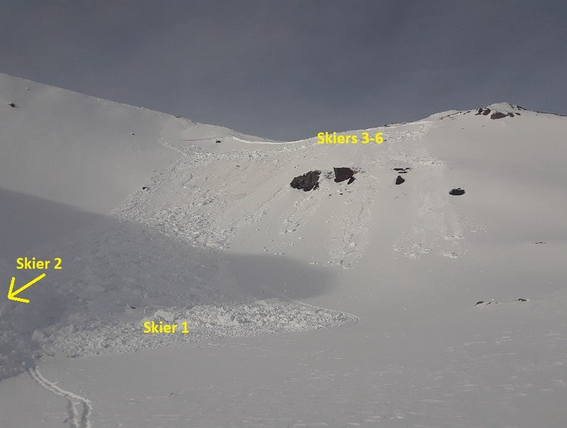
Marshall had been participating in the Silverton Avalanche School Level 2 American Institute for Avalanche Research and Education (AIARE) class on Jan. 5, 2019. He was swept down a slope in an avalanche that caught five other skiers. Four were not buried. Another was buried but was able to extricate himself. When the skiers freed Marshall from the debris, he was not breathing.

The Colorado Avalanche Information Center (CAIC) report pointed to several mistakes during the advanced class, including a group of skiers gathered on a slope steep enough to slide, those skiers misjudging the steepness of that slope and a failure to recognize clear avalanche hazards. The guide triggered the first avalanche, which swept the whole group down the slope. A second avalanche buried Marshall under several feet of snow.

Remaining Complaint Against Backcountry Access and K2 Sports

The family of the 40-year-old Longmont skier is still suing K2 Sports and its subsidiary Backcountry Access, which makes an air bag backpack that was not deployed when rescuers found Marshall buried in more than 8 feet of avalanche debris. “Peter Marshall attempted to trigger his Float 32 avalanche air bag system but it did not fully deploy or inflate,” according to the complaint filed in Boulder District Court.

Marshall’s Backcountry Access Float 32 pack was not inflated. Colorado Avalanche Information Center investigators said in their report that the air bag backpack “was functioning properly,” with “the trigger out of the pack strap, but the bag was not deployed.”

K2 Sports, owned by private equity firm Kohlberg & Company, denied the allegations in a response filed this month. The K2 lawyers cited 16 facts they believe eliminate liability in their motion to dismiss the case. 

Previous Float Pack Problems

The complaint notes that Backcountry Access recalled “substantially similar” Float packs due to a problem that could lead to a failure to deploy. The U.S. Consumer Products Safety Commission reported the recall of 8,200 Float 18 packs on Nov. 26, 2013. They warned that the trigger assembly can fail “resulting in the air bag not deploying, posing a risk of death and injury in the event of an avalanche.”

The complaint by the Marshall family argues Backcountry Access “should have known insufficient changes were made to the design of avalanche air bags manufactured after the recall to prevent such failures.” The lawsuit argues that Backcountry Access should have been aware of “safer alternative designs,” such as a remote or automatic triggering or inflation system.

Another skier in the group was wearing an avalanche air bag and attempted to use it when he was swept off his feet. It also failed to inflate. “Later, he determined that he assembled the trigger mechanism incorrectly,” reads the CAIC report. It did not identify the brand of air bag used by that skier.

A 2014 study showed 60% of avalanche accidents involving skiers with un-inflated air bags were because the skier never pulled the trigger. That study also showed 12% of so-called non-inflation incidents were due to user error, including assembling the trigger mechanism incorrectly.

Site of fatal avalanche. During a Level 2 AIARE course held by Silverton Avalanche School.
Site of the fatal avalanche during a Level 2 AIARE course behind the lawsuit against Silverton Avalanche School (settled) and Backcountry Access.

Crystal Mountain avalanche fatality – first of the 2021/22 season

Crystal Mountain avalanche fatality reported

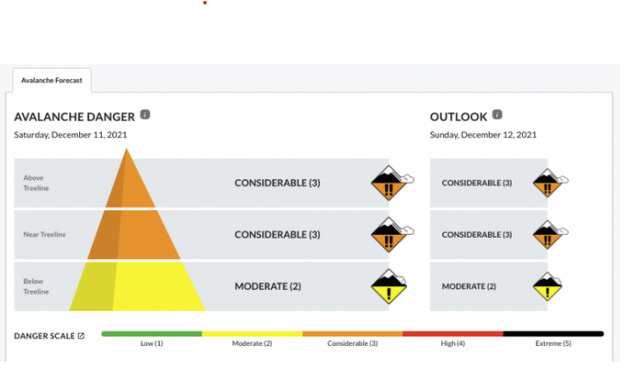
According to the US Forest Service, a skier was killed in an avalanche Saturday, December 11, in Silver Basin, a closed area of Crystal Mountain, Washington, that ski patrol had not mitigated for avalanche hazard. Six skiers from the same party were caught in the slide. The Pierce County Medical Examiner’s Office has identified the deceased as Robert “Bob” Weisel, 66, of Issaquah, Washington. This is the U.S.’s first avalanche fatality of the 2021/22 season.

After a long dry spell that has plagued much of the continental United States this winter, Crystal Mountain reported receiving 12 inches of snow in 24 hours with winds up to 100 mph at the summit Saturday. The Friday evening advisory rated the avalanche hazard as considerable near and above tree line. “Look for storm slabs to develop on Saturday at all elevation bands as the West South is targeted by a potent winter storm,” it warned. It reported of the newly forming storm slab, which was resting atop another recent storm layer and a crust from late November. They advised those entering the backcountry to “choose conservative terrain and realize that early season conditions still exist.”

Silver Basin, where the fatality occurred, is a north- through east-facing slope at approximately 6,500 feet that is marked as a black diamond when open. According to a preliminary report, the six individuals were traveling uphill when they triggered a large avalanche. Another party of two in the area that witnessed the avalanche reported it to Crystal Mountain Ski Patrol at 10:50 a.m. and assisted in the rescue. Four skiers were partially or fully buried, three of whom were successfully recovered. The fourth skier was found unconscious and did not respond to resuscitation efforts. All skiers involved were carrying avalanche equipment and several had taken a recent avalanche course.

A statement from Crystal Mountain following the fatality read, “As snow continues to fall, Crystal Mountain Ski Patrol reminds backcountry skiers to research uphill travel policies and check the avalanche forecasts before heading into the backcountry.”

Alaska avalanche survivor meets and thanks Arctic Guardian rescue team

A week from graduating high school, Alaska avalanche survivor Peter Schutt was physically on top of the world as he climbed Donoho Peak near the Alaska/Canada border.

Unfortunately, Schutt’s adventure took a dangerous turn when an avalanche struck. Snow that was once a fixture on the frigid face of the mountain suddenly cut loose and turned into a freight train of cold, sugary crystals stampeding in rapid, unstoppable motion.

The avalanche pitched him over a 75-foot cliff on his tumble down 2,500 feet of the jagged mountain face. He remembers covering his head as best he could to prevent further injury.

After the avalanche Schutt’s friend and partner made his way down, contacted National Park Service via cell phone and provided cell phone GPS coordinates to aid the rescue response.

Alaska Air National Guardsmen of the 176th Wing partnered with multiple civil search and rescue partners to rescue Schutt during the May 26, 2021, ordeal.

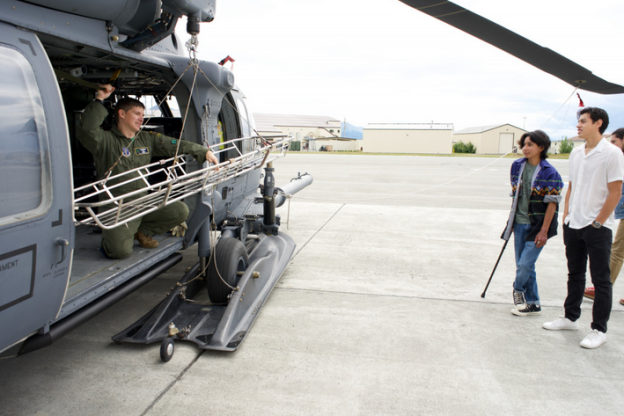
Following weeks of recovery, Alaska avalanche survivor Schutt, with several family members, visited the 176th Wing July 9 to share his story, tour the aircraft involved in the rescue, and thank his rescuers.

Following Schutt’s fall, National Park Service contacted the Alaska Rescue Coordination Center at 6:20 p.m. to notify them of the incident and request a hoist-capable aircraft be on standby. Snow conditions and steep terrain on Donoho made it impossible for the National Park Service A-Star helicopter to reach the injured hiker, and at 8:05 p.m. the NPS requested Air National Guard sup-port.

“The patient lost footing and rolled hundreds of feet down a snow-covered slope near Donoho Peak in Wrangell-St. Elias National Park and Preserve,” said NPS Ranger and incident commander Stephens Harper. “The fall triggered a snow slide, which then carried the patient over a cliff into a ravine.”

Schutt’s father, Aaron, was boarding a plane bound for Minnesota when he got the phone call no parent wants to receive. He was told the fall was “not a survivable incident.”

“Which is what you don’t want to hear as a parent,” he recalled.

Wrangell Mountain Air, a private charter company, spotted Schutt, confirmed his location, and re-layed GPS coordinates to the National Park Service who then relayed the information to the AK RCC.

With coordinates in hand, the AK RCC contacted the 176th Wing who dispatched a 210th Rescue Squadron HH-60G Pave Hawk helicopter, a 211th Rescue Squadron HC-130J Combat King II and a 212th Rescue Squadron Guardian Angel team comprising pararescue personnel (PJs).

First responders from Kennicott Wilderness Guides, who are also Wrangell-St. Elias National Park and Preserve Search and Rescue Team members, hiked a couple of miles to the ravine. They pro-vided emergency medical care while on the phone with the National Park Service Alaska Region medical director who is also an emergency room physician for Alaska Regional Hospital.

The NPS helicopter flew to the area but was unable to land safely, so they air-dropped medical supplies to the first responders and notified Harper of the need for a hoist and litter to safely move the patient off of the mountain.

The danger on the mountain didn’t dissolve when help arrived.

“While on the phone with [the doctor], they heard the snow shifting above them and moved the patient to higher ground before a second snow slide traveled down the ravine,” Harper said.

Maj. Ben Leonard, 210th RQS HH-60 rescue pilot, said the crew was training for the week at Eielson Air Force Base, about 300 miles north of their home base of Joint Base Elmendorf-Richardson. Leonard said the training proved helpful during the real-world rescue after Master Sgt. Tim Ching, HH-60 special missions aviator, completed 23 simulated hoists during four hours of training.

“In particular that week, we had done a ton of hoist training, especially high-angle hoist training, which is the scenario you ended up in later that week.,” he said. “In the days prior, we had flown a lot as a crew, and Tim had done what I would call a record number of live hoists in very challeng-ing scenarios with the PJs.”

Once on-scene, the Air National Guard pararescue team of Senior Master Sgt. Bryan Dalere and Sen-ior Airman Nathan Graber hoisted down to Schutt’s location where they provided additional medi-cal support and stabilized him for hoist to the helicopter. Looking through the window, HH-60 res-cue pilot Maj. Jake Ring said he marveled at the cliff fall Schutt survived.

“I remember looking up and thinking that has to be at least 80 feet,” he said.

The Pave Hawk crew transported Alaska avalanche survivor Schutt to the McCarthy Airport where he was transloaded to a Guardian Flight AirMedCare air ambulance and taken to Alaska Regional Hospital in Anchorage.

This rescue involved coordination between multiple agencies, including the 176th Wing, Alaska Air National Guard, Wrangell St. Elias National Park and Preserve Search and Rescue Team, National Park Service Fire Management in Fairbanks, National Park Service A-Star Helicopter, Wrangell Mountain Air, Guardian Flight, and Kennicott Wilderness Guides.

“It was the people, including Peter, with his will to live,” Aaron said in crediting the save. “His friend who was with him called for help immediately, and they got down to him within an hour and did all the right things on the ice – kept him as comfortable as possible, kept him alert, and continued to talk to his mother.”

During the July 9 visit, Schutt’s family toured a 211th RQS HC-130 as well as the HH-60 that res-cued him. Maj. Stephen Ludwig, 176th Wing Exercise and Planning officer and Combat King pilot, coordinated the event and gave Schutt a detailed rundown of the HC-130 flight deck.

“It’s always great, working in the RCC and working here, having survivors come back and share their stories, and to put a face to [a rescue,]” Ludwig said.

After recalling the events of May 26, Aaron expressed his appreciation of the multi-agency team that rescued his son.

“We’re just very thankful to all of you and what you do on a daily basis.,” he said.

Alaska avalanche survivor meets and thanks Arctic Guardian rescue team

Avalanche trapped bikers on Going-to-the-Sun Road in Glacier Park

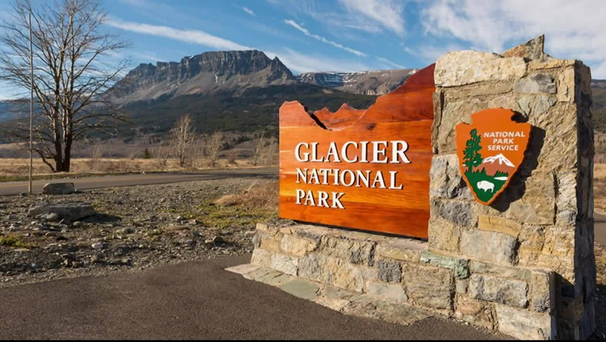
An avalanche trapped bikers on Thursday, May 13. At about 6:30 pm Glacier National Park rangers responded to a report of three bikers who were trapped behind an avalanche near Triple Arches on Going-to-the-Sun Road.

Three bikers – a husband and wife along with a friend – traveling up the road encountered an avalanche across the road, turned around, and started back down. Soon after, they encountered a second avalanche in progress. The wife was ahead of her husband and friend and heard the avalanche. She warned her husband and friend to stop. The avalanche came down between them. So the avalanche trapped bikers – the woman’s husband and friend – on the uphill side.

The wife biked down to call for help. A ranger arrived at the site of the avalanche around 7:30 pm.

Afternoon sun and warming were to blame

“The sudden onset of sunny and warm weather on Thursday afternoon, combined with recent new snow from the previous weekend, created unstable surface snow conditions,” said USGS scientist Erich Peitzsch. “These conditions resulted in a wet, loose avalanche originating above the road in Triple Arches that deposited debris on the road.”

Park officials determined that they would wait until the sun was off the slope above, decreasing the chances for further slides, before starting rescue attempts.

Rescue began around 9:30 pm. Rangers belayed across the avalanche chute and belayed the bikers individually back across the chute. No injuries were sustained by the bikers; all three are from Bigfork.

Going-to-the-Sun Road is currently closed to vehicles at Avalanche Creek until the road opens to Logan Pass for the season. Due to continued avalanche conditions, hiker/biker access is currently not permitted past the Loop. Check the park website for updates.

Park officials remind visitors that snow can avalanche above Going-to-the-Sun Road in active avalanche terrain that often cannot be seen from the road. Avalanches are more likely to occur before or after sunny/warm weather, rainstorms, or snowstorms. Visitors are encouraged to start and finish their trip before the warmest part of the day. Do not stop under gullies or snowfields and turn around if there is a rapid increase in temperature.

An avalanche trapped bikers on Going-to-Sun Road in Glacier Park

Aleutian Avalanche blasts 3 climbers down Mt Neacola

An Aleutian avalanche woke three climbers on Easter morning. They found they were tumbling down the Neacola Mountains in Southwest Alaska. Their tents were propelled down Mount Neacola in Lake Clark National Park and Preserve by an air blast from an avalanche above them.

The climbers had set up camp several days earlier. They were waiting for the weather to improve. The group planned to attempt to climb the roughly 9,350-foot Neacoloa peak via the north face. A route that has never been successfully climbed, according to the American Alpine Club. It has stymied mountaineers like the legendary Fred Beckey.

The climbers received a grant from the American Alpine Club to fund the north face attempt. The three have more than a decade of experience. Two work as avalanche instructors. They work together as climbing guides in New Hampshire. The team had traveled to Alaska planning to spend about 3 1/2 weeks on the mountain. They returned home to New Hampshire on Thursday but are keeping an eye on Alaska weather in hopes that conditions in the Neacola Mountains will improve enough in the next few weeks that they can return.

Amplified Aleutian Avalanche Risk

Heavy snowfall and high winds in recent weeks had amplified avalanche risk in areas of Lake Clark National Park that are normally not affected.

⚠️Safety alert! ⚠️ Field staff are reporting significant avalanche activity in the park. Please remain observant,...Posted by Lake Clark National Park & Preserve on Friday, April 2, 2021

Caught in Their Sleep

Just before 4:30 a.m. one of them woke up pressed against the front wall of his tent as it started to flip. “The immediate first thought was, oh no, I’m getting buried in an avalanche,” he said.

When the tents came to a rest roughly 300 feet away they were on top of the debris.

The men called out to one another and realized they were all safe.

One climber hit his head during the fall but the men were otherwise uninjured.

The three managed to prop one of their tents back up and sheltered until dawn.

Salvaged Food Supplies

When daylight broke, they worked their way around the glacier, hunting for the remainder of their food. They didn’t know how long they might be waiting, but it was clear that the weather was not going to improve enough for a plane to fly in that day.

The climbers estimated it would take six days total to climb the 4,500-foot north face. They managed to find enough food to feed them comfortably for a week.

Lucky Conditions for Flying Out

They messaged Doug Brewer, the pilot who had flown them into the range, on their InReach devices. He agreed to pick them up as soon as it was safe.

Brewer has been flying in the Neacola Mountains for decades and described the range as breathtaking but requiring a technically challenging flight through a narrow canyon around the incredibly steep Mount Neacola. He said there’s a limited window of time each day with enough light on the glacier to safely navigate, and only during low winds.

The Neacola Mountains are visited infrequently, even by climbers, said a spokeswoman for Lake Clark National Park. That’s partly because tackling the rugged terrain requires extreme skill, but also because the mountains — located in the northern portion of the national park — are in such a remote area.

This mountain range is relatively newly named. The first recorded climbers explored the area in the 1960s but it took several more decades for another set of climbers to publish findings.

The climbers were nervous staying in the aleutian avalanche area, but there didn’t seem be safer options. So they waited.

Blizzard conditions continued for much of Monday, but by Tuesday the skies were clearer.

The climbers attempted to stomp out a runway and Brewer and his son flew in, making an uphill landing on the glacier in their ski-equipped planes. The landing was rough because avalanche debris had obscured the runway area, Brewer said.

“It was still cold, probably zero, and it was a down-glacier wind about 15-20, so this was right on the edge of being able to get them out safely,” he said.

The climbers helped stomp out additional chunks of debris on the makeshift runway and turn the planes around.

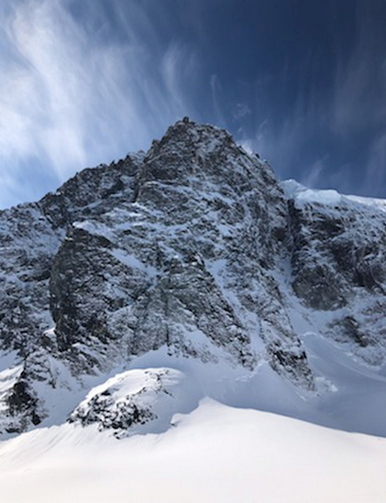
Mt Neacola north face. Camp below east face hit by an aleutian avalanche.
Mt Neacola North Face

Hatcher Pass Avalanche – Road Reopened – Alaska DOT

A Hatcher Pass avalanche blocked the road but it reopened just before 4 p.m. Friday

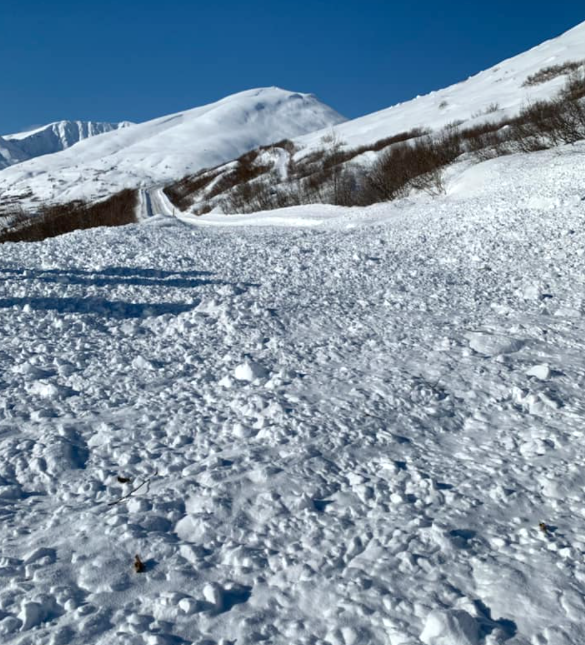
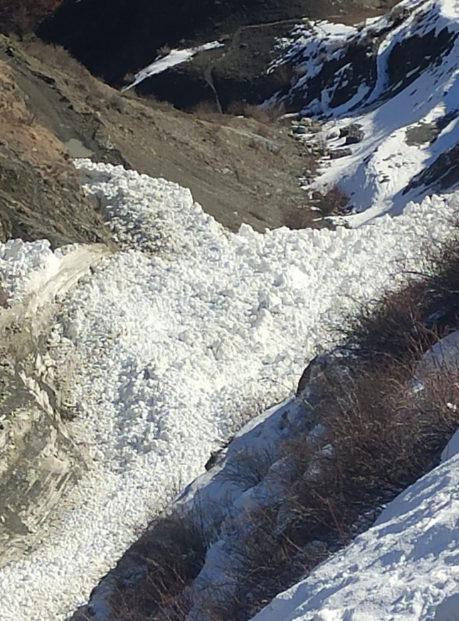
A large, remotely triggered Hatcher Pass avalanche covered the road around 12 p.m. on Friday. Hatcher Pass Avalanche Center posted photos of the avalanche. They said that the road would likely be closed at the Gold Mint parking lot. The avalanche did not involve any people.

Increased Avalanche Danger had been predicted

On March 25, the HPAC warned of an increased avalanche danger due to nearly a foot of new snow. Persistent slabs and storm slabs were likely problems. Later that day three observations of small avalanches were reported.

“No one was caught or carried it was people skinning on the standard Marmot uptrack and triggered a smaller avalanche and then it stepped down to the deeper layers in the snowpack” said HPAC Board Chair Andy Dennis.

Road Cleared of Avalanche Debris

The Department of Transportation and State Parks were alerted to clear the road. It was closed at the turn near the Gold Mint parking lot. Throughout the winter numerous skiers have been caught in small avalanches. Nobody has been buried and there have been no fatalities in Hatcher Pass. Palmer Fire and Rescue did assist other agencies in a rescue in Hatcher Pass on March 21.

“As we come into spring I think we have a tricky snowpack, so any new load is potentially going to awaken the persistent slab problem. These cold temperatures have not allowed the snowpack to heal at all and really just trying to make sure people are heads up coming into the longer, warmer days. It’s going to be A little bit delayed in terms of kind of the snowpack stabilizing,” said Dennis. “We’ve got a couple crust layers that are going to, what we’re thinking is most likely going to prohibit fast healing.”

The avalanche occurred just after 12 p.m. and the road was cleared at around 6 p.m.

Hatcher Pass Avalanche on road
Hatcher Pass Avalanche blocks road

Snow avalanche blocked road: Triloknath-Udaipur link road

Snow avalanche blocked the road Triloknath-Udaipur link near Shakoli village in tribal Lahaul-Spiti district today. The snow avalanche was triggered during the day, which brought the traffic movement on this road to a complete halt.

Heaps of snow covered the vast stretch of the road though no loss of life and property was reported.

Deputy Commissioner Lahaul Spiti Pankaj Rai said workforce and machinery have been deployed in the area to restore this link road for movement of vehicles.

As weather is getting warmer in the region, the incidents of snow avalanches were occurring frequently in Lahaul-Spiti. A few days ago snow avalanches were triggered at Karpat and Lobar under Udaipur sub division in the district.

A snow avalanche blocked the road
A Snow avalanche blocked the road Triloknath-Udaipur link

North Caucasus Avalanche – Up To 12 People Feared Buried

A North Caucasus avalanche struck a skiing area in the region of Karachai-Cherkessia. Russian authorities say as many as 12 people may have been buried under snow.

Russia’s Emergency Ministry said on January 18 that the avalanche hit the area around the resort town of Dombai. On Mussa-Achitara mountain at around 1:30 p.m. local time.

Rescue work to locate and extract those trapped by the avalanche is under way.

The wall of snow buried two ski equipment rental stands and damaged a cafe.

Dombai is a popular skiing resort in the North Caucasus.

A North Caucasus avalanche struck a skiing area in the  region of Karachai-Cherkessia
On the scene at an avalanche in the North Caucasus

Snowboarder caught in avalanche carried 1,000 feet, deployed airbag

Maurice Kervin has spent 65 days snowboarding so far this season. Friday is a day he won’t forget. On that day the snowboarder was caught in an avalanche.

“Friday was beautiful. It was golden. We had actually been planning all week to ski this line,” he said.

Recent AIARE Course

Kervin had recently completed a Level 1 safety course through the American Institute for Avalanche Research and Education (AIARE).

All week he and his friends had been watching the avalanche forecast and felt conditions were improving.

“Everyone was actually really excited that the avalanche danger level had actually gone down,” said Kervin. He wasn’t as sure about the forecast, adding, “I was very concerned. I was like, ‘I don’t know guys.'”

Nervous about the day

Kervin and his riding partner hiked toward a spot called No Name near Loveland Pass. They continued to check conditions on their way. And they tested patches of snow for stability. Although the results didn’t show any signs of instability he felt nervous before dropping in.

“I remember telling my buddy ‘I don’t know man. I’m kind of nervous about this run, and if it goes it’s probably going to go big,'” said Kervin.

Kervin think he made it a third of the way down when everything changed. Then the snowboarder was caught in the avalanche.

Caught in an Avalanche

“I cut into a thin patch of snow in some cliff bands. At that point it released below me and the whole slab started to go underneath me. I looked up and around and I saw the snow start coming down from above,” said Kervin.

The avalanche happened quickly and swept him off his feet.

“I definitely wasn’t in control at all, the avalanche was in control. I never had a doubt in my mind that I was going to get buried. My biggest concern was that I was going to hurt myself in some way and make it difficult getting off the mountain,” said Kervin.

He deployed the avalanche airbag in his backpack.

“So I freed my hands, I pulled the bag and I started to do backstroke and kick my feet up to stay on top of the snow, basically just to make myself as big and less dense as possible,” said Kervin.

Kervin was carried about 1,000 feet before he came to a stop on the snow surface. In his video you can hear his air bag fill up. Then seconds later his board hits a large rock where he went over a cliff.

“I was very calm through the whole thing. I think that’s very important thing to be in such a situation. Often times when people panic they make poor decisions or don’t make any decisions at all,” said Kervin.

Role of Training and an Airbag

He made it out with only a dislocated finger. He’s been skiing and riding in the backcountry for about 10 years and completed a Level 1 safety course through AIARE. Despite that, he did not avoid the recognized risk. But Kervin believes the airbag and his training likely saved his life. “I knew what we were doing, and the possibilities that I had feared came true,” said Kervin. He called 911 to report the avalanche but did not require assistance from a rescue team.

He was skiing again the very next day but he wants his story to be an cautionary tale for others who might be venturing into the backcountry, some for the first time.

A snowboarder was caught in an avalanche.
Snowboarder caught in avalanche

Dutch Draw avalanche in Park City Utah – victim identified

PARK CITY — A Clinton, Utah man killed in a Dutch Draw avalanche in a popular backcountry area has been identified.

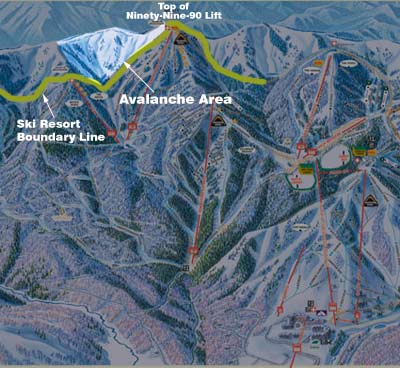
Kevin Jack Steuterman, 31, died Friday, while snowboarding in the Dutch Draw area. Which is just off the 9990 chairlift in the Canyons area of Park City Ski Resort.

“Our hearts break for the Steuterman family and friends. Hug your loved ones often and tell them you love them.” Summit County Sheriff Justin Martinez tweeted Monday while releasing Steuterman’s name.

No Rescue Gear

Steuterman was with his girlfriend around 10 a.m. when the avalanche occurred. According to the Utah Avalanche Center, Steuterman was buried under 2 feet of snow in a slide that was 150 feet wide and 400 feet long.

Steuterman was on a snowboard and his girlfriend was on skis. Neither was carrying avalanche rescue gear.

“At the top of Silver Peak the rider began a descent of a slope called Conehead. When the snowboarder was halfway down the slope, the skier started her descent. After making two turns, the avalanche broke at her feet. The snowboarder was still midway down the slope where he was caught, carried, and buried in the avalanche. The skier was not caught in the avalanche,” the center stated.

Search and Recovery

The Park City Mountain Ski Patrol, Utah Department of Public Safety helicopter, Park City Fire District and University of Utah AirMed helicopter all assisted the sheriff’s office in the search and recovery effort. Explosives were dropped from the DPS helicopter to trigger a second slide near the first one. In order to make sure the area was safe before rescuers got onto the mountain, according to the center.

Steuterman’s body was found about 2:30 p.m.

“His snowboard was still attached to one foot while his other foot had been pulled out of his boot,” the avalanche center stated.

Popular Area with a bad history

Dutch Draw is a popular area for snowboarders and skiers, but has also been the scene of several fatal avalanches, including December 15 2019, February 23, 2012, and January 15, 2005.

Dutch Draw Avalanche area in Park City, UT
Location of Dutch Draw avalanche