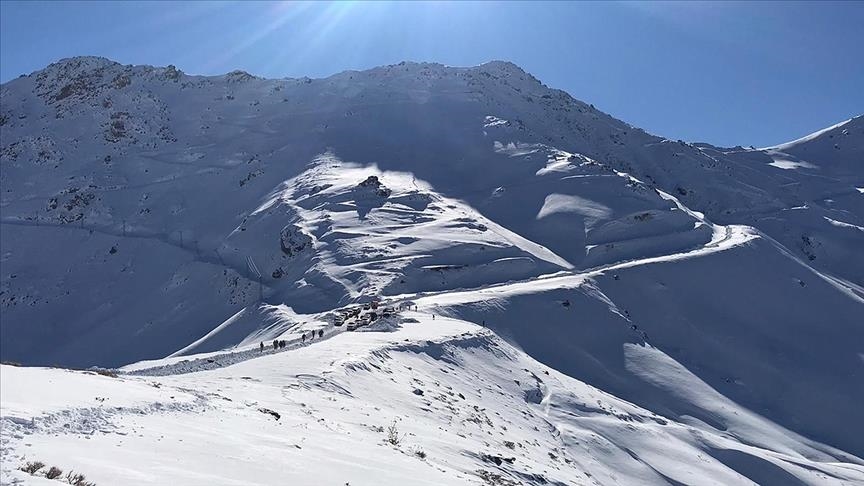
Three bodies were found by search and rescue teams after an arctic avalanche hit a ski resort in Siberia
The three victims are reportedly members of the same family. Their eldest son survived and was taken to hospital. Other buildings were struck, but the bad weather meant most were empty at the time.
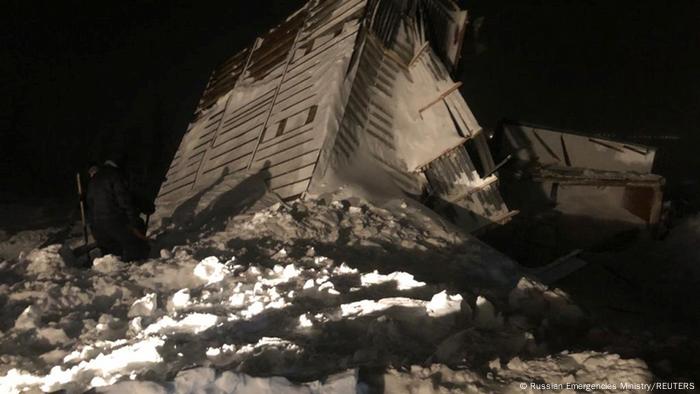
The scene after and arctic avalanche near Norilsk
A total of three people died in an avalanche that struck the Otdelnaya Gora ski resort in northern Russia overnight, investigators said on Saturday.
Authorities were notified at 00:30 a.m. local time (1730 UTC, Friday) of the avalanche near Norilsk — the world’s northernmost city.
Rescuers recovered the bodies of a 45-year-old man, named as Vladimir Popov, his 38-year-old partner and their 18-month-old child.
The couple’s eldest son, a 14-year-old boy, was found alive and “taken to the hospital with serious injuries,” including frostbite.
What do we know so far?
Between four and six huts at Otdelnaya Gora were buried by the snow, according to Russian media reports.
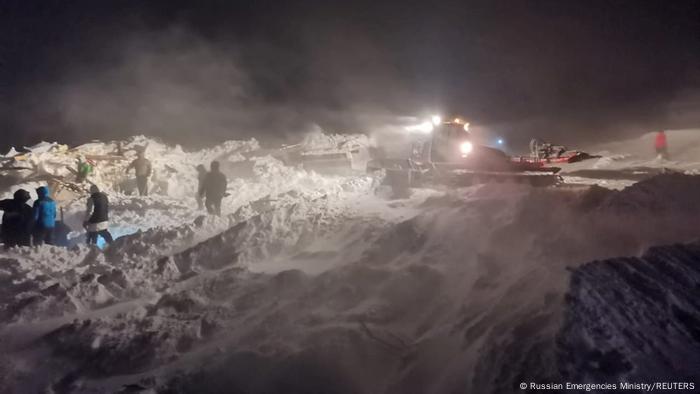
A search and rescue operation involving more than 200 people and 29 vehicles was launched.
Search operation after an avalanche near Norilsk in northern Siberia
On Saturday morning the emergencies ministry branch in Siberia’s Krasnoyarsk region, which includes Norilsk, announced via Instagram that all of the missing people had been found.
It said it was calling off the search and rescue mission.
Two people made their own way to safety, according to Russian media reports.
A 14-year-old boy was taken to hospital with severe injuries
Most buildings unoccupied
All of the buildings were unoccupied at the time of the avalanche except for one, reported news agency AFP, citing volunteer rescuer Maxim Inikhov.
“We have a very strong blizzard so there were very few people vacationing today at the ski resort,” Inikhov told Rossiya-24 television.
Two people walked out of the avalanche alive, reported Russian media
Risk of more arctic avalanches
Siberian Norilsk often experiences huge snowstorms, including blizzards last month where wind speeds reached up to 27 meters per second.
The emergency services has warned that there is a threat of further avalanches.
The regional department of the Investigative Committee of the Russian Federation opened a criminal case into deaths by negligence as a result of safety violations.
Heavy snowfall crippled normal life in tribal Lahaul and Spiti district today. An Atal Tunnel avalanche occurred on the Manali-Leh highway but no loss of life or property damage was reported.
Due to heavy snowfall in the region yesterday, the threat of snow avalanche had been looming on the Manali-Leh highway. Between the Solang valley and Keylong in the Lahaul valley.
100-m stretch hit
BRO officials said snow avalanche covered a 100-m stretch of road near the South portal of the tunnel.
The snow avalanche was 265 cm high, which has blocked the highway completely even for emergency vehicles between Manali and Keylong.
The BRO has pressed its workforce and machinery into service
Site of the Atal Tunnel Avalanche, Jan 2021
According to sources in the Border Roads Organisation (BRO), a snow avalanche has covered 100-metre stretch of the highway. It was near the South portal of the Atal tunnel on the Manali-Leh highway. (MSP-12). The snow avalanche was 265 cm high. It blocked the highway completely, even for emergency vehicles, between Manali and Keylong.
The BRO authorities have pressed into service its workforce and machinery to clear the highway for traffic movement.
According to the report of the District Disaster Management Authority, Lahaul and Spiti, 35.65 cm of fresh snowfall was reported at Sissu. At Jispa it was heavier at 38.01 cm. In Udaipur 10.16 cm of snow was reported during the day.
Due to the snowfall, traffic movement in Lahaul and Spiti came to a standstill. The residents of the Lahaul valley were cut off from the rest of the state after the road beyond the Solang valley towards Lahaul was blocked.
The Snow and Avalanche Study Establishment (SASE), Manali, has issued an avalanche alert for the coming days. As a result, the deputy commissioners of Kullu and Lahaul-Spiti have issued an advisory for common public to avoid venturing into snowbound areas.
The movement of tourists has been restricted towards the Solang valley from Manali beyond Nehru Kund.
Peter Marshall died in an avalanche during an avalanche safety class near Red Mountain Pass in 2019. In an avalanche lawsuit his family names the school, the guide, and Backcountry Access.
The slide swept six skiers down a slope. All of them were part of a Level 2 American Institute for Avalanche Research and Education (AIARE) class. Which was offered by the Silverton Avalanche School.
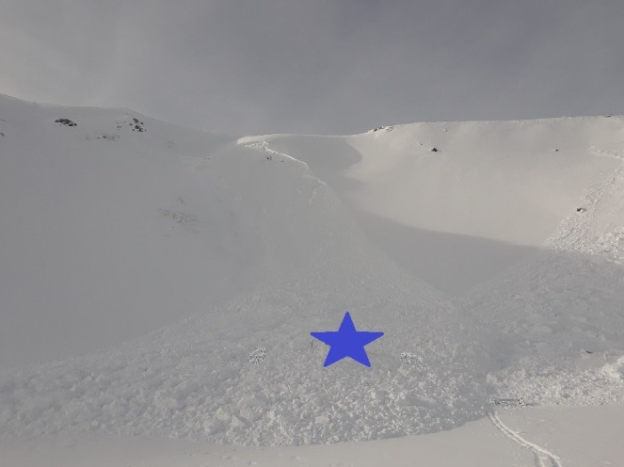
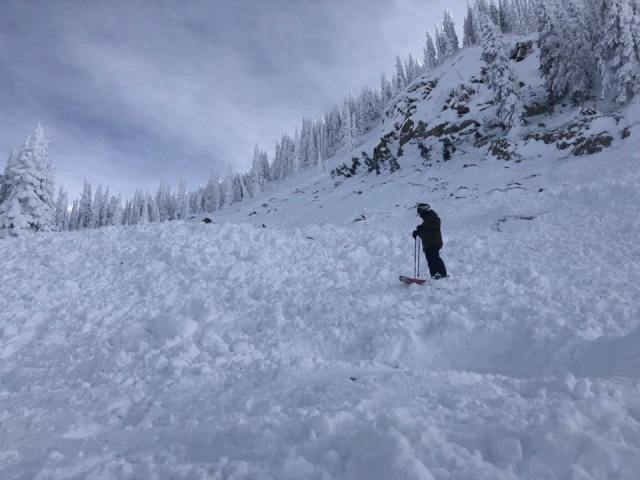
Site of the 2019 avalanche which caught six participants in an AIARE Level 2 avalanche class taught by Silverton Avalanche School.
The family is suing the guide, school and local rescue group. And also the maker of an avalanche airbag and its private equity firm owner. This lawsuit marks the second recent legal action involving avalanches based on reports by the Colorado Avalanche Information Center (CAIC).
Lawsuit defendants
The wrongful death lawsuit names Silverton Avalanche School, San Juan County Search and Rescue and guide Zachary Lovell. It alleges a litany of failures, fraud, misrepresentation, negligence and consumer protection law violations.
The lawsuit also charges Boulder-based Backcountry Access (BCA) with making a defective Float 32 avalanche airbag. It says the airbag did not inflate after Marshall “attempted to trigger” the balloon-like backpack. The lawsuit also names Kohlberg & Company, the private equity firm that acquired BCA and parent company K2 Sports.
“The defendants, each of them, acted willfully, wantonly, and recklessly, without regard for the consequences or the rights and safety of Peter Marshall or of others,” reads the lawsuit. It argues the school, guide and airbag maker “created substantial and unreasonable risks of serious injury and death to participants” in the avalanche class. “Defendants were grossly negligent and that gross negligence was a cause of the injuries, damages, and losses suffered by plaintiffs and the heirs of Peter Marshall.” The CAIC report noted several mistakes that led to the avalanche. The group was skiing together on a slope that was steep enough to avalanche. They misjudged the steepness, aspect and avalanche danger on the slope they skied. And they failed to recognize the potential for triggering avalanches on nearby slopes.
Allegations against the school and guide
The avalanche was triggered by the guide. It also caught Marshall and carried him to the bottom of the slope. A second avalanche on an adjacent slope buried Marshall in several feet of snow. Lovell and the students searched for Marshall. He was uncovered after 50 minutes.
The 2019 avalanche which caught six participants in an AIARE Level 2 avalanche class taught by Silverton Avalanche School. The original snow slide is off the edge on the right, the debris and star are where the second avalanche buried and killed a student.
In the 12 days before the slide, the avalanche center logged 72 avalanches in the North San Juans and noted “considerable” danger. The lawsuit says Silverton Avalanche School staff and instructors agreed not to travel in avalanche terrain that weekend with students.
During those discussions, school staff “expressed concern that defendant Lovell seemed inclined to travel in more complex and bigger terrain. Despite the fragile snowpack and concerning avalanche conditions,” reads the lawsuit.
The lawsuit cites several dozen failures by both the school and Lovell. Those include charges of negligence. Like failing to communicate the day’s avalanche forecast. And allowing instructors to lead students “into, through and below” avalanche terrain. The lawsuit also says the school and Lovell “falsely represented” training and qualifications. The lawsuit notes that BCA in October 2013 recalled some of Float airbags.
Second Lawsuit to rely on CAIC reports
The lawsuit marks a second recent case where a CAIC report supports legal action. In October Summit County prosecutor Bruce Brown levied a $168,000 fine against two snowboarders who triggered an avalanche above the Eisenhower-Johnson Memorial Tunnels in March. The slide buried a service road and destroyed remote avalanche mitigation devices. The two snowboarders gave video to CAIC avalanche investigators. They thought their interviews and perspective would help others avoid future avalanche accidents. A motion filed by the snowboarders’ attorney in November to suppress the video argued the criminal charges stemming from an avalanche could pose a slippery slope for backcountry skiers who traditionally have worked cooperatively with the avalanche center in detailing avalanche accidents.
“The backcountry community needs to know if CAIC is not an ally in their efforts to improve best avalanche practices, but (operates) merely as an extension of law enforcement,” the motion reads. “This is a posture that needs to be clarified for all parties, because if CAIC is seen as a revolving door to police and prosecutor there will be a chilling effect.”
January 7 marks one year since the tragic Silver Mountain avalanche in Idaho. Three skiers were killed and four others were buried in the snow of the avalanche and survived.
The avalanche was unintentionally triggered by skiers. It ran over 900 feet down the slope and fell about 450 vertical feet.
One of the four survivors said he is still feeling some of the emotions that he felt this time last year.
“Still really grateful, grateful to be here, grateful that there were people that saw me, grateful that so many people that day came out to risk their own lives to find me,” said Bill Fuzak, survivor of the Silver Mountain Avalanche.
But Fuzak was lucky. Three others died.
“I definitely look at the world a little different now,” said Fuzak.
Fuzak is an avid skier but said that day changed him.
“I don’t trust myself as much anymore, I’m constantly looking around and being a little more aware of what’s going on,” said Fuzak.
Through it all, Fuzak is still skiing.
He has 30 ski days in this season already, starting in October.
Fuzak said it was nerve racking getting back out for the first time. But he added that it takes time, and it’s getting better.
He said if he can offer any advice, the biggest thing to keep you safe on the mountain, is education.
“Knowledge is power, knowledge can help save you,” said Fuzak.
He said he is constantly checking avalanche reports and sending them to friends to help educate them.
He and his wife are even taking more refresher courses. They encourage everyone to get avalanche training.
And one more tip: “Don’t go alone, have someone there, because they won’t know where you are if something does happen,” said Fuzak.
An avalanche survivor is talking about being buried by snow to encourage others to be safe while in the mountains.
A year ago Ryan Mitchell had a life changing experience. He and some friends were snowboarding at Steamboat Resort when an avalanche was triggered above them.
Area was closed, but access not blocked
Mitchell was one of eight people who were in a closed area. Although the area was closed they did not duck any ropes to access it. They traversed in above Big Meadow, which was open, and below the chutes. It is believed they triggered the avalanche from below. Several people were caught in the slide but only Mitchel was completely buried. Another person was buried up to their waist.
“Just a normal day”
“It was just a normal day. We were actually planning to go out and build a jump out in Steamboat,” said Mitchell. “I was out in front and my buddy Dane cut across, and all of a sudden there was a loud boom.”
They tried to outrun the slide but he and a friend were buried. “It hit me in the back of my board and I just went in.”
His friend extricated himself and was able to tell the other friend where Mitchell was last seen. Having some avalanche training, they started digging. A skier who witnessed the whole thing went to get ski patrol. Ryan was buried for 8 minutes. He had to come to terms with what could have been the end of his life.
“I was like, ‘Man, this is it.’ Everything went through my brain. The last conversations I had with everybody that I feel like I ever had a conversation with.”
Recovered before ski patrol arrived
Miraculously, he says his friends found him just as ski patrol was arriving. “I guess my buddies were saying they took my arm out and it just flopped and I was just blue.”
Mitchell was taken to a hospital and was not injured. When he was released he went for chicken wings to celebrate. He is telling his story now as an avalanche survivor because he has seen stories about avalanches trapping and killing people.
Keep enjoying the mountains, safely
He wants people to know that enjoying the mountains is still a good thing. Just make sure you go with people who have avalanche training.
“Keep doing what you love to do and just keep pushing man. I’m thankful that I had good people around me. Good friends that knew what they were doing and when times got tough, they didn’t panic.”
“I’m taking some time off to let the snowpack settle out,” said Whistler skier Mike Douglas. “It’s gotten really really dangerous.”
When Douglas was touring with some friends in “safe manageable terrain” they released a slab.
This is a good week to stay out of the Whistler area backcountry. We discovered some very easily triggered soft slab sitting on a layer of surface hoar today. 50cm crown on 30 degree N slope at 1500m. Likely to get worse. Be careful. pic.twitter.com/it0I2OblZO
— Mike Douglas (@MikeDski) December 31, 2020
“We kicked off a small slab avalanche with about a 50 cm crown,” he said, “it kind of spooked us a little bit, like wow it’s actually even more touchy out here than we thought.”
Twitter, MikeDski
Avalanche Canada is warning this is not the time to be in the backcountry. They are reminding those who want to venture out, to check forecasts before going. There is a severe avalanche risk right now.
“We’re on the storm track right now,” said Ilya Storm. “Right now, in some ways, the decision making is easiest.”
Meaning just don’t go! Because the high avalanche risk rating means it’s natural avalanches are likely and human triggered are very likely.
“It is snowing heavily, the wind is blowing, you can see it, you can see the snow accumulate and there are obvious clues out there,” he said. “Snow hates rapid change. The rapid change is a person. A person on a snowmobile, a person on skis, that can be enough to tip the balance.”
Douglas said this is the time to ski in bounds.
“Your life is not worth that day of powder skiing,” he said.
The body of a second snowplow driver has been found after an avalanche in Asturias (Spain) on New Year’s Day.
A search was launched after two snowplow operators were buried in snow. It occurred close to the port of San Isidro in Aller at around 3.30pm.
The body of one of the men was found at around 11.30pm on January 1. The recovery followed several hours of rescue operations involving the Guardia Civil and firefighters with canine units.
And this morning (Saturday, January 2), members of the Military Emergency Unit found the lifeless body of his colleague.
A 46-year-old man was also injured in the avalanche in Asturias. He broke a leg and several ribs. It’s believed he may have been trying to help the two victims.
La Braña hotel manager assists
The 46-year-old man was rescued by the manager of the nearby La Braña hotel. He said he received a call from some males who were 50 meters ahead of the avalanche, “safe and secure” but trapped.
They said they had seen a specialized vehicle in front of them, at a small distance, but that “a very big dust cloud” arrived and they lost sight of it.
Cordero feared the worst so he and his brother got in their SUVs. After four kilometers on a road covered by “five feet of snow”, they found the white mass and a van on its side.
Below was the wounded 46-year-old man, “on the verge of fainting from the cold”.
He told them the two men had got out of the snowplow because the chimney that expels snow had got stuck minutes before the avalanche buried them in snow.
“Worthless” avalanche defenses
The hotel manager said residents have been fighting for 20 years for improvements on the road to tackle the “terrible conditions” in the winter, arguing the avalanche barriers in the area are “worthless”.
Soldiers were clearing snow off a road near a military base when an avalanche in Turkey hit them. The avalanche was in the country’s southeastern province of Hakkari, the Defense Ministry said on Sunday, December 27.
The statement said two soldiers were trapped in the avalanche. One of the soldiers was rescued and taken to the state hospital but did not survive. Idris Akbiyik, Hakkari’s governor, said the soldier was seriously wounded and succumbed to his injuries despite all medical interventions.
Akbiyik said that 37 specialist personnel and gendarmerie troops were still working to rescue the other soldier on Sunday. The body of that soldier was recovered from the avalanche on Monday. Which raised the death toll from the incident to two.
The local governorship said the body of the second soldier was found at 9.30 a.m. local time (0630GMT) during a search and rescue operation. It was conducted with the support of a drone, rescue workers, commandos, and rescue dogs.
“May Allah’s grace and mercy be upon our martyr. We extend our condolences to his grieving family, the Turkish Armed Forces and our noble nation,” a statement by the governor’s office said.
An avalanche in New York caused by a Christmas Day storm has damaged a ski resort in the Catskill Mountains.
The storm brought high winds and more than 6 inches (15 cm) of rain to the Belleayre Mountain Ski Center.
The ski resort is cleaning up on Christmas after an avalanche in New York smashed into a lodge. The avalanche caused some serious damage.
Officials at the Belleayre Mountain Ski Center in Ulster County say the snow slide happened Friday morning. It was caused by heavy rainfall, high amounts of snow on the ground, and warm temperatures.
The resort posted an update on its website saying “This morning, supersaturated snow from the Yahoo trail let loose and slid into the Overlook Lodge.”
Belleayre’s general manager Bruce Transue received an alert of a break-in at the Overlook Lodge around 5:30 a.m. only to learn that snow, water, and debris were the culprits.
The windows have been blown out on the uphill side, the doorways and a lot of water damage. We probably had four foot of snow inside the base lodge in the upstairs.
Bruce Transue
Transue says he doesn’t believe something like this has ever happened at the resort before. An avalanche in New York is a rather uncommon event.
Resort to Remain Closed December 26
In a bit of a Christmas miracle, no one was injured. The resort was scheduled to be closed on Friday due to the storm. However, they will remain closed through Saturday, Dec. 26th to continue clean up efforts.
In an update, the resort said “For those of you that had tickets for the 26th, please complete the Customer Service form and we will get back to you with regards to your purchases as soon as possible.”
Transue says Belleayre Mountain plans to be back open Sunday, Dec. 27th.
Avalanche damage to the lodge at Belleayre Mountain Ski Center
A ski patroller buried by an avalanche was on the northeast end of the Anthracite Range, known as Friendly Finish, in the Gunnison area. He was touring alone in the backcountry at the time.
GUNNISON COUNTY, Colo. — A solo backcountry skier died in an avalanche in the Gunnison area on Friday.
The man was skiing on the northeast end of the Anthracite Range when he was buried in an avalanche. The area is known locally as “friendly finish”.
The avalanche occurred on a northeast-facing slope and the avalanche risk was rated as “considerable,” or 3 out of 5. The slide took place at about 10,500 feet.
Victim Identified as Ski Patroller Jeff Schneider
Crested Butte Ski Patrol identified the ski patroller buried by an avalanche as Jeff Schneider in a Facebook post.
“Jeff was a bastion of kindness, knowledge, hard work, wit, and humor,” the post read. “A legendary Ski Patroller in Crested Butte, and Aspen before that, adventure had no better emissary. We wish you well on the last leg of the ultimate adventure. Rest peacefully, and may you make many, many turns, each one better than the last.”
Before descending, the victim spoke with two other skiers who were also traveling in the area. When the other two skiers finished their descent they found the victim’s snowmobile parked, and there was no sign of him. The skiers then snowmobiled to a position where they could see the slope that the victim planned to descend and saw a fresh avalanche. They then located the victim with a transceiver and recovered his body.
This was the first US avalanche-related death of the season. The only other incident this season was on Dec. 15, when a snowboarder was caught in an avalanche on Snodgrass Mountain and was injured.
Last season, there were six avalanche-related deaths, according to CAIC.
The avalanche where a ski patroller was buried in an avalanche on December 17.
This was the first fatality of the season in the US and the second in North America, according to this list.