Category Archives: skiing

The Alps see Many Fatal Avalanches

There have been many fatal avalanches recently in the Alps. Some of the people caught were inexperienced, but professionals have also died.

The latest fatality was a massive slide in Verbier, Switzerland in which a local guide, out with clients, died. Verbier also had two other separate and fatal slides last week. One involved an experienced skier and the other an instructor, both locals.

On January 22nd a 23-year old Swedish skier died in the Savoleyres area of Verbier.

Last week there were five fatalities in France. Additional accidents occurred in France over the weekend.

There was at least one fatal avalanche in Italy.

Switzerland, where ski resorts are open, has had 16 avalanche deaths so far this winter.

Is this typical?

At the same period last season the total was 4. Last season saw seven total. But the season ended in mid-March due to coronavirus. In the 2018/19 season it was 21 total and in 2017/18 it was 27.

Weak Snow

The current deaths result from a highly unstable snowpack with weak layers at the bottom of the snowpack. It is not so much the amount of snow that has fallen, but rather its fragility.

“Underneath the wind slabs the bonding of the snowpack is unfavourable at high altitudes, in particular in the western part of the northern flank of the Alps, in Valais and in Grisons,” said a recent advisory from the Swiss Institute for Snow and Avalanche Studies.

Considerable Danger

There remains “considerable” (Level 3) danger across the whole of the Swiss Alps. This is the level which sees the most fatal avalanches.

“In these regions, distinct weak layers exist in the middle part and near the base of the snowpack in all aspects. Fatal avalanches can be triggered in these layers and release the entire snowpack, in particular in places where relatively little snow is lying. Remote triggering has been observed in central Valais and in Upper Engadine in particular. These weak layers are still to be found in the central and eastern parts of the northern flank of the Alps as well, but here they are mostly embedded deep and therefore unlikely to be released. On the southern flank of the Alps, the bonding of the snowpack is more favourable. Here, fractures are unlikely to occur deep in the snowpack.”

So it is quite dangerous in some areas.

Many areas affected

The fatalities in Switzerland have been across the country.

Map of swiss fatal avalanches
Fatal Avalanches in Switzerland

In France conditions are also highly unstable.

“While this is not unprecedented during the middle of a busy winter with a persistent unstable snowpack and moderate snowfalls coming down on top of the weak layer or layers, a lot of people are asking questions about why this is happening now, especially when there’s a lot less skiers out there…and many of the victims are experienced, or even professional,” said Henry Schniewind.

The latest snow is sitting on top of a very weak layer.

Some people claim that coronavirus is adding to the problem. In areas where the lifts are closed, like Italy and France, people are hiking up into the dangerous terrain.

No slopes have been kept safe by the resorts since lifts are closed.

Where resorts are open, Switzerland and Austria, there are not the numbers skiing off piste.

More snow is currently falling in the Alps on the already weak foundation.
Mt Washington Avalanche buries skier who survives

A Mt Washington avalanche on Friday buried a skier who was successfully rescued.

The skier was swept into and under the moving debris and lost skis and poles. It happened near the left gully of Tuckerman Ravine around 3 p.m. on Friday.

When the snow stopped he was buried face down. Fortunately his head was very near the surface. But the rest of his body was buried by two feet or more of debris. He was unable to move but could raise his head for a breath.

Another skier who was with the man did not see him get buried and skied away. That second skier eventually alerted others. Hermit Lake and Harvard Cabin caretakers, along with snow rangers, helped dig him out safely.

The man who was buried and the friend he was skiing with did not have avalanche beacons, probes or shovels. Experts say this gear is highly recommended for anyone skiing or hiking in the area.

An avalanche warning was expected to remain in place on Mt. Washington until Sunday.

Avalanche Rescue after a Mt Washington Avalanche. usfs
After an avalanche on Mt Washington.

Avalanche Risk Discussion Spurred by Fatal Dutch Draw Accident

The second avalanche death in two years in the same location, and at least the fourth in total, has spurred an Avalanche Risk Discussion.

The Avalanche

On Friday, January 8, Clinton, Utah man was killed in an avalanche on the Park City ridgeline in Dutch Draw. It’s a popular backcountry skiing area that is easily accessible from a chairlift at Park City Mountain. It’s the fourth fatal accident in Dutch Draw in the past 15 years. And the second year in a row in which someone has been killed in an accident on the steep run known as Conehead. The tragic accident has raised concerns in the community about how prevent avalanche accidents among people who are not aware of the dangers.

The victim and his girlfriend exited the backcountry access gate atop the Ninety-Nine 90 Express. Then they hiked up the ridge before dropping in to snowboard down a run called Conehead. The victim went first, and when he was about halfway down his girlfriend followed. Then an avalanche occurred. The woman was not caught in the slide.

Rescue personnel responded to the accident when the woman called 911 immediately after the avalanche. But due to risks of additional avalanches they were unable to proceed until after 2:00 p.m. Both riders had some experience in the backcountry, but neither were carrying avalanche rescue equipment at the time of the accident.

A patroller said a self-rescue of the victim in this accident may have been possible with properly equipped and trained partners. They also said this accident was predictable due to recent avalanche activity in the area and the overall state of the snowpack. Which features a considerable avalanche risk on a persistent weak layer of snow.

The Avalanche Risk Discussion

This area is a readily accessible backcountry area. Because of this easy access the area in Dutch Draw and Square Top further north are very popular. And since these areas are visible from chairlifts they are also appealing to people who may not have the experience and equipment required to safely ski and snowboard there.

Park City Mountain, however, is not able to limit access based on a person’s qualifications due to liability concerns. The private property resort borders National Forest. And the forest service encourages, but does not require, access gates. The gate is marked with stern warnings about the dangers inherent to leaving the resort boundary. However, to many people this signage is just one more warning. Others mark inbounds dangers, closed terrain, and other hazards.

Some people have argued more should be done to warn skiers who may be unaware of the dangers posed by backcountry terrain. They could put resort personnel near the gate to inform people of the risk. Or require checking out with ski patrol and carrying an avalanche beacon, shovel and probe. A check-out procedure is used at some other resorts.

While the avalanche risk discussion is ongoing the Park City Mountain Resort has not indicated decisions to date.

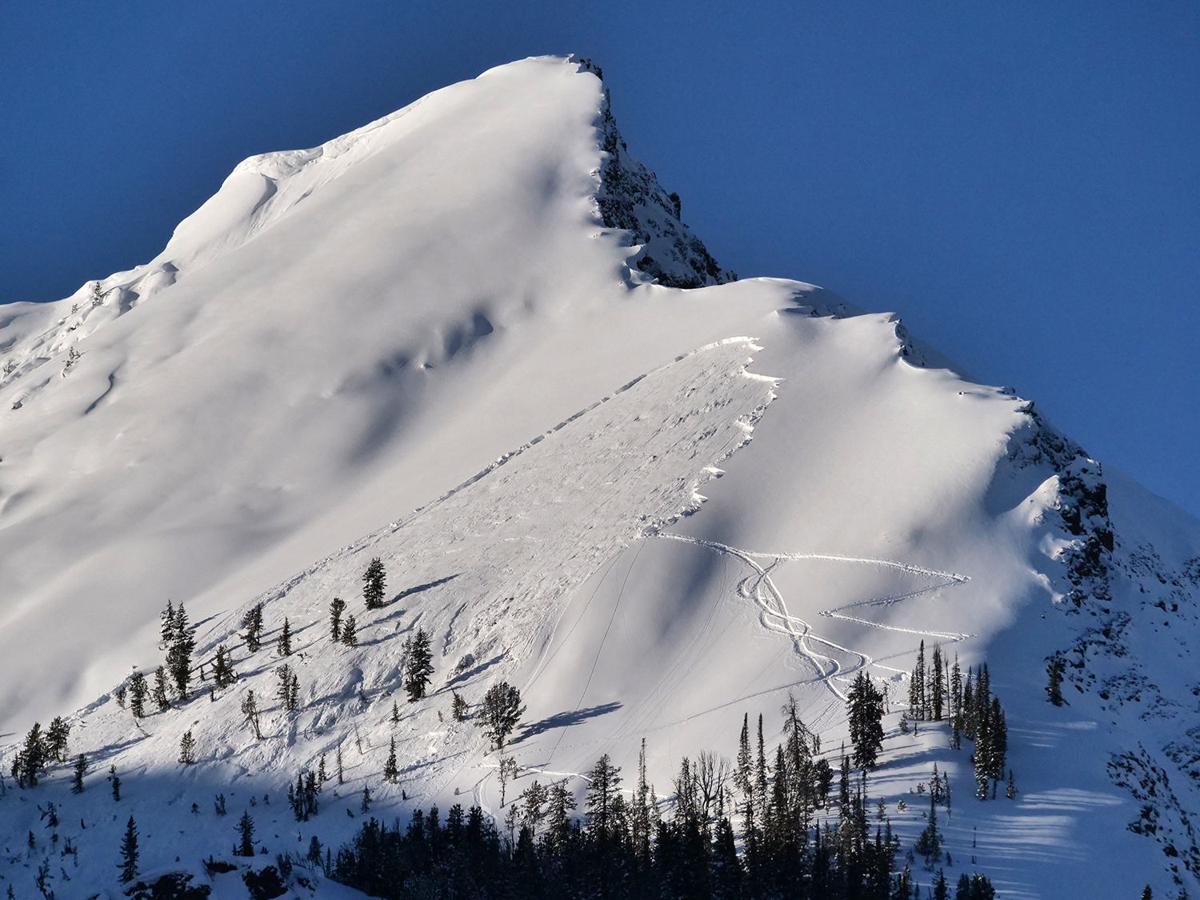
fatal avalanche site - forest service
The Park City accident site which has spurred an avalanche risk discussion. Note all the other tracks which are visible in this popular area.

Snowboarder caught in avalanche carried 1,000 feet, deployed airbag

Maurice Kervin has spent 65 days snowboarding so far this season. Friday is a day he won’t forget. On that day the snowboarder was caught in an avalanche.

“Friday was beautiful. It was golden. We had actually been planning all week to ski this line,” he said.

Recent AIARE Course

Kervin had recently completed a Level 1 safety course through the American Institute for Avalanche Research and Education (AIARE).

All week he and his friends had been watching the avalanche forecast and felt conditions were improving.

“Everyone was actually really excited that the avalanche danger level had actually gone down,” said Kervin. He wasn’t as sure about the forecast, adding, “I was very concerned. I was like, ‘I don’t know guys.'”

Nervous about the day

Kervin and his riding partner hiked toward a spot called No Name near Loveland Pass. They continued to check conditions on their way. And they tested patches of snow for stability. Although the results didn’t show any signs of instability he felt nervous before dropping in.

“I remember telling my buddy ‘I don’t know man. I’m kind of nervous about this run, and if it goes it’s probably going to go big,'” said Kervin.

Kervin think he made it a third of the way down when everything changed. Then the snowboarder was caught in the avalanche.

Caught in an Avalanche

“I cut into a thin patch of snow in some cliff bands. At that point it released below me and the whole slab started to go underneath me. I looked up and around and I saw the snow start coming down from above,” said Kervin.

The avalanche happened quickly and swept him off his feet.

“I definitely wasn’t in control at all, the avalanche was in control. I never had a doubt in my mind that I was going to get buried. My biggest concern was that I was going to hurt myself in some way and make it difficult getting off the mountain,” said Kervin.

He deployed the avalanche airbag in his backpack.

“So I freed my hands, I pulled the bag and I started to do backstroke and kick my feet up to stay on top of the snow, basically just to make myself as big and less dense as possible,” said Kervin.

Kervin was carried about 1,000 feet before he came to a stop on the snow surface. In his video you can hear his air bag fill up. Then seconds later his board hits a large rock where he went over a cliff.

“I was very calm through the whole thing. I think that’s very important thing to be in such a situation. Often times when people panic they make poor decisions or don’t make any decisions at all,” said Kervin.

Role of Training and an Airbag

He made it out with only a dislocated finger. He’s been skiing and riding in the backcountry for about 10 years and completed a Level 1 safety course through AIARE. Despite that, he did not avoid the recognized risk. But Kervin believes the airbag and his training likely saved his life. “I knew what we were doing, and the possibilities that I had feared came true,” said Kervin. He called 911 to report the avalanche but did not require assistance from a rescue team.

He was skiing again the very next day but he wants his story to be an cautionary tale for others who might be venturing into the backcountry, some for the first time.

A snowboarder was caught in an avalanche.
Snowboarder caught in avalanche

Skiers injured in avalanche near Cooke City, Montana

An avalanche south of Cooke City carried three skiers down Republic Mountain, two were injured in the avalanche. One had to be evacuated by helicopter and another was temporarily unconscious and not breathing, according to a report.

“It’s super serious avalanche terrain,” said Doug Chabot, director of the Gallatin National Forest Avalanche Center.

In many ways, the skiers had done everything right. All six were carrying beacons and had rescue gear. They had radios to summons help.

Skiers checked with a 6 foot deep snowpit

However, they did not check the snowpack in the place they decided to ascend the mountain, Chabot said. They had dug a snowpit 2 meters deep to check the likelihood of an avalanche. “A hundred feet off to the side the snowpack changed,” he said, to an area with much less snow, only three feet.

“In terrain like that you have to be 100 percent sure” that the snowpack has no instabilities, Chabot added. All week long in its daily reports, the avalanche center had warned the snowpack was unstable and avalanches had been remotely triggered on even low-angle slopes. However, the Cooke City area had been standing out as a relatively more stable snowpack compared to other areas.

The avalanche broke about 1.5 to 2 feet deep approximately 250 feet above the skiers.

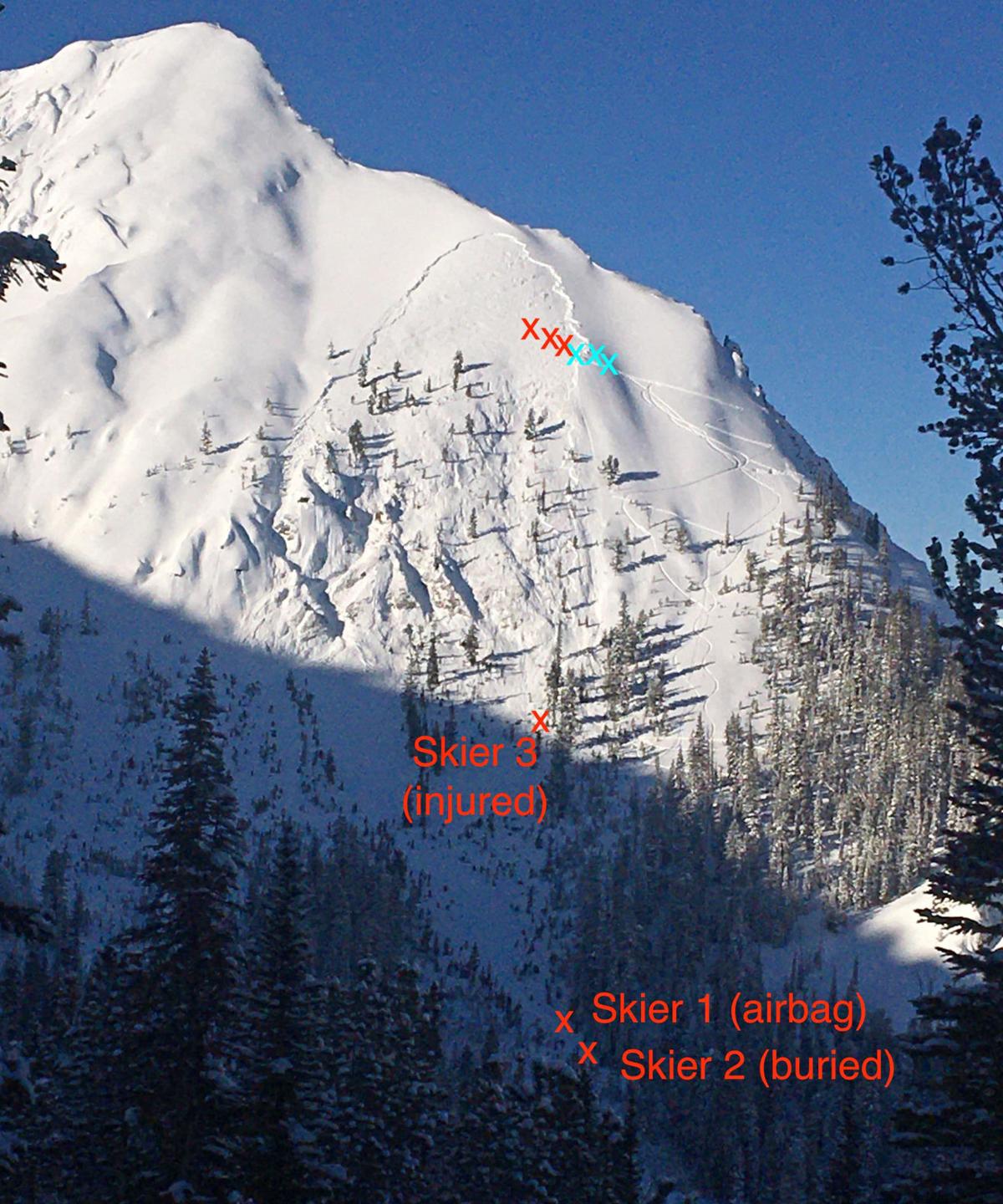
Photo of the avalanche which injured skiers. Forest Service.
The avalanche

Recovery of the two injured in the avalanche

Three of the skiers were swept downhill. The avalanche was 200 feet wide and ran 700 feet down the mountain. It was a large avalanche, and it went through some ugly terrain.

One skier deployed his airbag to keep from being buried. He was not injured in the avalanche. He quickly got up and began searching for his partners. One of the other skiers was found buried head down with his mouth packed full of snow. He freed that skier and cleared the airway so he was able to breathe on his own. That victim was able to ski out despite a leg injury.

Meanwhile, the three skiers who were not caught or injured in the avalanche found the third victim. He was buried higher on the mountain after being dragged across rocks. The trip caused injuries to his ribs and a collapsed lung.

location on the mountain of the skiers injured in the avalanche
Location of the skiers injured in the avalanche. Three were not caught despite being very close to the edge of it.

The Rescue

The skiers had two-way radios and were able to notify Park County Search and Rescue. Cellphones do not work in the remote area between Yellowstone National Park and the Absaroka-Beartooth Wilderness.

Two members of the search and rescue arrived and ascended 1200 feet then descended 400 to the avalanche zone. They brought medical and survival gear in case they had to spend the night.

The rescuers helped stabilize the injured skier and made a fire to stay warm while awaiting a helicopter to arrive from Jackson, Wyoming since Bozeman was too fogged in to fly.

The avalanche had occurred about noon. About 4 p.m. the helicopter arrived and long-lined the victim out. He was then flown to a regional hospital for care.

Snowpack is not improving

“It’s not going to get better anytime soon,” Chabot warned, because a weak layer of snow still sits underneath. As more snow falls that layer has a higher chance of failing under the increased weight.

“It’s different this year because it’s not taking a lot of snow”, Chabot said. “That makes it a little scarier.”

Monday is a holiday, Martin Luther King, Jr. Day. This might mean more people in the backcountry.

“Our fingers are crossed that people will continue to get lucky,” Chabot said. “But it’s a bit of a losing battle if you’re relying on luck.”

Chabot added that it will take time before the snowpack is stable, because right now even under moderate conditions people are triggering avalanches.

“You have to be really careful about where you’re headed,” Chabot said. “It’s a bit of a minefield.”

Silverton Avalanche School raises money with Rando Race

Silverton Avalanche School is the beneficiary of the second annual Know the Snow Rando Race. The race at Purgatory raises money for the Know the Snow Fund which supports avalanche classes.

This year’s race was dedicated to the memory of Bert Perry and Jeff Paffendorf, Durango community members and experienced backcountry enthusiasts who recently died in an avalanche outside of Silverton.

Dr. Jeff Paffendorf, an experienced skier, died on Dec. 10 along with Albert Perry. They were caught in an avalanche they triggered on the north face of the Battleship, which is near Silverton.

Their accident shows just how unstable the snowpack was. It is important for backcountry skiers to be as knowledgeable as possible about the conditions they will face.

Wind blown snow was deposited on the slope where Paffendorf and Perry skied. It accumulated on an unstable base layer. The Colorado Avalanche Information Center had reported that the avalanche danger was considerable that day.

In 2020, the race raised more than $10,000 and provided 19 scholarships for skiers to attend avalanche education courses with Silverton Avalanche School. The funds fully paid for Level 1 and Level 2 avalanche courses at Silverton Avalanche School.

Silverton Avalanche School Rando Race promo
Rando Race promo.

Dutch Draw avalanche in Park City Utah – victim identified

PARK CITY — A Clinton, Utah man killed in a Dutch Draw avalanche in a popular backcountry area has been identified.

Kevin Jack Steuterman, 31, died Friday, while snowboarding in the Dutch Draw area. Which is just off the 9990 chairlift in the Canyons area of Park City Ski Resort.

“Our hearts break for the Steuterman family and friends. Hug your loved ones often and tell them you love them.” Summit County Sheriff Justin Martinez tweeted Monday while releasing Steuterman’s name.

No Rescue Gear

Steuterman was with his girlfriend around 10 a.m. when the avalanche occurred. According to the Utah Avalanche Center, Steuterman was buried under 2 feet of snow in a slide that was 150 feet wide and 400 feet long.

Steuterman was on a snowboard and his girlfriend was on skis. Neither was carrying avalanche rescue gear.

“At the top of Silver Peak the rider began a descent of a slope called Conehead. When the snowboarder was halfway down the slope, the skier started her descent. After making two turns, the avalanche broke at her feet. The snowboarder was still midway down the slope where he was caught, carried, and buried in the avalanche. The skier was not caught in the avalanche,” the center stated.

Search and Recovery

The Park City Mountain Ski Patrol, Utah Department of Public Safety helicopter, Park City Fire District and University of Utah AirMed helicopter all assisted the sheriff’s office in the search and recovery effort. Explosives were dropped from the DPS helicopter to trigger a second slide near the first one. In order to make sure the area was safe before rescuers got onto the mountain, according to the center.

Steuterman’s body was found about 2:30 p.m.

“His snowboard was still attached to one foot while his other foot had been pulled out of his boot,” the avalanche center stated.

Popular Area with a bad history

Dutch Draw is a popular area for snowboarders and skiers, but has also been the scene of several fatal avalanches, including December 15 2019, February 23, 2012, and January 15, 2005.

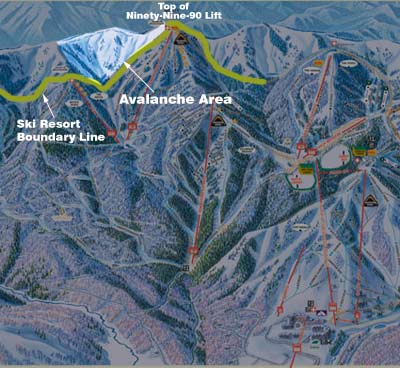
Dutch Draw Avalanche area in Park City, UT
Location of Dutch Draw avalanche

Silver Mountain avalanche marks one year anniversary

January 7 marks one year since the tragic Silver Mountain avalanche in Idaho. Three skiers were killed and four others were buried in the snow of the avalanche and survived.

The avalanche was unintentionally triggered by skiers. It ran over 900 feet down the slope and fell about 450 vertical feet.

One of the four survivors said he is still feeling some of the emotions that he felt this time last year.

“Still really grateful, grateful to be here, grateful that there were people that saw me, grateful that so many people that day came out to risk their own lives to find me,” said Bill Fuzak, survivor of the Silver Mountain Avalanche.

But Fuzak was lucky. Three others died.

“I definitely look at the world a little different now,” said Fuzak.

Fuzak is an avid skier but said that day changed him.

“I don’t trust myself as much anymore, I’m constantly looking around and being a little more aware of what’s going on,” said Fuzak.

Through it all, Fuzak is still skiing.

He has 30 ski days in this season already, starting in October.

Fuzak said it was nerve racking getting back out for the first time. But he added that  it takes time, and it’s getting better.

He said if he can offer any advice, the biggest thing to keep you safe on the mountain, is education.

“Knowledge is power, knowledge can help save you,” said Fuzak.

He said he is constantly checking avalanche reports and sending them to friends to help educate them.

He and his wife are even taking more refresher courses. They encourage everyone to get avalanche training.

And one more tip: “Don’t go alone, have someone there, because they won’t know where you are if something does happen,” said Fuzak.

Silver mountain avalanche
Rescue after Silver Mountain Avalanche
Silver Mountain Avalanche - Jan 2020
Silver Mountain Avalanche

Severe Avalanche Risk in BC backcountry

‘Your life is not worth that day of powder skiing’: Officials warn of severe avalanche risk.

This has been a deadly week in B.C.’s backcountry. On Monday two snow bikers were killed in an avalanche near Pemberton. Then on Thursday a backcountry skier fell into a tree well and died near Whistler.

“I’m taking some time off to let the snowpack settle out,” said Whistler skier Mike Douglas. “It’s gotten really really dangerous.”

When Douglas was touring with some friends in “safe manageable terrain” they released a slab.

This is a good week to stay out of the Whistler area backcountry. We discovered some very easily triggered soft slab sitting on a layer of surface hoar today. 50cm crown on 30 degree N slope at 1500m. Likely to get worse. Be careful. pic.twitter.com/it0I2OblZO
— Mike Douglas (@MikeDski) December 31, 2020

“We kicked off a small slab avalanche with about a 50 cm crown,” he said, “it kind of spooked us a little bit, like wow it’s actually even more touchy out here than we thought.”

Twitter photo during severe avalanche danger
Twitter, MikeDski

Avalanche Canada is warning this is not the time to be in the backcountry. They are reminding those who want to venture out, to check forecasts before going. There is a severe avalanche risk right now.

“We’re on the storm track right now,” said Ilya Storm. “Right now, in some ways, the decision making is easiest.”

Meaning just don’t go! Because the high avalanche risk rating means it’s natural avalanches are likely and human triggered are very likely.

“It is snowing heavily, the wind is blowing, you can see it, you can see the snow accumulate and there are obvious clues out there,” he said. “Snow hates rapid change. The rapid change is a person. A person on a snowmobile, a person on skis, that can be enough to tip the balance.”

Douglas said this is the time to ski in bounds.

“Your life is not worth that day of powder skiing,” he said.

Photo on an avalanche. There is severe avalanche risk now.
Avalanche Photo

Skiers caused over 10 San Juan avalanches in Colorado

During the past week backcountry skiers have triggered more than 10 avalanches in the San Juan Mountains of Colorado. Although nobody was seriously injured there have been some dangerous close calls.

There were six reports of skier-triggered San Juan avalanches in the Wolf Creek Pass area. And another five in the western San Juan Mountains. That’s just from reports people submitted to the CAIC.

On Monday a party of skiers near Wolf Creek Pass was caught in a relatively small avalanche that went up to the skiers’ knees. No one was injured.

On Tuesday near Wolf Creek Pass a skier was “knocked over and partially buried, head and one arm and ski out.” Another skier had to help the person extricate.

“No injuries or broken gear, so we were thankful for the somewhat gentle reminder that accidents can happen anywhere and it’s good to have partners that can rescue you in case of one,” the person who wrote the report said.

Skier caught in two avalanches

The skier was caught and carried about 100 to 130 feet and deployed an airbag. They were “pushed and knocked around but able to stay upright.”

The skier then came to a stop and got the airbag operational again. Attempting to ski down, the skier was caught in a second avalanche. They were carried another 100 to 130 feet and deployed the airbag again.

“Similar to (the first) slide … skier was caught, carried and knocked around but able to ski to right of deposition path just before being carried into trees,” according to the report.

Avalanche danger remains a concern across the state

A San Juan avalanche, CAIC
A San Juan avalanche

People triggered at least 12 avalanches just on Thursday.

“Our current weak and dangerous snowpack persists,” the CAIC wrote. “There is potential for avalanches to be exceptionally fatal this winter in Colorado.”

The snowpack has not been this unstable and weak since 2012, Ethan Greene, CAIC executive director, said in a previous interview.

The unstable snowpack is a result of early season snow in October and dry weather for weeks in November, causing the snowpack to become weak. Then, additional snow on top of that weak layer causes avalanches.

“How weak the snowpack gets depends on how the fall unfolds,” Greene said previously. “This particular year, the underlying snowpack is really weak.”

So far this winter season, four people have died in avalanches.

According to the CAIC, avalanche danger on Friday in the southern San Juan Mountains is listed as “considerable.”

“Avalanche conditions are slowly easing, but many slopes remain dangerous,” the report said. “Without a new load, you may not see natural avalanche activity, but many slopes are very weak and just waiting for a trigger.”

Friday, January 1, 2020