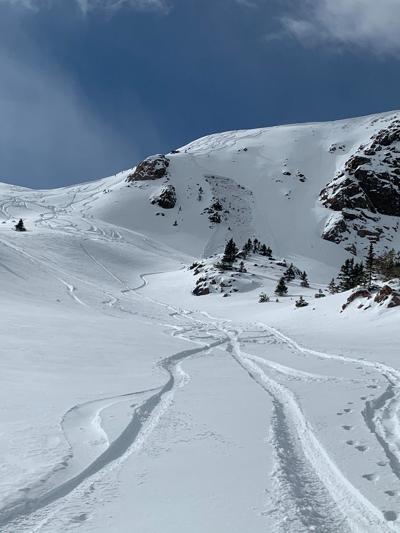
Skiers activities that often lead them to backcountry locations with limited services. Monday morning (12/28) Forest Service avalanche experts warned of possible avalanche activity when visiting these areas. They recommend doing some avalanche testing before using steep slopes.
“We have a block of harder snow over a section of weak sugary facets of the ground, so we have something over nothing,” said Dave Zinn, avalanche expert. “This is the recipe for an avalanche, all you need now is a steep slope and a trigger.”
Triggers can be caused either by nature — rain, snow, sun, wind — or by human activity.
“The danger is moderate, but it’s sort of that scary moderate because human triggered avalanches remain possible,” said Zinn. “If we trigger them, they could be large — and definitely big enough to injure, bury or kill an individual.”
“Really watch out for those signs of instability — like shooting cracks. Do some avalanche testing – dig stability tests, do an extended column test, see if you get stable results,” said Zinn. “And if you don’t see (stable results), find a different slope.”
Previous reports from 2017 to 2019 showed six-of-ten accidents occurred in January and February. Five of which, resulted in a death. It is not listed what caused these avalanches were deaths occurred but leads experts to continue to urge people to test they go.
Two people were caught in Tahoe avalanches in the backcountry over the weekend, on Saturday December 26. One was a skier and the other a snowmobiler. Both escaped serious injuries.
Carson Pass – Skier
Two skiers on Saturday afternoon were ascending Nipple Peak near Carson Pass when one accidentally triggered a slide.
The skiers were ascending opposite sides of a bowl above treeline when a slab gave way and caught the skier. The skier deployed his airbag and his head was just underneath the surface when the slide ended at the bottom in the trees.
The other skier was out of the path and avoided the slide.
Carson Pass avalanche, skier locations marked in red and blue
Little Truckee Summit – Snowmobiler
The other avalanche was in the Tahoe National Forest in the Little Truckee Summit region.
A snowmobiler was cognizant of the avalanche forecast as his group worked its way into the Webber Lake area. But they were rerouted due to “wind-scoured ridges and exposed rock.”
“We were side-hilling and in a momentary lapse of judgment, or the fact that we were just moving along too fast, I popped out of the trees onto an exposed face. I immediately recognized the hazard, but immediately saw the snow fracture above me and propagate across the ridge.”
The snowmobiler had little choice and attempted to outrun the slide. But he was caught while dropping into the treeline.
The rider was thrown from the sled and buried up to the helmet against a tree. The avalanche was about 280 feet in length.
The group witnessed the event and was there about a minute later to provide assistance. The rider was uninjured and recovered the machine that was buried in about 6 feet of snow.
Little Truckee Summit avalanche which caught a snowmobiler
Conditions
The Tahoe avalanches took place on steep slopes of 40 degrees or more. Officials are advising users to choose slopes that are 30 degrees or less.
“Whumpfing, shooting cracks, recent avalanches, and unstable snow pit test results are all indications of unstable snow in the area,” said a statement. “Do not underestimate potential avalanche size, potential run out distance, or the hazard from connected terrain above or to the side. Think bigger avalanche than expected.”
An avalanche in New York caused by a Christmas Day storm has damaged a ski resort in the Catskill Mountains.
The storm brought high winds and more than 6 inches (15 cm) of rain to the Belleayre Mountain Ski Center.
The ski resort is cleaning up on Christmas after an avalanche in New York smashed into a lodge. The avalanche caused some serious damage.
Officials at the Belleayre Mountain Ski Center in Ulster County say the snow slide happened Friday morning. It was caused by heavy rainfall, high amounts of snow on the ground, and warm temperatures.
The resort posted an update on its website saying “This morning, supersaturated snow from the Yahoo trail let loose and slid into the Overlook Lodge.”
Belleayre’s general manager Bruce Transue received an alert of a break-in at the Overlook Lodge around 5:30 a.m. only to learn that snow, water, and debris were the culprits.
The windows have been blown out on the uphill side, the doorways and a lot of water damage. We probably had four foot of snow inside the base lodge in the upstairs.
Bruce Transue
Transue says he doesn’t believe something like this has ever happened at the resort before. An avalanche in New York is a rather uncommon event.
Resort to Remain Closed December 26
In a bit of a Christmas miracle, no one was injured. The resort was scheduled to be closed on Friday due to the storm. However, they will remain closed through Saturday, Dec. 26th to continue clean up efforts.
In an update, the resort said “For those of you that had tickets for the 26th, please complete the Customer Service form and we will get back to you with regards to your purchases as soon as possible.”
Transue says Belleayre Mountain plans to be back open Sunday, Dec. 27th.
Avalanche damage to the lodge at Belleayre Mountain Ski Center
A final report on a fatal skier triggered avalanche that killed two Durango backcountry skiers last weekend says it appears the skiers likely triggered the slide while climbing up an avalanche path.
The skier triggered avalanche occurred on a steep slope above tree line. “They went on a day that wasn’t a good day to be there,” the official report said. Other skiers in the area that day were interviewed. They mostly stayed in lower angle areas and in the trees. They noted the dangerous conditions on the higher, steeper and open slopes.
The Avalanche Events
The two skiers – identified as Dr. Jeff Paffendorf, 53, and Albert “Bert” Perry, 55 – left Durango on Saturday morning, December 19, to ski the north face of an area known as Battleship, northwest of Silverton.
The report says the pair reached the trailhead about 10 a.m. They then skied about a mile before coming down a slope into Mineral Creek.
From the bottom, the Colorado Avalanche Center said, they headed east and onto the north face of Battleship. The two made one run, then climbed west through sparse woods toward the center of the north face of Battleship.
It is believed they were traveling uphill in an avalanche path when they triggered the slide, which started above them. It is not uncommon for slides to break above skiers.
“Ascending a big avalanche path during conditions like that is dangerous,” said Ethan Greene, executive director of the CAIC. “It’s a really unfortunate accident.”
The avalanche occurred on a steep slope above tree line. It had a crown face about 12 to 20 inches deep and about 700 feet wide. The avalanche ran 1,600 vertical feet, from the alpine into a tree-line creek bed.
Around 8 p.m., Paffendorf and Perry were reported overdue. Crews with San Juan Search and Recuse began a mission, and a Flight For Life helicopter scanned the area. They found “significant avalanche activity” on Battleship.
Because of the significant avalanche risk and the dangers of traveling at night the search was postponed until morning.
Recovery by Friends
However, three close friends of Paffendorf and Perry went to search for them on their own. They followed tracks to the avalanche debris and used avalanche beacons.
The friends found the pair before midnight at an elevation of about 11,100 feet. Both skiers had deployed their avalanche airbags. The friends excavated the bodies and marked the location. They returned to the trailhead around 2 a.m.
Greene said Paffendorf and Perry were “very experienced backcountry travelers.” But he said conditions so far this year have presented avalanche risks not seen in recent years, so places people may be familiar with could hold dangers that haven’t existed on previous trips.
Conditions
On the day of the accident the avalanche danger in the San Juan Mountains was “considerable.” It is not the highest risk category but one that highlights possible avalanche danger and the need for sound decision-making.
The unstable snowpack is a result of early season snow in October and dry weather for weeks in November. That caused the snowpack to become weak. Additional snow on top of that weak layer causes avalanches.
Of the pair’s friends’ rescue attempt, the report states that “the three rescuers were willing to accept a level of risk that was not appropriate for Search and Rescue. While they found the bodies hours before Search and Rescue would have, the swifter discovery did not change the outcome of the accident.”
Paffendorf was an anesthesiologist at Mercy Regional Medical Center for the past eight years. Perry was a homebuilder before becoming a realtor for Coldwell Banker Heritage House Realtors in Durango about four years ago.
Friends and colleagues have noted how experienced and familiar the pair was with the terrain.
“This year is a little bit different,” he said. “That place you always go to, think about whether it’s a good day to go there.”
A ski patroller buried by an avalanche was on the northeast end of the Anthracite Range, known as Friendly Finish, in the Gunnison area. He was touring alone in the backcountry at the time.
GUNNISON COUNTY, Colo. — A solo backcountry skier died in an avalanche in the Gunnison area on Friday.
The man was skiing on the northeast end of the Anthracite Range when he was buried in an avalanche. The area is known locally as “friendly finish”.
The avalanche occurred on a northeast-facing slope and the avalanche risk was rated as “considerable,” or 3 out of 5. The slide took place at about 10,500 feet.
Victim Identified as Ski Patroller Jeff Schneider
Crested Butte Ski Patrol identified the ski patroller buried by an avalanche as Jeff Schneider in a Facebook post.
“Jeff was a bastion of kindness, knowledge, hard work, wit, and humor,” the post read. “A legendary Ski Patroller in Crested Butte, and Aspen before that, adventure had no better emissary. We wish you well on the last leg of the ultimate adventure. Rest peacefully, and may you make many, many turns, each one better than the last.”
Before descending, the victim spoke with two other skiers who were also traveling in the area. When the other two skiers finished their descent they found the victim’s snowmobile parked, and there was no sign of him. The skiers then snowmobiled to a position where they could see the slope that the victim planned to descend and saw a fresh avalanche. They then located the victim with a transceiver and recovered his body.
This was the first US avalanche-related death of the season. The only other incident this season was on Dec. 15, when a snowboarder was caught in an avalanche on Snodgrass Mountain and was injured.
Last season, there were six avalanche-related deaths, according to CAIC.
The avalanche where a ski patroller was buried in an avalanche on December 17.
This was the first fatality of the season in the US and the second in North America, according to this list.
Several natural and human-triggered avalanches have been reported across the state this week, including one near Vail Pass on Thursday, the Colorado Avalanche Center said.
The Vail Pass avalanche broke at the ground, they said. Although it was relatively small, it could have injured someone if they had been caught in it. The avalanche was triggered by skiers.
People should avoid steep slopes, especially on north and northeast faces where cohesive slabs of snow are formed by the wind. Avalanches can break in upper wind-effected layers or at weak layers near the ground, the Avalanche Center said. “With a relatively shallow early season’s snowpack, it is not difficult to affect these layers and create a failure. It is best to avoid traveling on steep wind-loaded slopes where these conditions exist.”
There were several natural and human-triggered avalanches across the state on Wednesday. Avalanches were reported at Berthoud Pass, Montezuma and near the Eisenhower Tunnel.
The Avalanche Center said most of the mountains will see a moderate risk of avalanches on Friday and Saturday at and above treeline.
The wife of Hugh Lindsay, killed while skiing with Prince Charles, asked Netflix not to feature the avalanche
Nov 2020
The widow of a British army major who died in an avalanche while skiing with Prince Charles has criticized the producers of The Crown on Netflix as “unkind” for dramatizing the disaster against her wishes.
Major Hugh Lindsay, a former Queen’s equerry, was skiing off-piste at the Swiss resort of Klosters in 1988 with a group including senior royals when disaster struck, with his friend the Prince of Wales and others reported to have dug snow with their hands in a vain attempt to save his life.
After the episode on “The Crown” titled “Avalanche” was made available for streaming last week, Lindsay’s widow, Sarah Horsley, has revealed she had asked Netflix not to adapt the disaster for television.
“I was horrified when I was told [the episode] was happening and was very concerned about the impact on my daughter,” she told the Sunday Telegraph.
“I’m very upset by it and I’m dreading people seeing it. I wrote to them asking them not to do it, not to use the accident. I suppose members of the royal family have to grin and bear it, but for me it’s a very private tragedy.”
She added that the producers replied with “a very kind letter”, saying “that they understood my concerns, but they hope I will feel that they deal with difficult subject matters with integrity and great sensitivity”.
However, Horsley said: “I think it’s very unkind to many members of the family.”
Netflix’s description of the episode reads: “Charles is caught in a deadly avalanche, and he and Diana are prompted to reevaluate their commitment to their troubled marriage.”
At the time of the disaster, Horsley was pregnant with their daughter Alice and still working at her job in the press office at Buckingham Palace. She did not go on the ski trip and stayed at their south London home.
Charles, who went on to become a godfather to Alice, later wrote: “I still find it hard to understand why I survived and he didn’t.”
Patti Palmer-Tomkinson, another friend of the Prince, received severe injuries to both of her legs and her lungs. Princess Diana, who was also on the holiday, was not on the slopes when the avalanche hit and had stayed at their chalet in Davos, along with Sarah, Duchess of York.
The group then flew back to London, where a guard of honor from Major Lindsay’s regiment met his coffin.
Netflix has also faced criticism over the historical accuracy of its script, with calls for it to be accompanied by a disclaimer explicitly stating that some events have been embellished. The scriptwriter, Peter Morgan, has said: “Sometimes you have to forsake accuracy, but you must never forsake truth.”
The Times reported this week that friends of the Prince of Wales had described the show as exploitative and inaccurate. “This is trolling with a Hollywood budget,” a source said.