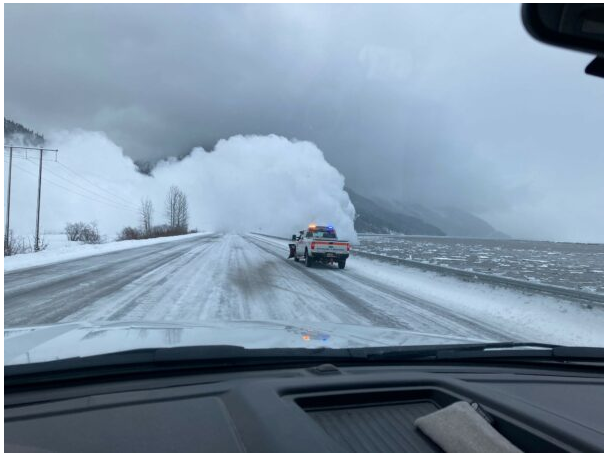
A Seward Highway avalanche closed the road for much of the day Friday. It was between Bird Creek and the Portage turnoff. The avalanche severed the only road access between Anchorage and the Kenai Peninsula for more than eight hours.
The Seward Highway avalanche hit at Mile 91.5 and the debris on the roadway was up to 15 feet high in spots, said a spokesperson for the DoT. The highway reopened around 2 p.m. but drivers should remain cautious.
“Travel is going to be wet and slick and bumpy. They’ve cleared all the snow but it’s definitely not down to dry highway measures by any means.”
Crews set off artillery to trigger 20 other avalanches along the highway on Friday. Also on Friday, several snow slides closed the Old Glenn Highway near the Old Knik River Bridge.
Farther north, snow slides near Summit Lake closed the Richardson Highway from mile 186 to 218.
The Hatcher Pass Avalanche Center also warned of very dangerous avalanche conditions in the area. It issued an avalanche warning early Friday, and it says the Hatcher Pass Road will be closed at mile 11 through the weekend due to avalanche activity.
National Weather Service meteorologist Michael Kutz said Anchorage has been having one of the wettest years on record so far. Snowfall this February is nearly three times higher than average, and rainfall this year is more than four times above normal, Kutz said.
Seward Highway Avalanche
Rain and Snow in Anchorage
Rain and snow have been falling in Anchorage and other areas of Southcentral since the beginning of the week. Which has led to treacherous road conditions in parts of town. Areas of the Mat-Su have been hit with heavy snow. Power to thousands of homes has been knocked out.
As of Friday evening, about 300 homes still did not have power. The Mat-Su school district canceled in-person classes on Friday for the third day in a row due to road conditions and winter weather.
Jan 20 – British Columbia is rolling out the artillery and bombs for avalanche bombing. There have been closures on some major roads for the first time in decades as the province grapples with record snowfall and rain.
The province, third-largest by population, uses helicopter avalanche bombing, remote-triggered explosives, and howitzers to keep roads open. But nonetheless critical routes to Vancouver are being disrupted by avalanche control.
Extreme weather, including November’s torrential precipitation, a deep freeze in late December and an early January thaw, has weakened the snowpack. Mountain slopes are more prone to avalanches that can release without warning.
Avalanche bombing requires closing sections of roads while teams use explosives to pre-emptively trigger slides, which prevents the snowpack from becoming deep and unstable.
Record amounts of control actions
A section of Highway 1 through Fraser Canyon northeast of Vancouver needed avalanche control for the first time in 25 years.
On Highway 99 north of Vancouver avalanche control actions are three times the seasonal average. Some paths have produced avalanches big enough to hit the highway for the first time in over a decade.
Avalanche bombing in Allison Pass further south on Highway 3 has also been above average.
These highways were all damaged in November by floods. A busy avalanche control season is putting further strain on resources. The Coquihalla Highway near Hope just reopened on Wednesday. And record snow along with avalanche risk delayed repairs to Highway 1 through the Fraser Canyon.
Rogers Pass
Further east avalanche teams in Rogers Pass, which runs below 135 slide paths in Glacier National Park, are dealing with more snow than usual. Control missions are also above average.
Approximately 3,000 vehicles traverse Rogers Pass every day in winter. A major Canadian Pacific rail line runs along the highway although it has a long tunnel under the top of the pass.
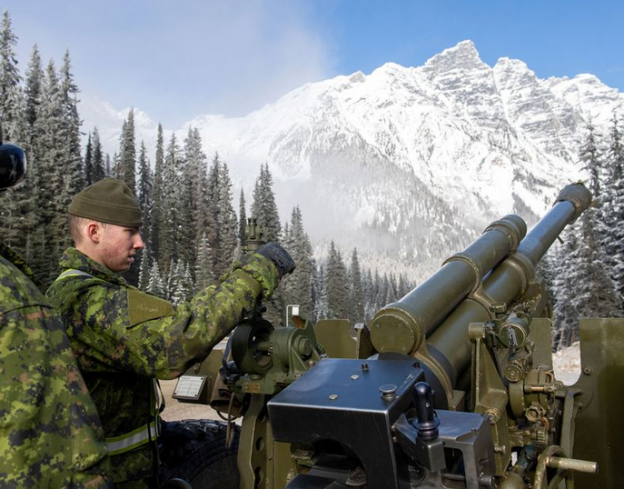
Rogers Pass avalanche bombing involves artillery soldiers who are stationed in Rogers Pass in winter. They use a howitzer to fire shells into loaded avalanche paths along the highway.
“Our goal is to bring down as much snow as we can and bring the hazard down to a point where it’s safe to open the highway,” said Jim Phillips, acting avalanche operations coordinator for Parks Canada.
The Rogers Pass program has been running since the highway opened in 1961. Before that, and before they built their tunnel, CP trains ran a high risk of deadly snow slides. One killed 62 railway workers in 1910.
So far this winter the team has fired 333 howitzer rounds, produced 197 controlled avalanches and closed the highway for 43 hours over seven separate days.
Helicopter Avalanche Bombing
Phillips said his team also uses heli-bombing and remote-trigger systems to set off detonations, and spends C$600,000 ($480,346) a year on explosives alone.
“It’s a balancing act. You want to keep traffic moving and minimize closures, but also minimize risk to people using the transportation corridor,” he added.
Avalanche control is typically needed until late April or early May.
November 22, 2019. MCpl PJ Letourneau/Canadian Forces. Avalanche bombing in Rogers Pass.
The Sierra Avalanche Center (SAC) is not a typical public service found in just any town. Although the Forest Service does have many such centers throughout the western US.
Nearly every day of the winter paid public forecasters grab their gear and head to the mountains for a day of skiing.
Sierra Avalanche Center Board of Directors President James Brown was once buried by an avalanche himself while ski touring in Canada. The snowpack conditions there are much different and more complex than in the Sierra.
A couple of forest service employees established SAC in 2004. Brandon Schwartz now works as the lead forecaster as a Forest Service employee.
The priority and purpose of SAC is to produce the avalanche forecast every winter morning, which includes two basic components. The avalanche danger — low, moderate, considerable, high, or extreme — and then what avalanche problem or problems backcountry users are likely to encounter that day.
The forecasters’ jobs are to assess avalanche hazards by traveling through the snow-covered backcountry.
Brown stated that SAC has come a long way since its first inception, when those who wanted the forecast would have to call a number. These days, backcountry users can get a quick glimpse of the forecast by following SAC on Instagram, Facebook, or Twitter, or by visiting their website to view the full and in-depth avalanche forecast.
“The avalanche community in general has come a really long way from making avalanche decisions based on colloquialisms …” Brown said. “… people used to say, as long as you don’t ski 24 hours after a storm, you’re OK. There is a certain grain of truth to that, especially in the Sierra, but that’s obviously not a good decision-making tool.”
In order to fund themselves the Forest Service Sierra Avalanche Center holds regular events and seeks donations.
Those interesting in supporting the US Forest Service avalanche center can donate, or attend events held in support of the avalanche center, such as a clinic being held 6 to 9 p.m. Dec. 17 at Palisades Tahoe. The event will host influential skiers and snowboarders in the community — such as Michelle Parker, Jeremy Jones, and Elyse Saugstad — who will be speaking about avalanche safety. Donations will be accepted.
December 8, 2021
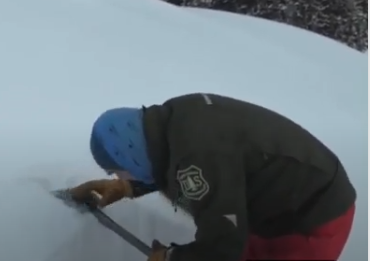
A Forest Service forecaster takes a break from a day of skiing to examine the snow.
WATERTON PARK, AB – A Waterton townsite avalanche resulted in a close call in Waterton Lakes National Park in Canada.
This past weekend a class-4 avalanche roared down Bertha Peak. Which is just outside the small resort community.
The avalanche dumped 10 metres of debris on the Bertha Falls trail and stopped just ahead of Evergreen Avenue South. Entry to the town using that street past Cameron Falls is not recommended due to the risk of further avalanches.
Additionally, the Akamina Parkway is closed until further notice. Pedestrian access on Akamina and Red Rock parkways remains open. The parkway will reopen to vehicles when conditions improve.
Fortunately, no injuries were reported, and no structures were damaged. The risk of avalanches, and another townsite avalanche, has increased significantly in the park. This is due to large snow falls, extreme wind gusts and rising temperatures.
It appears that Silverton Avalanche School was dropped from the lawsuit by the Marshall family, along with their guide. Neither party has commented so a settlement amount was most likely agreed on.
The family of Peter Marshall, who died in an avalanche during an AIARE advanced avalanche safety class with the Silverton Avalanche School, has dropped the school and teacher from their lawsuit. It appears that a settlement was reached. A complaint remains open against Backcountry Access, their owner K2 Sports, and K2 owner Kohlberg & Company.
Settlement Reached with Silverton Avalanche School?
Two years after the death Marshall’s wife and daughter sued San Juan Search and Rescue, the Silverton Avalanche School and the school’s guide, Zachary Lovell, in a wrongful death lawsuit. Last month the family dropped its claims against the county, school and guide. Attorneys for the Marshall family have not returned calls or responded to emails and representatives from the county and school declined to comment, indicating a settlement amount was most likely agreed upon.
The Fatal Avalanche Accident and the Allegations
The family had argued that the school and guide had misled Marshall into taking the class by “falsely presenting” that school staff “possessed deep operational experience in avalanche terrain.” The family also claimed the school and guide displayed gross negligence.
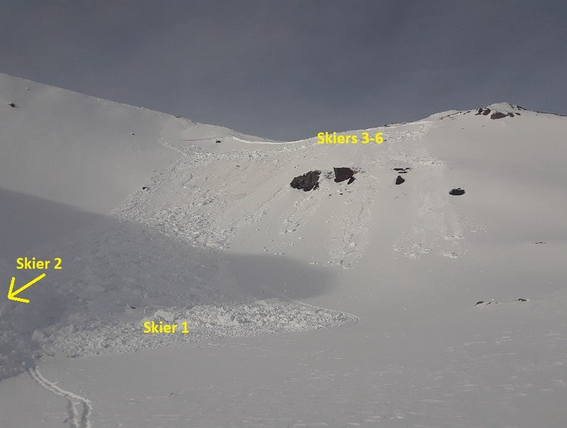
Marshall had been participating in the Silverton Avalanche School Level 2 American Institute for Avalanche Research and Education (AIARE) class on Jan. 5, 2019. He was swept down a slope in an avalanche that caught five other skiers. Four were not buried. Another was buried but was able to extricate himself. When the skiers freed Marshall from the debris, he was not breathing.
The Colorado Avalanche Information Center (CAIC) report pointed to several mistakes during the advanced class, including a group of skiers gathered on a slope steep enough to slide, those skiers misjudging the steepness of that slope and a failure to recognize clear avalanche hazards. The guide triggered the first avalanche, which swept the whole group down the slope. A second avalanche buried Marshall under several feet of snow.
Remaining Complaint Against Backcountry Access and K2 Sports
The family of the 40-year-old Longmont skier is still suing K2 Sports and its subsidiary Backcountry Access, which makes an air bag backpack that was not deployed when rescuers found Marshall buried in more than 8 feet of avalanche debris. “Peter Marshall attempted to trigger his Float 32 avalanche air bag system but it did not fully deploy or inflate,” according to the complaint filed in Boulder District Court.
Marshall’s Backcountry Access Float 32 pack was not inflated. Colorado Avalanche Information Center investigators said in their report that the air bag backpack “was functioning properly,” with “the trigger out of the pack strap, but the bag was not deployed.”
K2 Sports, owned by private equity firm Kohlberg & Company, denied the allegations in a response filed this month. The K2 lawyers cited 16 facts they believe eliminate liability in their motion to dismiss the case.
Previous Float Pack Problems
The complaint notes that Backcountry Access recalled “substantially similar” Float packs due to a problem that could lead to a failure to deploy. The U.S. Consumer Products Safety Commission reported the recall of 8,200 Float 18 packs on Nov. 26, 2013. They warned that the trigger assembly can fail “resulting in the air bag not deploying, posing a risk of death and injury in the event of an avalanche.”
The complaint by the Marshall family argues Backcountry Access “should have known insufficient changes were made to the design of avalanche air bags manufactured after the recall to prevent such failures.” The lawsuit argues that Backcountry Access should have been aware of “safer alternative designs,” such as a remote or automatic triggering or inflation system.
Another skier in the group was wearing an avalanche air bag and attempted to use it when he was swept off his feet. It also failed to inflate. “Later, he determined that he assembled the trigger mechanism incorrectly,” reads the CAIC report. It did not identify the brand of air bag used by that skier.
A 2014 study showed 60% of avalanche accidents involving skiers with un-inflated air bags were because the skier never pulled the trigger. That study also showed 12% of so-called non-inflation incidents were due to user error, including assembling the trigger mechanism incorrectly.
Site of the fatal avalanche during a Level 2 AIARE course behind the lawsuit against Silverton Avalanche School (settled) and Backcountry Access.
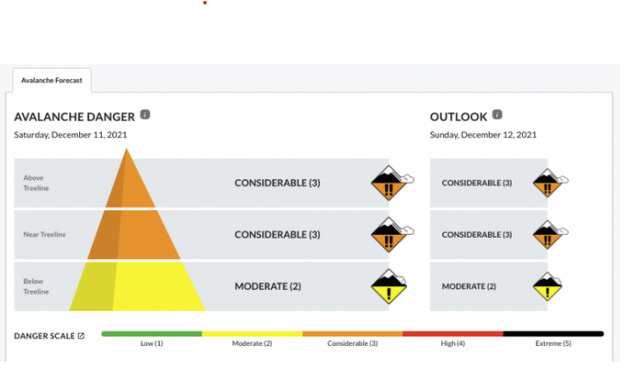
According to the US Forest Service, a skier was killed in an avalanche Saturday, December 11, in Silver Basin, a closed area of Crystal Mountain, Washington, that ski patrol had not mitigated for avalanche hazard. Six skiers from the same party were caught in the slide. The Pierce County Medical Examiner’s Office has identified the deceased as Robert “Bob” Weisel, 66, of Issaquah, Washington. This is the U.S.’s first avalanche fatality of the 2021/22 season.
After a long dry spell that has plagued much of the continental United States this winter, Crystal Mountain reported receiving 12 inches of snow in 24 hours with winds up to 100 mph at the summit Saturday. The Friday evening advisory rated the avalanche hazard as considerable near and above tree line. “Look for storm slabs to develop on Saturday at all elevation bands as the West South is targeted by a potent winter storm,” it warned. It reported of the newly forming storm slab, which was resting atop another recent storm layer and a crust from late November. They advised those entering the backcountry to “choose conservative terrain and realize that early season conditions still exist.”
Silver Basin, where the fatality occurred, is a north- through east-facing slope at approximately 6,500 feet that is marked as a black diamond when open. According to a preliminary report, the six individuals were traveling uphill when they triggered a large avalanche. Another party of two in the area that witnessed the avalanche reported it to Crystal Mountain Ski Patrol at 10:50 a.m. and assisted in the rescue. Four skiers were partially or fully buried, three of whom were successfully recovered. The fourth skier was found unconscious and did not respond to resuscitation efforts. All skiers involved were carrying avalanche equipment and several had taken a recent avalanche course.
A statement from Crystal Mountain following the fatality read, “As snow continues to fall, Crystal Mountain Ski Patrol reminds backcountry skiers to research uphill travel policies and check the avalanche forecasts before heading into the backcountry.”
The areas are Lochaber, Glen Coe, Creag Meagaidh, Southern Cairngorms, Northern Cairngorms and Torridon.
Last season, 212 avalanches were recorded – 10 of them involved people but there were no fatalities.
Avalanches can occur naturally, can be triggered accidentally by people, or caused deliberately to remove an avalanche risk in ski areas.
Hillwalkers, climbers and skiers use SAIS information alongside weather forecasts to help them plan trips.
In its latest annual report, SAIS said heavy snow during February’s Storm Darcy resulted in avalanche activity at lower levels in places outside its normal forecasting areas.
The locations included Galloway, Isle of Rum, Pentland Hills and Southern Uplands.
SAIS also said it had an unusual situation in early May when it reactivated the service for a short time due to unseasonably cold weather and snow.
Total number of avalanches and fatalities recorded in SAIS seasons:
2020-21 – 212 (0 fatalities)
2019-20 – 241 (1)
2018-19 – 144 (3 fatalities)
2017-18 – 260 (0)
2016-17 – 90 (0)
2015-16 – 207 (3)
2014-15 – 305 (1)
2013-14 – 350 (0)
2012-13 – 129 (8)
2011-12 – 154 (0)
2010-11 – 178 (1)
2009-10 – 220 (5)
Published 10 December 2021
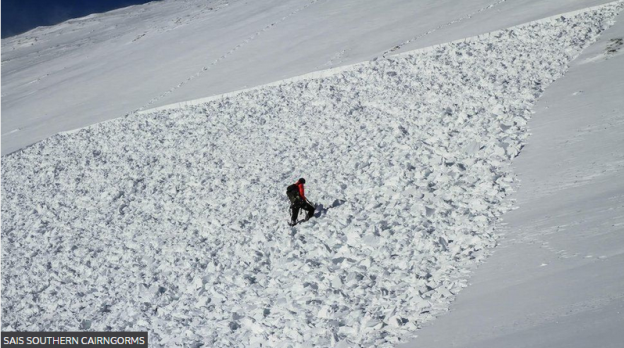
Debris from an artificially released avalanche in the Cairngorms, during training.
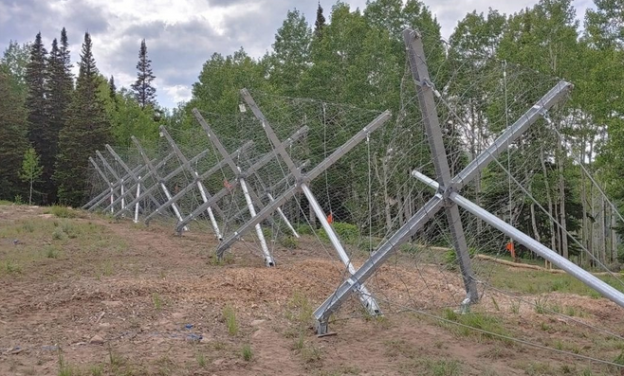
Avalanche fences are being installed in Park City, Utah despite a petition to halt the construction. However, the petition appears to be to irrelevant now, since the construction of the avalanche barriers are underway.
Iron Mountain Associates plans to install 214 avalanche fences. The avalanche fences are three to four meters tall and under construction in The Colony neighborhood. The avalanche barriers aim to prevent an avalanche from hitting the driveway of two specific homes.
An out-pour of community outrage has ensued since the county approved the project in 2020. Despite the community opposition, the construction of the fences is now underway.
While avalanche fences are effective, professionals feel there are better options. Alternatives exist which do not cause as much harm to wildlife and do not create extreme visual degradation.
Jake Hutchinson formerly managed the ski patrol avalanche mitigation program at The Canyons Resort (now Canyons Village at Park City) for over ten years. Hutchinson created the avalanche atlas currently used as a model for Canyons Village at Park City and The Colony. He claims that the avalanche modeling for the fences is based on insufficient data…. just what came from him and a couple of years of doing some measurements.
The Colony has long been concerned about avalanche mitigation. “Originally they proposed Gazex exploders up there, which are still a big nuisance and eyesore, but far less of an impact than permanent fences.”
Concerned citizens looked for a public comment period as an opportunity to express their concerns. The project’s approval under a Specially Planned Area (SPA) agreement surprised some residents. Hutchinson says, “We were watching for public comment period… and they slipped it through under the SPA agreement… The SPA doesn’t specifically have anything about avalanche fences or mitigation.”
The SPA agreement contains lengthy regulations for preserving sensitive lands and open spaces, wilderness protection, ordinances to minimize the visual impact of developments, and recreational access regulations.
Summit County resident and opponent to the avalanche fences, Seth Dromgoole, sent an email to the County Council to outline several conflicts found in the SPA agreement. Dromgoole states, “My interpretation of the Amended SPA (dated 1999) reveals multiple areas where this project may conflict with the agreement. Potential conflicts arise in the language surrounding viewshed, open space designation, and wildlife.”
Dromgoole also raised the concern, “The LIP [Low Impact Permit] for this project should not have been approved without public comment…The Dream Peak Avalanche Control Mitigation Fencing certainly creates unsightly conditions.”
Both Hutchinson and Dromgoole assert that there are more appropriate alternatives to avalanche mitigation than the installation of over 200 fences.
“Avalanche fencing is not industry standard for this use. The industry standard for fencing is to protect permanently inhabited structures and major roadways, not driveways. Avalanche fencing is excessive for what is essentially a shared driveway for two houses,” Dromgoole says.
Hutchinson is adamant that using Remote Avalanche Control Systems (RACS) such as Gazex is an adequate solution to potential avalanche activity in the area. “If they fire the RACS at 3 am, and then the road is cleared and opened, no one ever knows.”
Hutchinson believes that avalanche fences were proposed as an ultimate convenience for high-dollar property owners. “The reason for the fences is that they didn’t want a single moment of inconvenience for the homeowners,” he explains.
The main objection is that residents and visitors will suffer from visual impairment, restricted access to wilderness, and loss of wildlife through animal deaths.
Dyer Corp owner Russ Dyer has said that studies have shown that installing the barriers with 3 feet of space between each one allows for wildlife to pass through them and coexist safely.
But Hutchinson elaborates on the adverse effects of avalanche fences on wildlife. “They put fences near the Tombstone lifts in the early 2000s….. The first couple of years after they put those fences in… we were up there pulling dead animals out of those fences in the summertime, fairly consistently… big bull elk, deer, and other animals…. These [fences] will have a similar impact on wildlife, especially because these are about ten times the extent of what is near Tombstone right now,” he explains.
Dromgoole states, “The avalanche fencing will create a permanent scar on the landscape, will result in the destruction of viewshed for thousands of Summit County residents.”
The 200 plus fences will be visible across long distances. “If you are out riding your bike in Round Valley and look up there, it will look like rows and rows of fences,” says Hutchinson. He warns the community. “This is one of those things that people are going to look up there one day and wonder, ‘oh, how did that happen?’… Once they put the fences in, they will permanently impact the landscape.”
Neither Iron Mountain Associates nor Dyer Corp have responded to press inquiries.
A petition to halt the construction of the avalanche fences continues, but it appears to be to irrelevant now since the construction of the avalanche barriers are underway.
A week from graduating high school, Alaska avalanche survivor Peter Schutt was physically on top of the world as he climbed Donoho Peak near the Alaska/Canada border.
Unfortunately, Schutt’s adventure took a dangerous turn when an avalanche struck. Snow that was once a fixture on the frigid face of the mountain suddenly cut loose and turned into a freight train of cold, sugary crystals stampeding in rapid, unstoppable motion.
The avalanche pitched him over a 75-foot cliff on his tumble down 2,500 feet of the jagged mountain face. He remembers covering his head as best he could to prevent further injury.
After the avalanche Schutt’s friend and partner made his way down, contacted National Park Service via cell phone and provided cell phone GPS coordinates to aid the rescue response.
Alaska Air National Guardsmen of the 176th Wing partnered with multiple civil search and rescue partners to rescue Schutt during the May 26, 2021, ordeal.
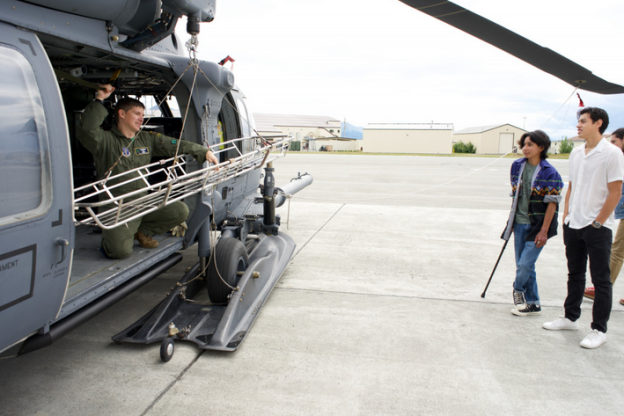
Following weeks of recovery, Alaska avalanche survivor Schutt, with several family members, visited the 176th Wing July 9 to share his story, tour the aircraft involved in the rescue, and thank his rescuers.
Following Schutt’s fall, National Park Service contacted the Alaska Rescue Coordination Center at 6:20 p.m. to notify them of the incident and request a hoist-capable aircraft be on standby. Snow conditions and steep terrain on Donoho made it impossible for the National Park Service A-Star helicopter to reach the injured hiker, and at 8:05 p.m. the NPS requested Air National Guard sup-port.
“The patient lost footing and rolled hundreds of feet down a snow-covered slope near Donoho Peak in Wrangell-St. Elias National Park and Preserve,” said NPS Ranger and incident commander Stephens Harper. “The fall triggered a snow slide, which then carried the patient over a cliff into a ravine.”
Schutt’s father, Aaron, was boarding a plane bound for Minnesota when he got the phone call no parent wants to receive. He was told the fall was “not a survivable incident.”
“Which is what you don’t want to hear as a parent,” he recalled.
Wrangell Mountain Air, a private charter company, spotted Schutt, confirmed his location, and re-layed GPS coordinates to the National Park Service who then relayed the information to the AK RCC.
With coordinates in hand, the AK RCC contacted the 176th Wing who dispatched a 210th Rescue Squadron HH-60G Pave Hawk helicopter, a 211th Rescue Squadron HC-130J Combat King II and a 212th Rescue Squadron Guardian Angel team comprising pararescue personnel (PJs).
First responders from Kennicott Wilderness Guides, who are also Wrangell-St. Elias National Park and Preserve Search and Rescue Team members, hiked a couple of miles to the ravine. They pro-vided emergency medical care while on the phone with the National Park Service Alaska Region medical director who is also an emergency room physician for Alaska Regional Hospital.
The NPS helicopter flew to the area but was unable to land safely, so they air-dropped medical supplies to the first responders and notified Harper of the need for a hoist and litter to safely move the patient off of the mountain.
The danger on the mountain didn’t dissolve when help arrived.
“While on the phone with [the doctor], they heard the snow shifting above them and moved the patient to higher ground before a second snow slide traveled down the ravine,” Harper said.
Maj. Ben Leonard, 210th RQS HH-60 rescue pilot, said the crew was training for the week at Eielson Air Force Base, about 300 miles north of their home base of Joint Base Elmendorf-Richardson. Leonard said the training proved helpful during the real-world rescue after Master Sgt. Tim Ching, HH-60 special missions aviator, completed 23 simulated hoists during four hours of training.
“In particular that week, we had done a ton of hoist training, especially high-angle hoist training, which is the scenario you ended up in later that week.,” he said. “In the days prior, we had flown a lot as a crew, and Tim had done what I would call a record number of live hoists in very challeng-ing scenarios with the PJs.”
Once on-scene, the Air National Guard pararescue team of Senior Master Sgt. Bryan Dalere and Sen-ior Airman Nathan Graber hoisted down to Schutt’s location where they provided additional medi-cal support and stabilized him for hoist to the helicopter. Looking through the window, HH-60 res-cue pilot Maj. Jake Ring said he marveled at the cliff fall Schutt survived.
“I remember looking up and thinking that has to be at least 80 feet,” he said.
The Pave Hawk crew transported Alaska avalanche survivor Schutt to the McCarthy Airport where he was transloaded to a Guardian Flight AirMedCare air ambulance and taken to Alaska Regional Hospital in Anchorage.
This rescue involved coordination between multiple agencies, including the 176th Wing, Alaska Air National Guard, Wrangell St. Elias National Park and Preserve Search and Rescue Team, National Park Service Fire Management in Fairbanks, National Park Service A-Star Helicopter, Wrangell Mountain Air, Guardian Flight, and Kennicott Wilderness Guides.
“It was the people, including Peter, with his will to live,” Aaron said in crediting the save. “His friend who was with him called for help immediately, and they got down to him within an hour and did all the right things on the ice – kept him as comfortable as possible, kept him alert, and continued to talk to his mother.”
During the July 9 visit, Schutt’s family toured a 211th RQS HC-130 as well as the HH-60 that res-cued him. Maj. Stephen Ludwig, 176th Wing Exercise and Planning officer and Combat King pilot, coordinated the event and gave Schutt a detailed rundown of the HC-130 flight deck.
“It’s always great, working in the RCC and working here, having survivors come back and share their stories, and to put a face to [a rescue,]” Ludwig said.
After recalling the events of May 26, Aaron expressed his appreciation of the multi-agency team that rescued his son.
“We’re just very thankful to all of you and what you do on a daily basis.,” he said.
Alaska avalanche survivor meets and thanks Arctic Guardian rescue teamAlaska avalanche survivor meets and thanks Arctic Guardian rescue team
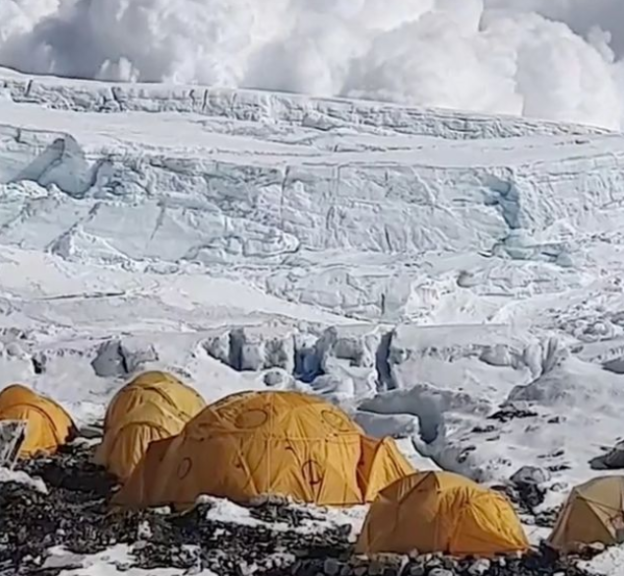
Frightening photos capture the moment a Mount Everest avalanche narrowly missed a group of tourists. They were on the mountain as it crashed down and headed right towards them. Part of the trail on the Himalayan peak collapsed, creating an avalanche headed straight towards the group of tourists.
The group were setting up camp when they narrowly escaped being buried by the avalanche in Nepal on June 1. Photos show the massive cloud of ice tumbling down the white mountain before it luckily slowed after hitting rocky parts. No one was hurt in the incident. The group inspected the area for safety after the Mt Everest avalanche.
Tour organizer Pemba Gyaltsen said they were doing a summit rotation to acclimate. They had just arrived from Nutspe mountain when the scary avalanche incident unfolded. He said: “The massive avalanche approached us at Camp 2 upon our arrival from Nutspe. We were relieved it did not reach us and we were all safe.”
In 2014, 16 Nepali mountaineering guides who were mostly ethnic Sherpas died after being hit by an avalanche in the mountain. It was regarded as one of the deadliest accidents in the history of the Himalayan peak.
In 2019 the peak had been branded a “death race” by those who had seen the horrors of frozen dead bodies and people collapsing as a total of 11 people died that year. It made 2019 one of the deadliest climbing seasons in history on the world’s highest mountain. Climbers told of how they have clambered over each other while abandoning bags and equipment on the narrow path in a desperate bid to reach the summit. Others were pushed and shoved by tourists taking selfies.
Mount Everest avalanche, extreme weather, lack of oxygen, falls, frostbite are what many deaths have been attributed to in the past. However, fatalities in 2019 were blamed on too many people and inexperienced climbers.
A Mount Everest avalanche in Camp 2 (viralpress)
A Mount Everest avalanche in Camp 2 (viralpress)
Crowding on Mount Everest in 2019 (AFP/Getty Images)