Avalanche Center Warns of Deadly Conditions as Storms Arrive

The high pressure over Utah is finally breaking down and snow showers are expected this weekend. While that’s good news for the ski resorts, the conditions in the backcountry will become dangerous – even deadly conditions could exist.

Since the first snow of the season has fallen,  there have been a lot of sunny days and a lot of clear, cold nights. What that’s done to the snowpack, according to Utah Avalanche Forecaster Trent Meisenheimer, is created the first condition for avalanche.

“We have generally shallow snow throughout the mountains,” says Meisenheimer. “What that creates is a very strong temperature difference in our snowpack right, so the ground stays relatively warm about 32 Fahrenheit and with that shallow snow the surface of the snow can be very cold like in the single digits cold. And that creates that big temperature difference across a very shallow layer of snow. And what that does is it makes our snow weak, or a term that gets thrown around a lot is faceted. Now what faceted snow is, is it takes that you know beautiful snowflake that falls out of the air and over a few days, it’ll actually become more square and angular, the shape of the crystal –  and it’s just like rock salt or sand  -if you could think about it that way. So, anywhere you look right now, and you see white snow on those hills it’s generally faceted snow. It’s become loose and sugary and weak.”  

Avalanches are created when snow is faceted, and a slab of new snow drops on top of the old, rotten snow.

“And a slab can just be anything that’s a little bit more dense than the snow underneath it,” he explains. “And as you heard, we’re expecting storms starting Friday morning and then lasting it looks pretty good all the way through Christmas with snow stacking up in the mountains. Now,  what this is going to do is it’s just going to raise our avalanche danger so because of that new snowfall, we’re gonna add a slab and now we’ve got avalanches throughout the mountains.”

No problem today – but this weekend things will change.

“Coming into the weekend, we’re gonna start building a slab on top of that weak layer and avalanches will become more likely,” he says. “So, what this means for us and what we need to do, is moving into the weekend, we need to be aware that this week snow exists and when we do get that stronger snow on top – we need to tone it down. So, that means sticking to slopes under 30 degrees in steepness. And really important, especially with weak layers, is that we don’t want to be under big slopes either because even if we’re standing on flat terrain and there’s that big, steep, hill above us, we can actually trigger the avalanche from below and have that avalanche come down on top of us.”

No one should be in the backcountry without a transceiver, probe,  a shovel – and a partner.
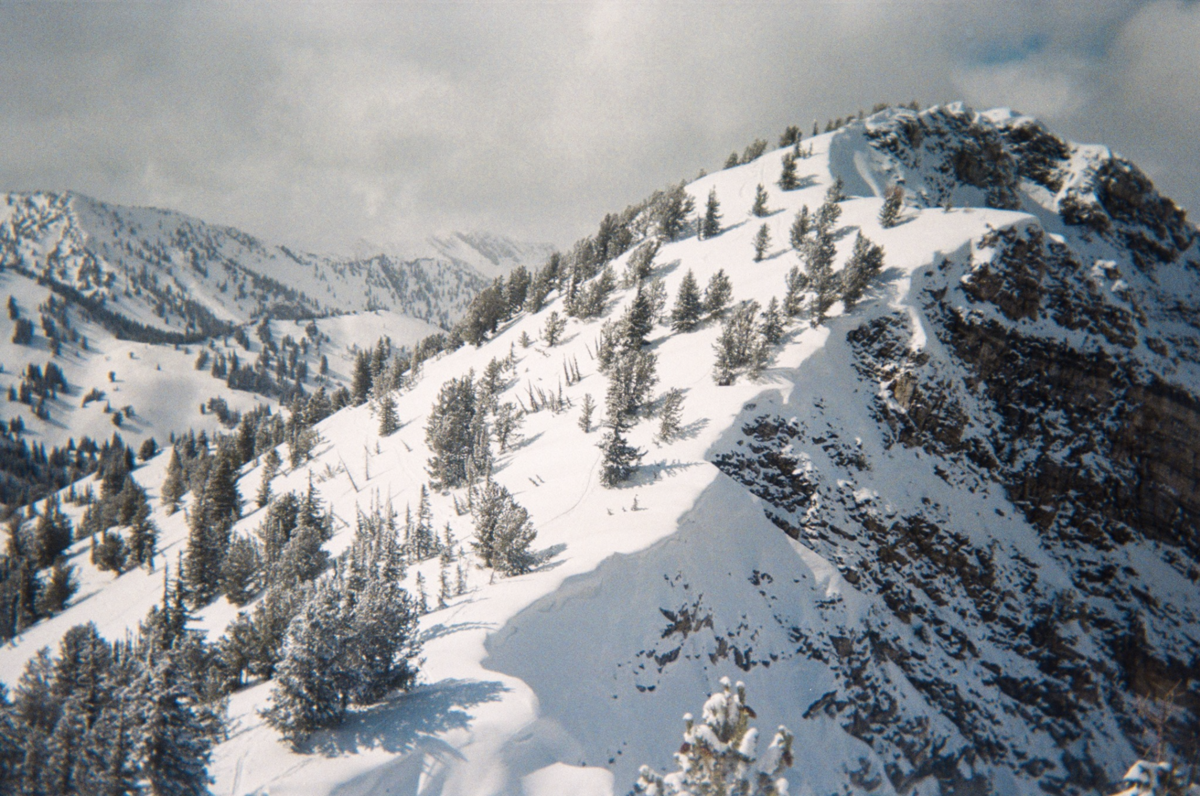
Utah avalanche center photo, US Forest Service
US Forest Service Photo

Highest avalanche situation level in East Tyrol

Piedmont, Italy - Extreme avalanche situation
Extreme avalanche situation in the Alps

The extreme avalanche situation in East Tyrol was made clear by an avalanche on Saturday evening in Prägraten am Großvenediger. Four houses and one vehicle were damaged. People were not injured. There were other snow avalanches with individual damaged buildings.

The Tyrolean avalanche warning service “imposed” avalanche warning level 5, i.e. very high risk, over East Tyrol. Spontaneous avalanches are to be expected from high catchment areas in the course of the day. In isolated cases they could also be extremely large. But at the same time, the head of the avalanche warning service, Rudi Mair, calmed down a bit. Due to the relatively warm temperatures and sometimes a lot of rain, wet snow avalanches in particular are to be expected, not powder avalanches. The latter would cause greater damage.

The emergency services also had to fight on all fronts due to the enormous rainfall in the state. Governor Günther Platter (ÖVP) assured East Tyrol financial support. District chief Olga Reisner appealed to the population to stay at home.

Lots of fresh snow in Carinthia

In Carinthia, enormous amounts of fresh snow in the Lesach Valley, the Gail Valley and the Upper Möll Valley. This resulted in roadblocks and an extreme avalanche situation. The milder temperatures in lower elevations caused some slopes to slide. Mudslides also blocked the road. The SPÖ regional councilor and disaster control officer Daniel Fellner appealed to the population in all areas affected by the weather to stay in their homes.

All emergency vehicles from the road maintenance depots were in constant use. Fellner asked the population in Upper Carinthia to adhere to the orders of the emergency services: “Please stay in your houses and do not climb the snow-covered roofs to shovel them free”.

After avalanches, some roads were closed, while snow chains were compulsory on others. In the course of the afternoon and towards evening, the snow in Lower Carinthia increasingly turned into rain showers. For the night it was expected that the precipitation would subside, but there should be some stormy wind in the Karawanken valleys.

New highs

According to the first data evaluation, the 24-hour fresh snow amounts at some ZAMG weather stations in the affected areas of the two federal states were in the record range. A “record” was even exceeded. In Umhausen in the Ötztal (1,030 meters above sea level) it snowed around 80 centimeters from Saturday to Sunday, the record for 24 hours there was 45 centimeters from October 2013. Measurements have been made here since 1956.

On the Brenner (1,400 meters) it snowed around 90 centimeters from Saturday to Sunday (record: 100 centimeters, measured in March 1975). In St. Jakob / Defereggen (East Tyrol, 1,283 meters) there was a snow cover of 110 centimeters on Sunday morning, in Döllach in the Upper Mölltal (Carinthia, 1,071 meters) of 97 centimeters and in Sillian (East Tyrol, 1,081 meters) of 89 centimeters.

According to ZAMG, it snowed around 100 to 150 centimeters from Friday to Sunday morning on the mountains of Upper Carinthia, East Tyrol and in the area of ​​the main Tyrolean Alpine ridge. Sometimes a little more. There will be another 50 to 100 centimeters of fresh snow by Monday, according to the forecast. After that, the situation should ease. The foehn storm still reached more than 100 km / h in the mountains on Sunday morning.

(apa, Wiener Zeitung Online)

Obergurgl, Tirol, Austria - extreme avalanche situation
Obergurgl, Tirol, Austria

Avalanche accident kills 1 in Switzerland

Dec. 8, 2020

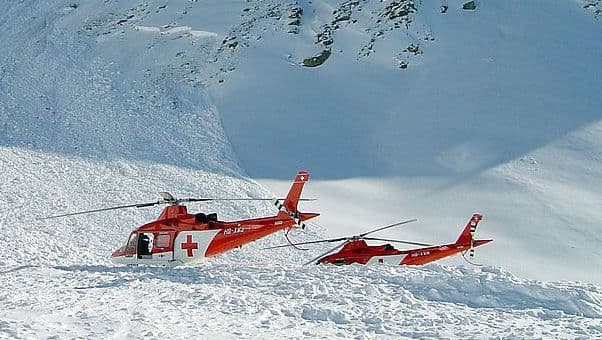
Swiss avalanche accident rescue
Stock image, SLF

BERLIN (AP) — An avalanche accident killed one skier in Switzerland.

Authorities in the Swiss canton of Nidwalden said one off-piste skier among a group of five people was killed in an avalanche accident Monday in the Titlis area, south of Lucerne. Rescue teams were not able to resuscitate the 23-year-old Swiss citizen after he was rescued.

The victim died on the scene near the Titlis mountain. Two others, out of five, were also hit but managed to free themselves without serious injury.

The group was skiing off-piste when the avalanche struck at around 10.15am. An investigation into what triggered the avalanche is ongoing.

A 23-year-old German man was also injured in an avalanche accident Monday in Austria’s Hahnenkamm skiing region in Tyrol. He went skiing on a closed slope. He was taken by rescue plane to a hospital in Kempten in Bavaria.

In a broad swath of the Alps in Switzerland, authorities raised the avalanche warning level to 3 on a five-point scale. Exceptionally heavy snowfall was dumped over the weekend. Some higher elevations recorded between 50 and 80 centimeters (20-32 inches) of snow over the last three days.

Snow Pummels Austria, Italy, Germany and Switzerland

Several roads were still closed in Tyrol and some valleys were cut off from the rest of the country. Electricity provider Tinetz said 4,000 homes lost power after several electrical lines were snapped by snow or fallen trees, public broadcaster ORF reported.

Austria issued avalanche warnings Tuesday for the country’s mountainous east after days of heavy snow pummeled the region.

Northern Italy saw massive snowfall over the weekend and snow also hit parts of Germany and Spain as well.

“It’s true that it’s early for the season” to have so much snowfall, said Mikhael Schwander, a meteorologist with Swiss weather service MeteoSuisse. He said the higher the elevation that the snow fell, the greater the risk of avalanches — although that also depends on other factors including the temperature and the types of snow on the ground.

According to SRF Meteo there is an elevated avalanche threat throughout northern Ticino, including Centovalli, and in the southern valleys of Graubünden and the Upper Engadine. In these regions, it’s a Level 4 on the five-part danger scale.

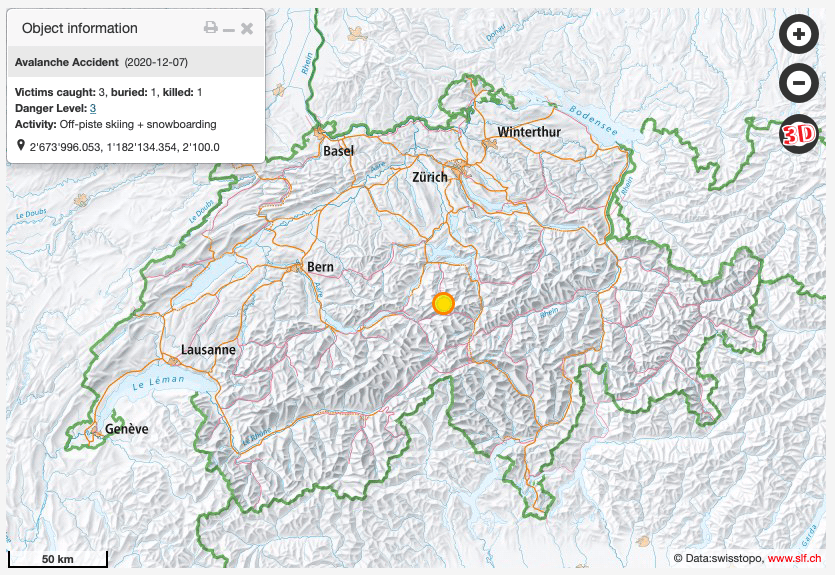
Location of avalanche accident
Location map, from Swiss SLF

Related:

Avalanche Warnings and Snowfall postpone Austrian virus testing

(AP) — Several communities in the Austrian Alps put mass coronavirus testing on hold Sunday. Others were urged to do the same after a storm dumped huge amounts of snow, sending some avalanche warnings to their highest level.

In East Tyrol, 500 households were left without electricity after trees brought down power lines. The avalanche warning was at its highest level of 5. Several areas in East Tyrol postponed virus testing. In North Tyrol, the avalanche warning was at 4 on Sunday.

Neighboring Italy and Switzerland also issued avalanche warnings, and the Brenner Pass highway between Austria and Italy was partially closed, as were some train connections, APA reported.

More than a meter (three feet) of snow fell within a few hours in the Italian Dolomites and rain burst riverbanks of the Panaro river, forcing a few dozen families to evacuate from the Modena area as a precaution, the ANSA news agency reported.

In Austria, Tyrol authorities told local communities to assess whether the conditions warranted postponing coronavirus testing planned for Sunday. “The safety of the population comes first,” authorities said.

Austria on Friday started a voluntary mass testing program that officials hope will prevent long, hard lockdowns in the future. The fast antigen tests started in Vienna and in the westernmost Vorarlberg and Tyrol provinces. The testing is part of Austria’s strategy to slow the spread of the coronavirus even as it starts to ease restrictions this coming week.

Tough lockdown measures that took effect Nov. 17 expire on Sunday. Going ahead, Chancellor Sebastian Kurz said Austria will allow skiing from Dec. 24 but will keep restaurants, bars and hotels closed until Jan. 7.

A member of French ski team removes snow from a car with a shovel.

Call to check avalanche transceivers as potential issue reported

A potential issue has been identified with the switches on Black Diamond/PIEPS DSP Pro and DSP Sport models of avalanche transceivers.

Pieps Avalanche Transceivers

Owners and users of these devices are encouraged to follow the manufacturers guidance and check that they are operating correctly.

During filming for this season’s TGR Film, pro skier Nick McNutt was caught in a snow avalanche right in front of the film crew and fellow skiers. As they rushed to search for him, they were quickly hit by the realization that they couldn’t get a signal from his avalanche transceiver. Fortunately for Nick, with a film crew and a bunch of experienced skiers on hand, a probe line was formed and he was found alive, though battered, broken and bruised. On digging him out it was found that his transceiver switch was in the OFF position. He was wearing his transceiver in the chest harness as indicated by the manufacturer.

Unfortunately, the offending transceiver was lost in the post whilst attempting to return it to Black Diamond for testing.

In publicizing this event on social media, and within the North American guiding community, other anecdotes have surfaced involving issues with the switches, and various videos have been posted showing the switches being overridden. Black Diamond/PIEPS state that their testing has shown no change in switch resistance with heavy use, but they noted that switches with visibly damaged lock/switch mechanisms showed a decrease in switch resistance of 50-100%. They also stated there have been only two recorded incidents in which the switch allegedly failed. In the other incident the transceiver was not worn in its harness and the police investigation reported that the victim’s avalanche transceiver was working properly.

Please ensure you check your own transceiver to ensure the switch is free from cracks and is working correctly. Should you be unsure, please contact PIEPS/Black Diamond on dsp@pieps.com

And if you’re wearing a transceiver, make sure you’re well practiced in using it and that you’re carrying the means of finding and digging someone out, which means carrying a probe and shovel.

British Mountaineering Council, December 4, 2020

I-70 Avalanche – Snowboarders say 4th, 5th Amendment rights were violated

Dec 2, 2020

SUMMIT COUNTY, Colo. (KDVR) — Two backcountry snowboarders who allegedly triggered a snow avalanche near the Eisenhower Tunnel last March are now responding with a first-of-its-kind court motion.

Evan Hannibal and Tyler DeWitt are being charged with a single misdemeanor count of reckless endangerment and are being ordered to pay $168,000 in restitution.

However, the pair is claiming the Colorado Avalanche Information Center (CAIC) violated their Fourth and Fifth Amendment rights.

In a motion filed Wednesday attorney Jason Flores-Williams alleges the Go-Pro video being used by prosecutors as evidence should never have been handed over to Summit County prosecutors.

The attorney says his clients gave the video to the CAIC in good faith, not knowing it was going to be used against them as evidence.

“He (Hannibal) believed he was contributing to overall knowledge of snow avalanches. It’s now being used to prosecute. You need to tell them, ‘What we’re using could be used against you,’” Flores-Williams explained.

Flores-Williams believes what happens in the case could have implications that extend far beyond Colorado. He believes his clients are being made an example.

“This is absolutely ridiculous. We’re fighting this message being sent that going forward skiing and backcountry life might be criminalized. What we’re doing here is defending the backcountry and this has implications throughout the entire Mountain West,” he explained.

Nobody was injured in the avalanche. However, a service road used primarily by transportation workers was buried under about 20 feet of snow. Expensive avalanche mitigation equipment was also destroyed.

District Attorney Bruce Brown plans to respond to the motion in court. He released this statement to FOX31:

“Information voluntarily surrendered without coercion enables prosecutors to use that information in court. I am unaware of any express or implied limitation that was placed on information obtained during the law enforcement investigation that would undermine that principal. It is important that every person charged with a crime have an opportunity to fully litigate all legal issues before a judge and have their guilt determined by an impartial jury of their peers.”

A trial is scheduled for late March.

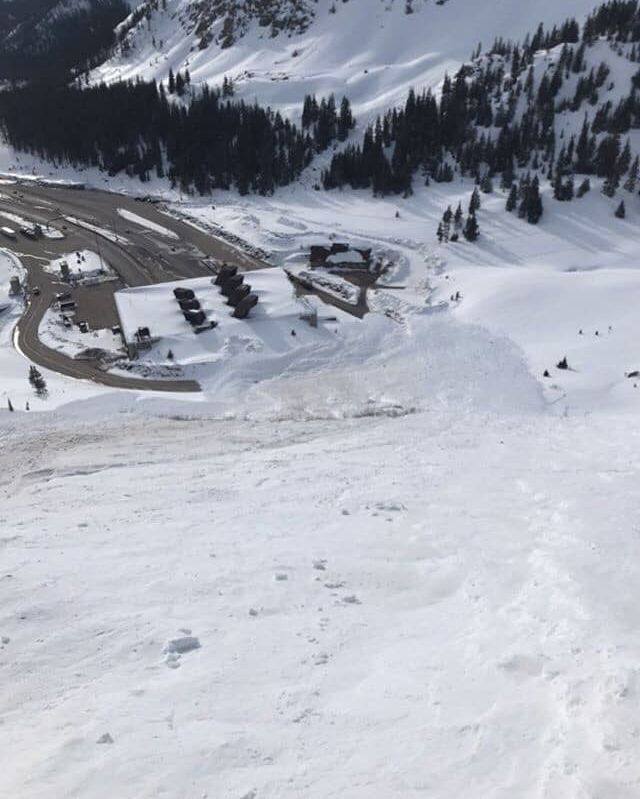
avalanche
Snow avalanche on I-70 which buried the service road

Avalanche risk considerable in East Kootenay

Avalanche Canada is reporting considerable avalanche risk in the alpine in the East Kootenay.

In the Lizard-Flathead, South Rockies and the Parks Canada ranges, Avalanche Canada reports: “It’s expected to be very warm and sunny Wednesday, alpine temperatures could be as warm as +6 C. The snowpack doesn’t like rapid changes like this. Cornice failures and even natural avalanches are possible as we head into the warm spell.”

For the Purcells, Avalanche Canada notes: “Things are looking hot up high for the next couple days. Naturally triggered wet loose avalanches are possible on all aspects and especially likely on solar aspects. Overhead hazards will be a primary concern.”

Travel and Terrain Advice

Be careful around freshly wind loaded features.

Extra caution for areas experiencing rapidly warming temperatures for the first time.

Minimize overhead exposure; avalanches triggered by warming or cornice fall may be large and destructive.

A moist or wet snow surface, pinwheeling and natural avalanches are all indicators of a weakening snowpack.

Snow Avalanche blocks Manali-Atal Tunnel

Nov 30, 2020

MANALI: A snow avalanche on the Manali-Atal tunnel highway beyond the Solang valley blocked the highway for nearly one hour on Sunday evening. Border Roads Organization (BRO) cleared the avalanche debris, after which the highway was opened. Fortunately, there was no vehicular movement when the avalanche hit the highway.

Tourists are not being allowed to go towards Atal Tunnel as the area has received very heavy snow. Only local residents are being allowed to use the Tunnel.

Tourist movement in Solang valley is restricted. The area between Solang and Atal Tunnel is prone to avalanches. Avalanche control structures are proposed to be built at some high-risk zones but only two such structures have been built so far.

Snow and avalanche study establishment (SASE) issued avalanche warning for five districts of Himachal.

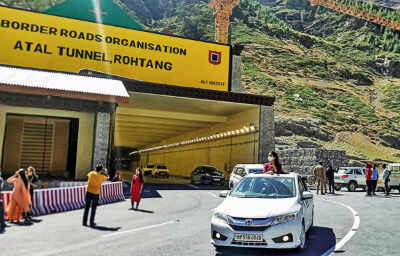
Snow Avalanche blocks Atal Tunnel

280 Buried in Avalanche; 70 Saved

Kullu, November 29

Around 280 sheep and goats were buried under the snow due to an avalanche in the Parbati valley on Saturday. According to information, 130 sheep of Gurdayal Singh, 120 sheep of Raju and 30 sheep of Room Singh, all from Barshaini village, were grazing at Shilha Nala and were buried in a large snow avalanche.

The villagers carried out the rescue operation but only 70 sheep could be saved. A team of district administration, police and Animal Husbandry Department visited the spot. Barshaini panchayat president Jairam said adequate compensation should be provided to the herders.

Passengers stranded at Zojila pass in avalanche rescued

29 November, 2020; ANI

Five passengers stranded at Zojila pass, after a snow avalanche hit the region, has been rescued by Border Roads Organizations (BRO) on Sunday.

The Project Beacon of Border Roads Organizations (BRO) on Sunday rescued the passengers from Srinagar-Sonmarg road. Vehicles were also evacuated from here and the road was opened for traffic later.

It is noted that a four-member committee has been constituted for the management of the opening and closure of Zojila pass this month. Divisional Commissioners of Kashmir, Ladakh, Ganderbal, and Kargil are members of the committee. (ANI)

Srinagar-Leh highway perilous for travelers

Four persons traveling in a Xylo car on way to Kargil from Sonamarg had a narrow escape when their vehicle came under a massive avalanche near India Gate on Zojila Pass on Saturday.

The four had set out on the journey after some light motor vehicles were allowed to move on the highway which was reopened for traffic after five days on Saturday. However, soon the highway was again closed.

As they reached near India Gate on Zojila Pass a massive avalanche hurtled down burying their car, sources said. “Luckily, few workers of border roads organization who were carrying the snow clearance work on the highway saw the incident and immediately a joint rescue operation of Drass police and BRO was started,” sources said. After hectic efforts by the rescue team, all the four including the driver were rescued safely and the cab was pulled out from the snow. The rescue operation continued till late night and was monitored by SDM Drass Asgar Ali, SHO Drass Manzoor Ahmed and BRO officials.

The strategic 434 Km long Srinagar-Leh highway, which is the lifeline for Ladakh and its socioeconomic development, connects the region with rest of Jammu and Kashmir. The road remains closed for about five months during winters as the area from Sonamarg-Drass along the highway receives heavy snowfall. Come winters, one can see the chaos and confusion that always prevails on the Srinagar-Leh highway due to snowfall, slippery road conditions, traffic jams and the dangerous snow avalanches that occur anytime.

Due to the pandemic, the authorities on the recommendations of the Ladakh UT administration this winter decided to keep open the Srinagar-Leh highway till maximum possible time to stock up essential commodities in Ladakh. “However the situation emerging after the recent snowfall and the road conditions prevailing can be a death trap for the travelers,” sources said.

Sub divisional magistrate, Drass, Asgar Ali told Greater Kashmir that it was a miraculous escape for the four persons. “The light motor vehicles were allowed from Sonamarg to Kargil on Sunday and the road is connected, but the sudden snow slides triggered by heavy winds remain a concern and challenge. In winters the chances of snow avalanche caused by heavy winds are more and it puts the life of travellers as well as the people working on highway at risk,” the SDM said, adding that to keep the highway open during winters is risky as well as challenging.

Meanwhile, a traffic advisory issued today said that subject to fair weather and good road condition, only one-way traffic from Kargil towards Srinagar shall be allowed on Srinagar-Sonamarg-Gumari road. “LMVs (shall be allowed) from Minamarg followed by HMVs between 0830 hrs to 1400 hrs. No vehicle shall be allowed after cut off time; the vehicles may carry anti-skid chain to gain more grip on the slippery road. Security forces shall follow the same schedule. No vehicle shall be allowed from Gagangir towards Sonamarg between 1800 hrs to 0900 hrs due to slippery condition of the road.”