New avalanche-control system on Lizard Head Pass

The Colorado Department of Transportation has completed installing a remote avalanche control system on Lizard Head Pass, Colorado 145.

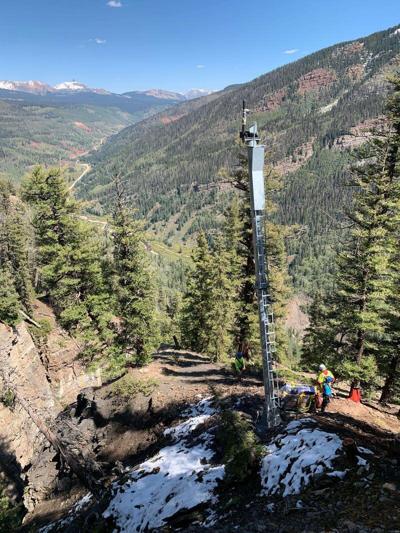
Crews installed five towers on the mountain and ridge about the highway, about 1 mile north of Rico and 20 miles south of Telluride. The towers will be used for triggering avalanches at known snow slide paths in the area.

This summer, CDOT installed the remotely controlled Wyssen avalanche mitigation system. Charges can be tethered and dropped from the towers, into the avalanche paths to bring down the slides in a controlled manner.

Wyssen Avalanche Control of Switzerland’s WAC.3 system replaces aging technology and other methods CDOT currently uses to shoot off avalanches on 145 before they can become a hazard to the motoring public.

The new system is expected to help keep Colorado 145 open, or allow it to be more readily reopened, during heavy snows, as the road is an alternative route for U.S. 550 Red Mountain Pass, which closes frequently during severe weather.

Separately, CDOT has also installed a new remotely controlled avalanche mitigation system on U.S. 6 from the Arapahoe Basin ski area.

Nov 29, 2020

New avalanche-control system installed on Lizard Head Pass

Avalanches reported across Colorado

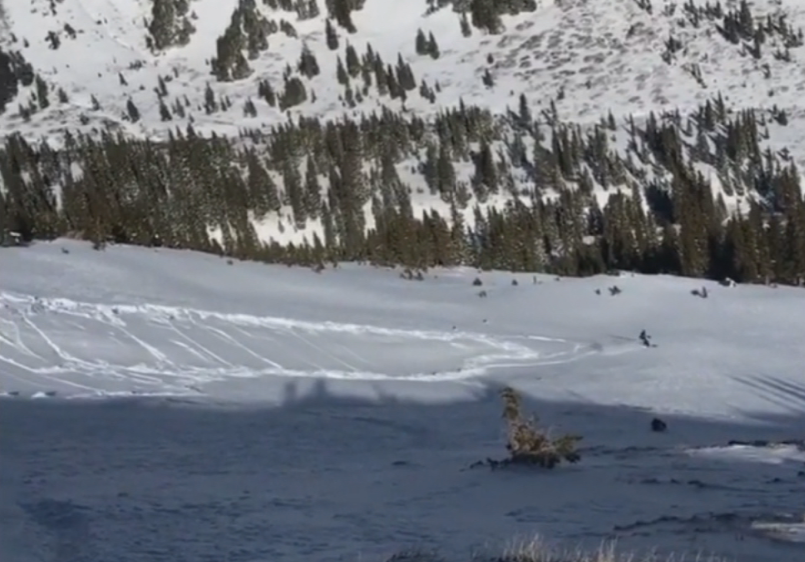
Several natural and human-triggered avalanches have been reported across the state this week, including one near Vail Pass on Thursday, the Colorado Avalanche Center said.

The Vail Pass avalanche broke at the ground, they said. Although it was relatively small, it could have injured someone if they had been caught in it. The avalanche was triggered by skiers.

People should avoid steep slopes, especially on north and northeast faces where cohesive slabs of snow are formed by the wind. Avalanches can break in upper wind-effected layers or at weak layers near the ground, the Avalanche Center said. “With a relatively shallow early season’s snowpack, it is not difficult to affect these layers and create a failure. It is best to avoid traveling on steep wind-loaded slopes where these conditions exist.”

There were several natural and human-triggered avalanches across the state on Wednesday. Avalanches were reported at Berthoud Pass, Montezuma and near the Eisenhower Tunnel.

The Avalanche Center said most of the mountains will see a moderate risk of avalanches on Friday and Saturday at and above treeline.

Avalanche near Vail

Avalanche Warning Issued

November 24, 2020

SRINAGAR: Following the adverse weather forecast on Monday and Tuesday, authorities on Sunday issued a snow avalanche warning for higher reaches in the Kashmir division.

An official of the Disaster Management Department said a medium danger avalanche warning will remain in force during the next few days in Kupwara district while low danger avalanche warning will remain in force in Baramulla, Anantnag, Kulgam, Bandipora and Ganderbal districts.

“People are advised to avoid unnecessary movement outside their homes while the warning remains in force,” the official said.

Avalanches have claimed human lives in much larger numbers in recent years than they used to in the past. Experts are blaming deforestation for the growing avalanche threat because once a mountain slope is bereft of its tree cover there is nothing to stop an avalanche once it starts rolling down the slope. (IANS)

Prince Charles avalanche episode on Netflix criticized

The wife of Hugh Lindsay, killed while skiing with Prince Charles, asked Netflix not to feature the avalanche

Nov 2020

The widow of a British army major who died in an avalanche while skiing with Prince Charles has criticized the producers of The Crown on Netflix as “unkind” for dramatizing the disaster against her wishes.

Major Hugh Lindsay, a former Queen’s equerry, was skiing off-piste at the Swiss resort of Klosters in 1988 with a group including senior royals when disaster struck, with his friend the Prince of Wales and others reported to have dug snow with their hands in a vain attempt to save his life.

After the episode on “The Crown” titled “Avalanche” was made available for streaming last week, Lindsay’s widow, Sarah Horsley, has revealed she had asked Netflix not to adapt the disaster for television.

“I was horrified when I was told [the episode] was happening and was very concerned about the impact on my daughter,” she told the Sunday Telegraph.

“I’m very upset by it and I’m dreading people seeing it. I wrote to them asking them not to do it, not to use the accident. I suppose members of the royal family have to grin and bear it, but for me it’s a very private tragedy.”

She added that the producers replied with “a very kind letter”, saying “that they understood my concerns, but they hope I will feel that they deal with difficult subject matters with integrity and great sensitivity”.

However, Horsley said: “I think it’s very unkind to many members of the family.”

Netflix’s description of the episode reads: “Charles is caught in a deadly avalanche, and he and Diana are prompted to reevaluate their commitment to their troubled marriage.”

At the time of the disaster, Horsley was pregnant with their daughter Alice and still working at her job in the press office at Buckingham Palace. She did not go on the ski trip and stayed at their south London home.

Charles, who went on to become a godfather to Alice, later wrote: “I still find it hard to understand why I survived and he didn’t.”

Patti Palmer-Tomkinson, another friend of the Prince, received severe injuries to both of her legs and her lungs. Princess Diana, who was also on the holiday, was not on the slopes when the avalanche hit and had stayed at their chalet in Davos, along with Sarah, Duchess of York.

The group then flew back to London, where a guard of honor from Major Lindsay’s regiment met his coffin.

Netflix has also faced criticism over the historical accuracy of its script, with calls for it to be accompanied by a disclaimer explicitly stating that some events have been embellished. The scriptwriter, Peter Morgan, has said: “Sometimes you have to forsake accuracy, but you must never forsake truth.”

The Times reported this week that friends of the Prince of Wales had described the show as exploitative and inaccurate. “This is trolling with a Hollywood budget,” a source said.
Austria avalanche: Skier survives five hours

27 December 2019

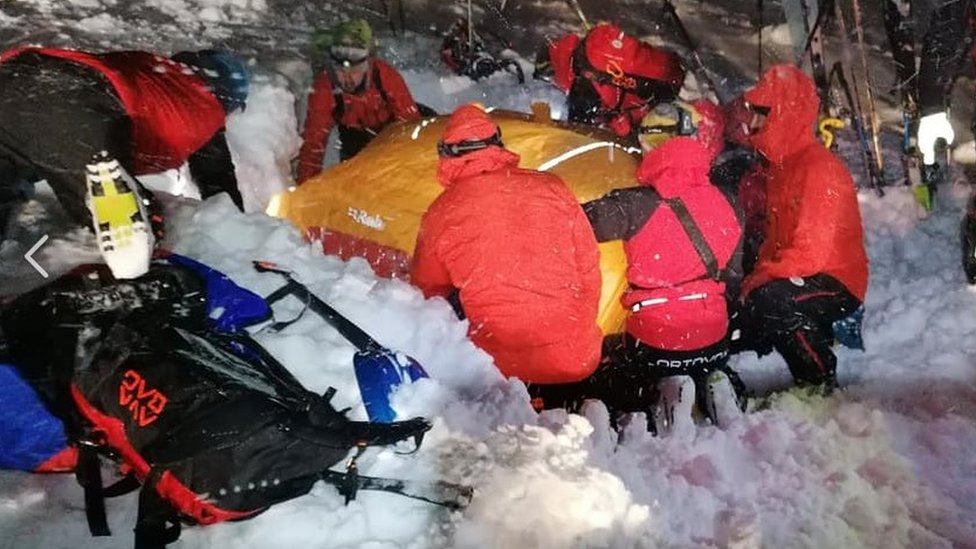
Rescuers have dubbed the survival of a man a “Christmas miracle” after an avalanche in Austria buried him in snow for five hours.

Authorities were contacted shortly before 17:00 (16:00 GMT) on Christmas Day 2019 by a man who said the 26-year-old had not yet returned from skiing.

The man had managed to get through to the skier’s mobile phone but heard only “crackling noises”.

The missing skier was located a couple hours later.

He was found beneath a meter of snow with his avalanche transceiver, which pinpointed the man on Mt Pleschnitzzinken in the north-western area of Upper Styria.

Transceivers are worn on the body and emit an electromagnetic signal. They can also be used in search mode to pick up signals from other devices.

‘Extremely lucky’

A team from the Gröbming mountain rescue and local police dug the man out of the snow and he was taken down to the valley suffering from hypothermia but otherwise unharmed.

“You can’t move under the snow like this,” said Stefan Schröck of the Styria mountain rescue service. “The man was extremely lucky, he had a large enough air pocket under the blanket of snow, so he had oxygen and was able to breathe.”

Surviving for five hours under an avalanche happens only every 20 years in the Alps, according to Mr Schröck. If you are not found within 15 minutes of an avalanche your chances of survival are slim and if you are to survive beyond an hour you need a source of oxygen.

Skier brought out after five hours

Most Colorado Avalanches Don’t Involved Beginners

November, 2020

The Colorado Avalanche Center (CAIC) recently published a report related to how the COVID-19 pandemic and correlated surge of backcountry use has impacted avalanche numbers in Colorado. One key finding was that while the number of backcountry beginners involved in snow avalanches stayed similar before and after the pandemic and the number of intermediate users involved in avalanches actually decreased, the number of advanced skiers involved in avalanches spiked.

Another trend discovered in the report was that more avalanche-related accidents occurred during ‘considerable’ avalanche risk days, despite less total ‘considerable’ risk days during the season.

During their analysis, the Avalanche Center categorized those involved in avalanches based on their skill level. Fifteen percent were beginner, 25 percent were intermediate, 47 percent were advanced, and 8 percent were expert.

According to the CAIC Avalanche Center, results from this study align with previous research that has indicated that avalanche education does not reduce avalanche exposure.

Another interesting finding from the CAIC study was that most avalanche incidents during the 2019-2020 season occurred during level 2 (moderate) risk, accounting for 60 percent of incidents. Thirty percent of avalanches occurred during level 3 risk (considerable) risk.

North Cascades Highway closes for the season due to avalanche risks

The heavy snows of the past few storms mean the time has come for the annual North Cascades Highway closure in Washington state. WSDOT announced the closure Monday as snow has filled the avalanche chutes that line the highway, which pose a safety risk for drivers and road crews.

The seasonal avalanche closure currently begins at the Ross Dam Trailhead on the west side and Silver Star Gate 37 miles away on the east side. As the snow accumulates this fall and winter, the closure will extend a few more miles in each direction.

The earliest closure was on Oct. 17 in 2003, and the latest “closure” was in 1976 when so little snow fell the pass didn’t need to close that winter. That is the only time that’s occurred since 1972. In the winter of 1989, it didn’t close until Jan. 3, 1990.

Hikers, skiers, snowmobilers and other recreationalists can access the closed portion of highway during the winter season. Users should park in designated parking areas to allow plow drivers the space they need to clear snow around the closed stretch’s access gates.

Sign greets travelers to the North Cascades Highway (WSDOT image)

Heavy snowfall, avalanche warning in 4 Kashmir districts

New Delhi, Nov 16 (PTI)

Heavy snowfall and landslides in the Union Territory forced closure of the important Jammu-Srinagar National Highway in Ramban and authorities in Kashmir have issued an avalanche warning for four districts — Kupwara, Bandipora, Baramulla and Ganderbal.

While a medium danger avalanche warning has been issued for the higher reaches of Kupwara and Bandipora districts, a low danger avalanche warning has been issued for the higher reaches of Ganderbal and Baramulla districts, they said.

Several high-altitude areas of Jammu and Kashmir, Uttarakhand and Himachal Pradesh were wrapped in thick white sheets of snow, with many tourist destinations like Kufri, Manali and Auli receiving the season’s first snowfall, while temperatures dipped in Delhi, Haryana and Punjab following rains.

The Jammu-Srinagar National Highway, the only all-weather road connecting Kashmir with rest of the country, was closed for traffic following snowfall around Jawahar Tunnel and landslides from the hillocks at several places in Ramban district, officials said. The alternate link between the valley and rest of the country, Mughal Road, also remained closed for the third day as high-altitude areas experienced snowfall.

https://th.thgim.com/news/national/other-states/wk36mo/article33106821.ece/ALTERNATES/FREE_660/SRINAGAR

Upper Himalayan areas, including Kedarnath, Badrinath, Gangotri, Yamunotri, Auli and Harsil, of Uttarakhand received the season’s first heavy snowfall, intensifying cold conditions across the state. Snowfall began on Sunday night and continued till Monday morning, according to officials. The shrines of Kedarnath and Yamunotri in Uttarakhand closed for the winters amid the heavy snowfall.

In Jammu and Kashmir, security forces have rescued 10 people, including two women and a child, after they were trapped in heavy snowfall at the high-altitude Sinthan pass. The rescue operation was carried out late Sunday night after information was received about a group of stranded civilians. The rescue team, comprising army and police personnel, walked for five hours along the National Highway 244 in zero visibility conditions during the night and brought the stranded people to Sinthan ground where they were provided with food and shelter.

Delhi recorded a maximum temperature of 25.8 degrees Celsius, the lowest this season so far, following rains under the influence of a Western Disturbance. However, the minimum temperature rose to 16 degrees Celsius, the highest since October 22, according to the India Meteorological Department (IMD). IMD officials attributed the drop in the maximum temperature and the increase in the minimum temperature to the presence of clouds in the region under the influence of the Western Disturbance. Until now, Delhi had been witnessing a trend of low minimum temperatures this month due to the absence of cloud cover. Clouds trap some of the outgoing infrared radiation and radiate it back downward, warming the ground.

Skiers Trigger Avalanches Near Independence Pass

Avalanche forecasters recently raised warning flags following a pair of skier-triggered snowslides. Neither skier was injured.

The Colorado Avalanche Information Center (CAIC) suggests that backcountry skiers stay clear of steeper slopes or simply wait for greater depth of solid snow.

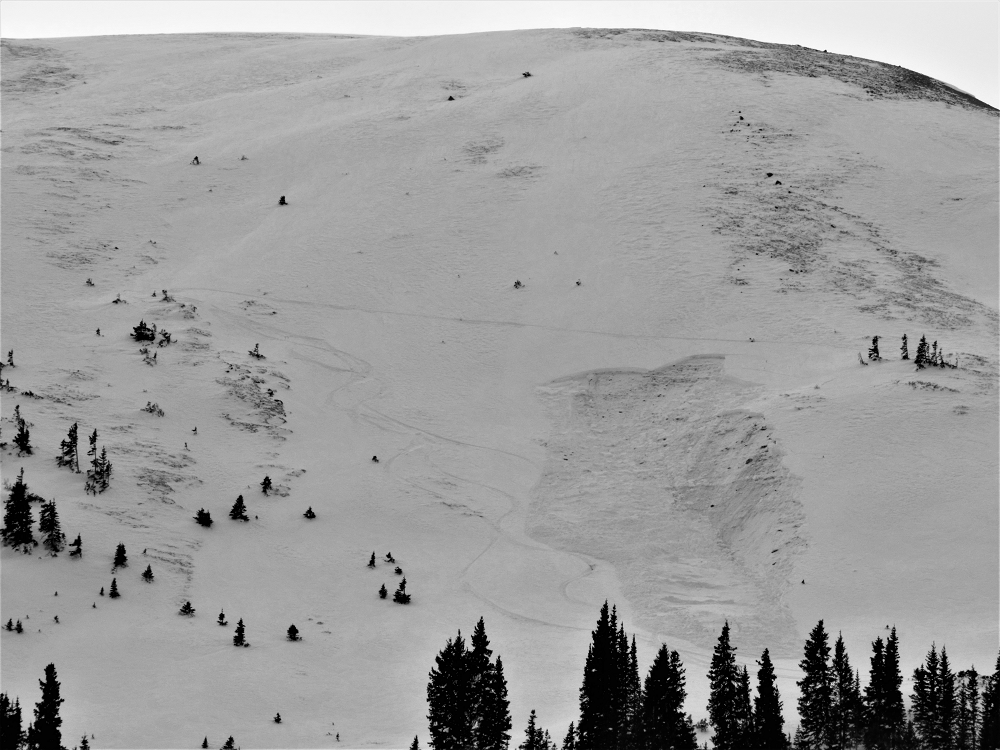
The first occurred Tuesday near Independence Pass. The skier was caught in the avalanche and pulled off their feet.

The second avalanche happened Friday in Mountain Boy Gulch, south of Independence Pass, on a north-facing slope.

The skier was traveling quickly and moved out of the slide’s path.

CAIC said dry snow from an October storm is now the weak base for additional depth. Both of the locations that slid last week are subject to drifting that proves attractive to early season recreationists. “Attractive for riding, but also the slopes with enough snow for avalanches.”

Avalanche in Colorado

In a new Avalanche Safety initiative survivors share harrowing experience

A new avalanche safety initiative started in Alberta is looking to prepare backcountry explorers for the unthinkable.

The founders of the Backcountry Safe are drawing from their own tragic story of surviving an avalanche in 2016.

“Upon reflection, over the last couple of years every member of our group has come to realize that we had a shared responsibility,” Sheila Churchill, avalanche survivor and Backcountry Safe co-founder, said.

“There were lessons that we have learned that we need to share with the greater public about safe travel in the backcountry.”

They say having experience and confidence just aren’t enough to prevent a tragedy.

“Obviously we thought we would be fine too,” Churchill said.

“We thought this would never happen to us. We thought we had done our due diligence, but the reality is the mountains don’t care.”

Co-founder Mitch Putnam said an incident during the group’s ski trip continues to leave each of the members with heavy hearts as well as scars.

“There’s no doubt it was very tragic,” Putnam said. “We lost a dear friend and Sheila’s husband Doug Churchill passed away as a result of the tragedy and we had multiple injuries within our group.”

Putnam said hiring a guide is not where the preparation should end.

“We did not come as prepared as we should have been individually,” Putnam admitted. “We checked out mentally and left everything to the guide, which was a mistake.”

Backcountry lessons

The initiative groups learned lessons into main themes:

Know yourself and your group. Plan your day. Know what to do in an emergency.

“How are you communicating and making decisions?” Putnam said. “That’s a really interesting piece for anyone heading into the backcountry or undertaking any outdoor adventure.”

“We know that the stories are there and that is where we will learn as a community,” Churchill said. “By sharing these stories together and keeping everyone safe.”

A documentary on their harrowing experience is included on the Backcountry Safe website.

If you have your own experience, tips or warnings to share feel free to add a comment, no login is required.