Tag Archives: avalanche accidents

Swiss Avalanche Deaths Up 50% Over the 20-year Average This Winter

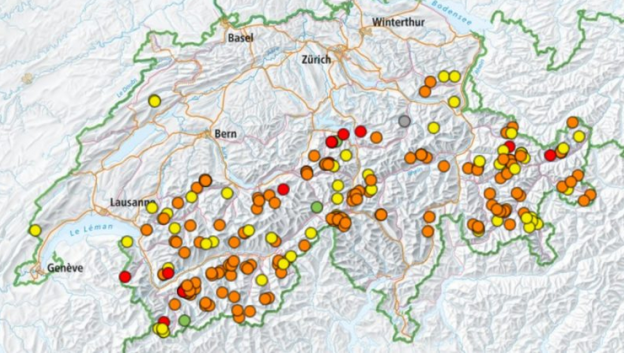
Swiss avalanche deaths are up this season. Significantly more people have been killed than the latest 20-year average. The majority of victims were off-piste skiers or snowboarders. The grim statistics come in a report by the Swiss Institute for Snow & Avalanche Research (SLF) and cover the period from 1st October 2020 to 30th March 2021.

27 people have died in avalanches and one person is still missing. The 20 year average is 18 Swiss avalanche deaths to the end of March. This shows an increase of 50%.

“All of the victims were winter sports enthusiasts in unsecured terrain,” the report states. 11 were backcountry ski touring or hiking and 16 were off-piste skiing or snowboarding.

Two people died in one accident, but for all other accidents, one person died.

The 4 Valleys area, which includes Verbier, was the worst hit with seven (26%) of the season’s avalanche deaths recorded there. One fatal accident was recorded in the Swiss Jura, where such incidents are very rare, with the last one dating back to 1991.

Overall 318 avalanches causing damage – material and bodily injury – were reported to the SLF Institute. Of these, 215 were triggered by people, rather than spontaneous slides, with 296 people being caught in them. The 20-year average for triggered avalanches is 113.

The 20-year average for the number of people caught is 177, meaning this winter roughly two-thirds more people were involved in some way.

There were also spontaneous slides, most of them in mid-December and late January.

Possible Reasons

Fragile old snow

Layers of metamorphosed snow close to the ground and weak layers in the centre of the snowpack. Most serious accidents had this cause, including the eight fatal avalanches from 15th to 18th January.

Abundant fresh snow

From December until the beginning of February and again in mid-March, the situation was critical for weeks because of a several episodes of snowfall. Constant snow and the formation of layers of windblown snow added to the problem of the old snow layer.

Large avalanches

The slides triggered in old snow were often large and sometimes very large.

Increase in off-piste accidents

More than half the fatal accidents were in the off-piste area. In multi-year statistics, there are more fatalities among backcountry tourers or hikers.

Five of the fatal avalanches happened when the avalanche risk was at level 4 (on a scale of 1 to 5).

The report also says there were slightly more accidents than average at the weekend, especially Saturdays, when more people are usually on the mountains.

“It is not known whether the coronavirus pandemic has an influence on mountain attendance date and the risky behavior of winter sports enthusiasts,” it says.

Swiss Avalanche deaths and reported avalanches

Tahoe Avalanches: “Stupid Mistakes?” as people trigger slides

By the end of Friday the Sierra Avalanche Center had received numerous reports of Tahoe avalanches.

“Perfect Day” leads to many avalanches

Friday started as a perfect winter day. About a foot of new snow fell overnight. In the morning the sky cleared. Then by the end of the day the Sierra Avalanche Center had received many avalanche reports. Some happened naturally but many were caused by skiers and snowboarders.

In the morning the Sierra Avalanche Center posted its forecast. The center stated the obvious – that storm slabs in the new snow were a big concern. They rated the avalanche danger as “considerable,” meaning that skiers and snowboarders were likely to trigger avalanches.

Reports of Tahoe avalanches continued through the weekend. There were no fatalities but multiple people were buried in avalanches. At least one person was seriously injured.

New storm snow problem, different from Utah and Colorado

In the United States avalanches have killed 25 people so far this season, including 18 just in February. The snowpack across the mountain west has been riddled with inherent dangers since the beginning of the winter. In Colorado and Utah those persistent dangers are still playing a role in avalanches. The Sierra Nevada’s snowpack is generally faster to resolve those weaknesses. The avalanches on the holiday weekend were simply from new snow. According to the Sierra Avalanche Center the main issues are things like storm slabs and wind slabs.

Slew of Tahoe Avalanches

At Castle Peak, atop Donner Summit, a snowboarder jumped off a rock and was engulfed in snow.

Another skier-triggered avalanche near Carson Pass buried a person for about five minutes. The victim survived but had severe injuries.

At Mount Tallac the El Dorado County Sheriff’s Office dispatched a search and rescue team in a helicopter to respond to an avalanche triggered by a group of backcountry skiers. The response ended when authorities confirmed that no one had been caught in the avalanche.

“I would say any time you’re caught in a slide and you walk away, it’s lucky,” said Andrew Oesterreicher, a volunteer and board member with Tahoe Nordic Search and Rescue (TNSAR). “You don’t ever want to rely on that luck.”

An anonymous skier reported an avalanche on Flagpole Peak. After their first run they decided the snowpack was “bomber” and solid. So they skied a more aggressive line next.

“Clearly, it was a stupid mistake getting caught up with powder fever,” the skier reported. A few turns down the line a storm slab of new snow slid down the mountain, along with the skier.

TNSAR didn’t get any calls to respond to incidents over the weekend, Oesterreicher said. If they are dispatched it usually means the situation is tragic.

“The brutal reality is, typically, by the time we’re responding to an avalanche situation, it’s pretty much a recovery at that point,” Oesterreicher said. “Just because it takes our team so long to get to the scene.”

U.S. Forest Service, Sierra Avalanche Center

The Sierra Avalanche Center works to prevent accidents by issuing daily forecasts. The U.S. Forest Service hires three full-time avalanche forecasters who backcountry ski and then write reports. The Sierra Avalanche Center fundraises on behalf of the U.S. Forest Service to cover much of the payroll and related expenses. There are also three part-time paid observers who go skiing to check on conditions.

Due to the pandemic the center lost two fundraising sources they rely on to fund the Forest Service. The loss adds up to about $100,000, which is about a quarter of their annual budget.

Tahoe avalanches triggered by people after a big storm.
Tahoe avalanche center, US Forest Service

Tahoe avalanches catch a skier and a snowmobiler

Two people were caught in Tahoe avalanches in the backcountry over the weekend, on Saturday December 26. One was a skier and the other a snowmobiler. Both escaped serious injuries.

Carson Pass – Skier

Two skiers on Saturday afternoon were ascending Nipple Peak near Carson Pass when one accidentally triggered a slide.

The skiers were ascending opposite sides of a bowl above treeline when a slab gave way and caught the skier. The skier deployed his airbag and his head was just underneath the surface when the slide ended at the bottom in the trees.

The other skier was out of the path and avoided the slide.

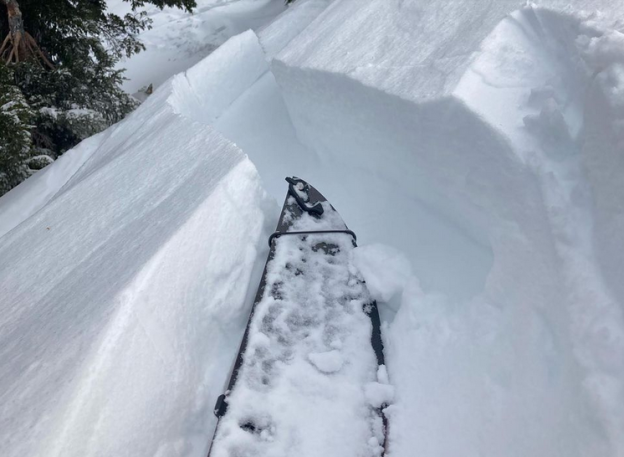
Carson Pass Tahoe avalanche photo, forest service
Carson Pass avalanche, skier locations marked in red and blue

Little Truckee Summit – Snowmobiler

The other avalanche was in the Tahoe National Forest in the Little Truckee Summit region.

A snowmobiler was cognizant of the avalanche forecast as his group worked its way into the Webber Lake area. But they were rerouted due to “wind-scoured ridges and exposed rock.”

“We were side-hilling and in a momentary lapse of judgment, or the fact that we were just moving along too fast, I popped out of the trees onto an exposed face. I immediately recognized the hazard, but immediately saw the snow fracture above me and propagate across the ridge.”

The snowmobiler had little choice and attempted to outrun the slide. But he was caught while dropping into the treeline.

The rider was thrown from the sled and buried up to the helmet against a tree. The avalanche was about 280 feet in length.

The group witnessed the event and was there about a minute later to provide assistance. The rider was uninjured and recovered the machine that was buried in about 6 feet of snow.

Little Truckee Summit Tahoe avalanche, forest service
Little Truckee Summit avalanche which caught a snowmobiler

Conditions

The Tahoe avalanches took place on steep slopes of 40 degrees or more. Officials are advising users to choose slopes that are 30 degrees or less.

“Whumpfing, shooting cracks, recent avalanches, and unstable snow pit test results are all indications of unstable snow in the area,” said a statement. “Do not underestimate potential avalanche size, potential run out distance, or the hazard from connected terrain above or to the side. Think bigger avalanche than expected.”

Most Colorado Avalanches Don’t Involved Beginners

November, 2020

The Colorado Avalanche Center (CAIC) recently published a report related to how the COVID-19 pandemic and correlated surge of backcountry use has impacted avalanche numbers in Colorado. One key finding was that while the number of backcountry beginners involved in snow avalanches stayed similar before and after the pandemic and the number of intermediate users involved in avalanches actually decreased, the number of advanced skiers involved in avalanches spiked.

Another trend discovered in the report was that more avalanche-related accidents occurred during ‘considerable’ avalanche risk days, despite less total ‘considerable’ risk days during the season.

During their analysis, the Avalanche Center categorized those involved in avalanches based on their skill level. Fifteen percent were beginner, 25 percent were intermediate, 47 percent were advanced, and 8 percent were expert.

According to the CAIC Avalanche Center, results from this study align with previous research that has indicated that avalanche education does not reduce avalanche exposure.

Another interesting finding from the CAIC study was that most avalanche incidents during the 2019-2020 season occurred during level 2 (moderate) risk, accounting for 60 percent of incidents. Thirty percent of avalanches occurred during level 3 risk (considerable) risk.