Avalanche fences are being installed in Park City, Utah despite a petition to halt the construction. However, the petition appears to be to irrelevant now, since the construction of the avalanche barriers are underway.
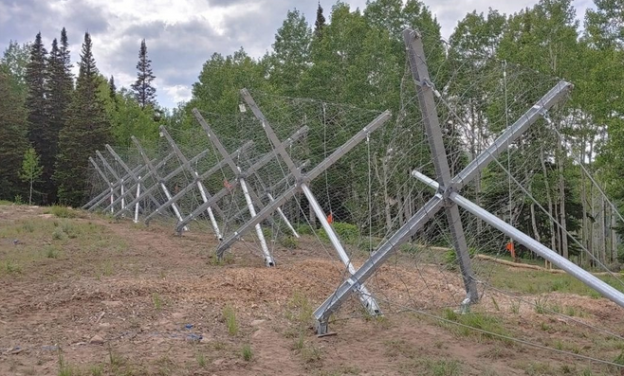
Iron Mountain Associates plans to install 214 avalanche fences. The avalanche fences are three to four meters tall and under construction in The Colony neighborhood. The avalanche barriers aim to prevent an avalanche from hitting the driveway of two specific homes.
An out-pour of community outrage has ensued since the county approved the project in 2020. Despite the community opposition, the construction of the fences is now underway.
While avalanche fences are effective, professionals feel there are better options. Alternatives exist which do not cause as much harm to wildlife and do not create extreme visual degradation.
Jake Hutchinson formerly managed the ski patrol avalanche mitigation program at The Canyons Resort (now Canyons Village at Park City) for over ten years. Hutchinson created the avalanche atlas currently used as a model for Canyons Village at Park City and The Colony. He claims that the avalanche modeling for the fences is based on insufficient data…. just what came from him and a couple of years of doing some measurements.
The Colony has long been concerned about avalanche mitigation. “Originally they proposed Gazex exploders up there, which are still a big nuisance and eyesore, but far less of an impact than permanent fences.”
Concerned citizens looked for a public comment period as an opportunity to express their concerns. The project’s approval under a Specially Planned Area (SPA) agreement surprised some residents. Hutchinson says, “We were watching for public comment period… and they slipped it through under the SPA agreement… The SPA doesn’t specifically have anything about avalanche fences or mitigation.”
The SPA agreement contains lengthy regulations for preserving sensitive lands and open spaces, wilderness protection, ordinances to minimize the visual impact of developments, and recreational access regulations.
Summit County resident and opponent to the avalanche fences, Seth Dromgoole, sent an email to the County Council to outline several conflicts found in the SPA agreement. Dromgoole states, “My interpretation of the Amended SPA (dated 1999) reveals multiple areas where this project may conflict with the agreement. Potential conflicts arise in the language surrounding viewshed, open space designation, and wildlife.”
Dromgoole also raised the concern, “The LIP [Low Impact Permit] for this project should not have been approved without public comment…The Dream Peak Avalanche Control Mitigation Fencing certainly creates unsightly conditions.”
Both Hutchinson and Dromgoole assert that there are more appropriate alternatives to avalanche mitigation than the installation of over 200 fences.
“Avalanche fencing is not industry standard for this use. The industry standard for fencing is to protect permanently inhabited structures and major roadways, not driveways. Avalanche fencing is excessive for what is essentially a shared driveway for two houses,” Dromgoole says.
Hutchinson is adamant that using Remote Avalanche Control Systems (RACS) such as Gazex is an adequate solution to potential avalanche activity in the area. “If they fire the RACS at 3 am, and then the road is cleared and opened, no one ever knows.”
Hutchinson believes that avalanche fences were proposed as an ultimate convenience for high-dollar property owners. “The reason for the fences is that they didn’t want a single moment of inconvenience for the homeowners,” he explains.
The main objection is that residents and visitors will suffer from visual impairment, restricted access to wilderness, and loss of wildlife through animal deaths.
Dyer Corp owner Russ Dyer has said that studies have shown that installing the barriers with 3 feet of space between each one allows for wildlife to pass through them and coexist safely.
But Hutchinson elaborates on the adverse effects of avalanche fences on wildlife. “They put fences near the Tombstone lifts in the early 2000s….. The first couple of years after they put those fences in… we were up there pulling dead animals out of those fences in the summertime, fairly consistently… big bull elk, deer, and other animals…. These [fences] will have a similar impact on wildlife, especially because these are about ten times the extent of what is near Tombstone right now,” he explains.
Dromgoole states, “The avalanche fencing will create a permanent scar on the landscape, will result in the destruction of viewshed for thousands of Summit County residents.”
The 200 plus fences will be visible across long distances. “If you are out riding your bike in Round Valley and look up there, it will look like rows and rows of fences,” says Hutchinson. He warns the community. “This is one of those things that people are going to look up there one day and wonder, ‘oh, how did that happen?’… Once they put the fences in, they will permanently impact the landscape.”
Neither Iron Mountain Associates nor Dyer Corp have responded to press inquiries.
A petition to halt the construction of the avalanche fences continues, but it appears to be to irrelevant now since the construction of the avalanche barriers are underway.