An avalanche in New York caused by a Christmas Day storm has damaged a ski resort in the Catskill Mountains.
The storm brought high winds and more than 6 inches (15 cm) of rain to the Belleayre Mountain Ski Center.
The ski resort is cleaning up on Christmas after an avalanche in New York smashed into a lodge. The avalanche caused some serious damage.
Officials at the Belleayre Mountain Ski Center in Ulster County say the snow slide happened Friday morning. It was caused by heavy rainfall, high amounts of snow on the ground, and warm temperatures.
The resort posted an update on its website saying “This morning, supersaturated snow from the Yahoo trail let loose and slid into the Overlook Lodge.”
Belleayre’s general manager Bruce Transue received an alert of a break-in at the Overlook Lodge around 5:30 a.m. only to learn that snow, water, and debris were the culprits.
The windows have been blown out on the uphill side, the doorways and a lot of water damage. We probably had four foot of snow inside the base lodge in the upstairs.
Bruce Transue
Transue says he doesn’t believe something like this has ever happened at the resort before. An avalanche in New York is a rather uncommon event.
Resort to Remain Closed December 26
In a bit of a Christmas miracle, no one was injured. The resort was scheduled to be closed on Friday due to the storm. However, they will remain closed through Saturday, Dec. 26th to continue clean up efforts.
In an update, the resort said “For those of you that had tickets for the 26th, please complete the Customer Service form and we will get back to you with regards to your purchases as soon as possible.”
Transue says Belleayre Mountain plans to be back open Sunday, Dec. 27th.
Avalanche damage to the lodge at Belleayre Mountain Ski Center
A final report on a fatal skier triggered avalanche that killed two Durango backcountry skiers last weekend says it appears the skiers likely triggered the slide while climbing up an avalanche path.
The skier triggered avalanche occurred on a steep slope above tree line. “They went on a day that wasn’t a good day to be there,” the official report said. Other skiers in the area that day were interviewed. They mostly stayed in lower angle areas and in the trees. They noted the dangerous conditions on the higher, steeper and open slopes.
The Avalanche Events
The two skiers – identified as Dr. Jeff Paffendorf, 53, and Albert “Bert” Perry, 55 – left Durango on Saturday morning, December 19, to ski the north face of an area known as Battleship, northwest of Silverton.
The report says the pair reached the trailhead about 10 a.m. They then skied about a mile before coming down a slope into Mineral Creek.
From the bottom, the Colorado Avalanche Center said, they headed east and onto the north face of Battleship. The two made one run, then climbed west through sparse woods toward the center of the north face of Battleship.
It is believed they were traveling uphill in an avalanche path when they triggered the slide, which started above them. It is not uncommon for slides to break above skiers.
“Ascending a big avalanche path during conditions like that is dangerous,” said Ethan Greene, executive director of the CAIC. “It’s a really unfortunate accident.”
The avalanche occurred on a steep slope above tree line. It had a crown face about 12 to 20 inches deep and about 700 feet wide. The avalanche ran 1,600 vertical feet, from the alpine into a tree-line creek bed.
Around 8 p.m., Paffendorf and Perry were reported overdue. Crews with San Juan Search and Recuse began a mission, and a Flight For Life helicopter scanned the area. They found “significant avalanche activity” on Battleship.
Because of the significant avalanche risk and the dangers of traveling at night the search was postponed until morning.
Recovery by Friends
However, three close friends of Paffendorf and Perry went to search for them on their own. They followed tracks to the avalanche debris and used avalanche beacons.
The friends found the pair before midnight at an elevation of about 11,100 feet. Both skiers had deployed their avalanche airbags. The friends excavated the bodies and marked the location. They returned to the trailhead around 2 a.m.
Greene said Paffendorf and Perry were “very experienced backcountry travelers.” But he said conditions so far this year have presented avalanche risks not seen in recent years, so places people may be familiar with could hold dangers that haven’t existed on previous trips.
Conditions
On the day of the accident the avalanche danger in the San Juan Mountains was “considerable.” It is not the highest risk category but one that highlights possible avalanche danger and the need for sound decision-making.
The unstable snowpack is a result of early season snow in October and dry weather for weeks in November. That caused the snowpack to become weak. Additional snow on top of that weak layer causes avalanches.
Of the pair’s friends’ rescue attempt, the report states that “the three rescuers were willing to accept a level of risk that was not appropriate for Search and Rescue. While they found the bodies hours before Search and Rescue would have, the swifter discovery did not change the outcome of the accident.”
Paffendorf was an anesthesiologist at Mercy Regional Medical Center for the past eight years. Perry was a homebuilder before becoming a realtor for Coldwell Banker Heritage House Realtors in Durango about four years ago.
Friends and colleagues have noted how experienced and familiar the pair was with the terrain.
“This year is a little bit different,” he said. “That place you always go to, think about whether it’s a good day to go there.”
An Elko, Nevada, snowmobiler died in a Wyoming avalanche on Friday. It is estimated that he was buried inverted under the snow for about 15 minutes.
Brandon Jones, 41, was snowmobiling away from his party late on Dec. 18 on “Suicide Mountain”. He triggered a medium-sized avalanche 24″ deep. He was able to deploy an airbag, which kept him near the snow surface with a leg sticking out.
“The balloon worked – it kept him up above. If someone would have seen it, he probably would have survived it, because they would have dug him out” said Lincoln County Coroner Dain Schwab.
When the other snowmobilers did recover him he lacked a pulse, was blue in the face, and wasn’t breathing. The man who found Jones suspected he had broken his neck. Schwab ordered a CT scan to see if this was a factor in the death. CPR was not administered, according to the coroner, who visited the scene the night of the accident.
“It was actually pretty dangerous just digging him out of there,” Schwab said. “We were up on the hillside under cornices that were unbroken.”
First Wyoming Fatality, in the Salt River Range
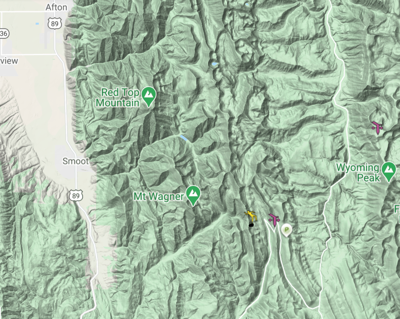
Jones and his group were snowmobiling in the Sheep Pass area, southeast of Afton at the far southern end of the Salt River Range. The slide occurred at nearly 10,000 feet on an eastern aspect.
The fatality marks the first lethal avalanche of the winter in Northwest Wyoming.
The Bridger-Teton Avalanche Center Director visited the site on Sunday to investigate. He determined the avalanche ran over the crusted snowpack that baked in the sun during the dry spell in late November and early December.
“We dug a snow pit near the site yesterday, and we feel confident that this was all the new snow that has fallen since Dec. 11,” he said. “The avalanche conditions are still dangerous up there. People should be careful.”
The avalanche danger on Monday morning was still deemed “considerable” at high elevations in the Salt and Wyoming ranges, according to the morning forecast.
Jones had a wife, Mary, and three kids, Blayde, Ebony and Slayde, according to a Facebook post by the Elko business Evolution Powersports. A funeral service has been scheduled for 11 a.m. Wednesday in Malad, Idaho.
As of December 22 this is one of 3 fatal incidents listed by the Avalanche Center, along with 3 others outside the US. There is also a link to the avalanche advisory for the day there.
The yellow symbol marks the site of the fatal Wyoming avalanche on Friday.
A ski patroller buried by an avalanche was on the northeast end of the Anthracite Range, known as Friendly Finish, in the Gunnison area. He was touring alone in the backcountry at the time.
GUNNISON COUNTY, Colo. — A solo backcountry skier died in an avalanche in the Gunnison area on Friday.
The man was skiing on the northeast end of the Anthracite Range when he was buried in an avalanche. The area is known locally as “friendly finish”.
The avalanche occurred on a northeast-facing slope and the avalanche risk was rated as “considerable,” or 3 out of 5. The slide took place at about 10,500 feet.
Victim Identified as Ski Patroller Jeff Schneider
Crested Butte Ski Patrol identified the ski patroller buried by an avalanche as Jeff Schneider in a Facebook post.
“Jeff was a bastion of kindness, knowledge, hard work, wit, and humor,” the post read. “A legendary Ski Patroller in Crested Butte, and Aspen before that, adventure had no better emissary. We wish you well on the last leg of the ultimate adventure. Rest peacefully, and may you make many, many turns, each one better than the last.”
Before descending, the victim spoke with two other skiers who were also traveling in the area. When the other two skiers finished their descent they found the victim’s snowmobile parked, and there was no sign of him. The skiers then snowmobiled to a position where they could see the slope that the victim planned to descend and saw a fresh avalanche. They then located the victim with a transceiver and recovered his body.
This was the first US avalanche-related death of the season. The only other incident this season was on Dec. 15, when a snowboarder was caught in an avalanche on Snodgrass Mountain and was injured.
Last season, there were six avalanche-related deaths, according to CAIC.
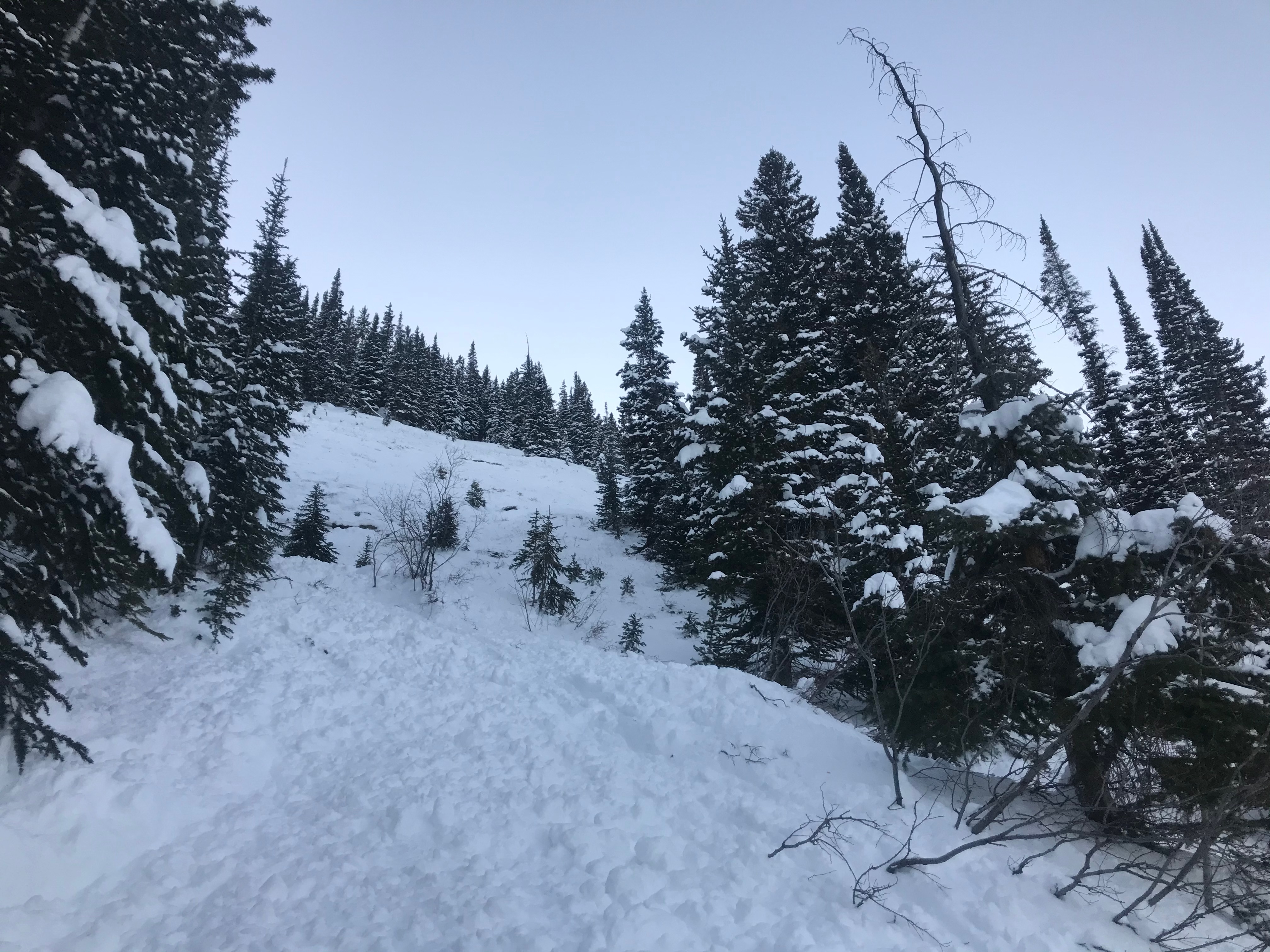
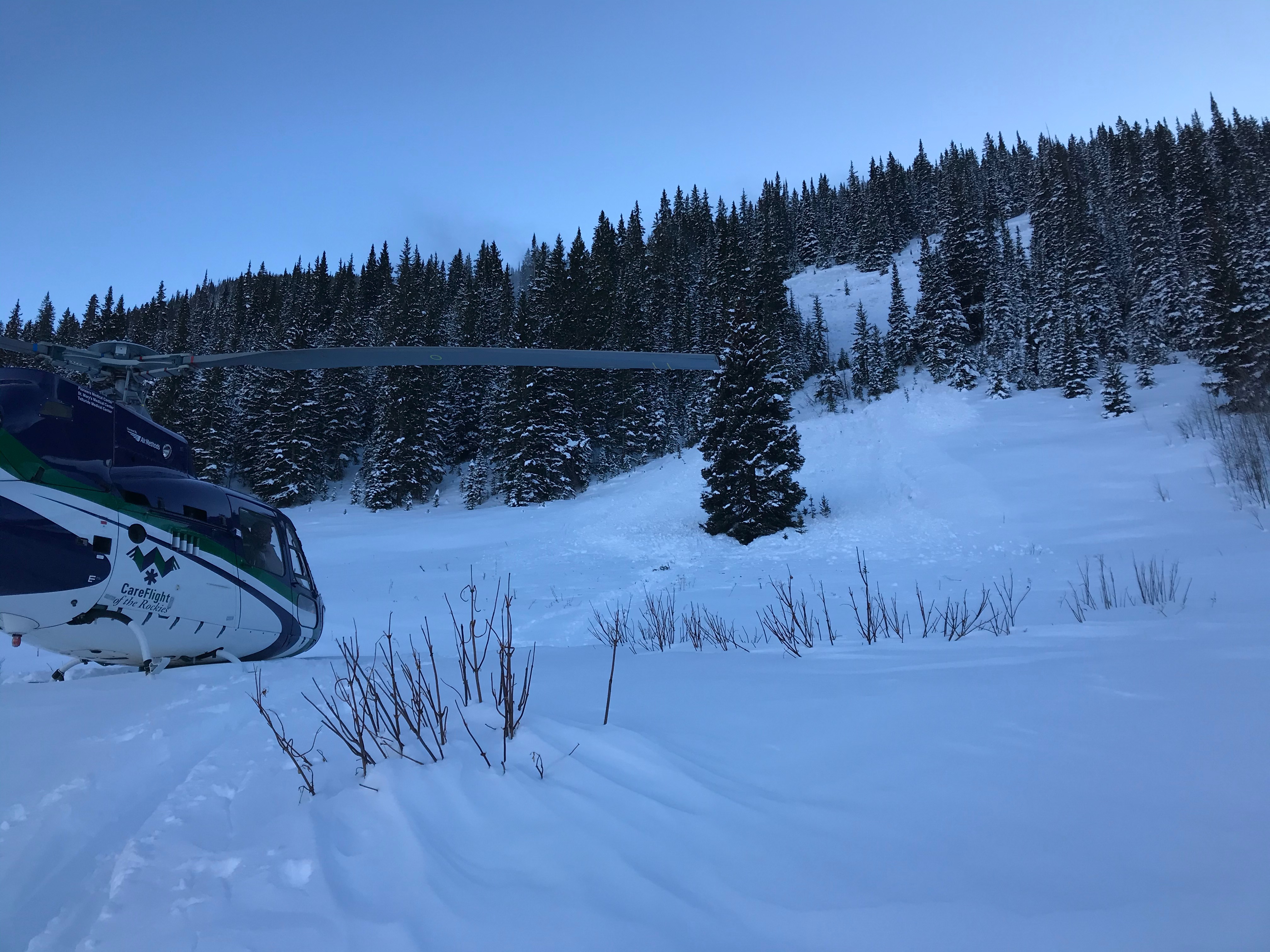
The avalanche where a ski patroller was buried in an avalanche on December 17.
This was the first fatality of the season in the US and the second in North America, according to this list.
An avalanche swept a snowboarder into a tree on Tuesday afternoon. It happened on Snodgrass Mountain near Crested Butte. The snowboarder was on a split board.
The Colorado Avalanche Center said the boarder and a skier skinned up the south side of the mountain and were descending the north side in an area called First Bowl, which is at an elevation around 10,000 feet. That’s when a slab avalanche released and swept the boarder into a tree injuring his leg.
The party was able to call 911 for help and a rescue team responded shortly thereafter. The avalanche took place within old snow on a slope with a northeast aspect.
While there have been several media worthy avalanche accidents already this season the official fatality list shows none in the US so far.
Site where an avalanche swept a snowboarder into a tree, CAIC
Site where an avalanche injured a snowboarder – CAIC
Avalanche risk is already present in Colorado despite the lack of early season snow. According to a report to the Colorado Avalanche Center a skier was caught in a human-caused avalanche burial on Monday near Marble.
The small avalanche occurred in a small gully near a grouping of trees at about 10,400 feet of elevation. As the first skier crossed a steeper section of terrain the slide carried the skier downhill. The skier was uninjured and didn’t require any sort of official search and rescue effort.
While most of the terrain being crossed by skiers in the group at the time was lower angle, small sections of steeper slope were present. According to someone at the scene, ‘complacency’ was a factor in the avalanche burial.
When the slide was triggered, the group was returning to their car. They had previously noted “major instabilities” at higher elevations. However, the terrain they were traveling just prior to the avalanche is described as having a “gentle slope angle”. It was so low-angle that it was impossible to maintain momentum.
The author of the report wrote: “This slide was a sharp reminder of the potential consequences of any backcountry terrain, even in the relatively benign areas that we traverse on approaches to and exists from the main ski runs.”
Current Risk
Those entering the backcountry in Colorado should know that avalanche risk is already present. This example shows that low risk terrain can still have localized high risk areas that should not be overlooked.
Currently the avalanche risk in Colorado is rated as moderate to considerable. Levels two and three on a five-level scale.
Avalanche observation reports made by both officials and the public indicate that there have been 219 slides so far this season. Unobserved and unreported slides have probably occurred in addition to those.
If you’re entering the backcountry this season, do so only with the proper training and equipment.