Category Archives: Avalanches

Avalanche Warning Issued

November 24, 2020

SRINAGAR: Following the adverse weather forecast on Monday and Tuesday, authorities on Sunday issued a snow avalanche warning for higher reaches in the Kashmir division.

An official of the Disaster Management Department said a medium danger avalanche warning will remain in force during the next few days in Kupwara district while low danger avalanche warning will remain in force in Baramulla, Anantnag, Kulgam, Bandipora and Ganderbal districts.

“People are advised to avoid unnecessary movement outside their homes while the warning remains in force,” the official said.

Avalanches have claimed human lives in much larger numbers in recent years than they used to in the past. Experts are blaming deforestation for the growing avalanche threat because once a mountain slope is bereft of its tree cover there is nothing to stop an avalanche once it starts rolling down the slope. (IANS)

Prince Charles avalanche episode on Netflix criticized

The wife of Hugh Lindsay, killed while skiing with Prince Charles, asked Netflix not to feature the avalanche

Nov 2020

The widow of a British army major who died in an avalanche while skiing with Prince Charles has criticized the producers of The Crown on Netflix as “unkind” for dramatizing the disaster against her wishes.

Major Hugh Lindsay, a former Queen’s equerry, was skiing off-piste at the Swiss resort of Klosters in 1988 with a group including senior royals when disaster struck, with his friend the Prince of Wales and others reported to have dug snow with their hands in a vain attempt to save his life.

After the episode on “The Crown” titled “Avalanche” was made available for streaming last week, Lindsay’s widow, Sarah Horsley, has revealed she had asked Netflix not to adapt the disaster for television.

“I was horrified when I was told [the episode] was happening and was very concerned about the impact on my daughter,” she told the Sunday Telegraph.

“I’m very upset by it and I’m dreading people seeing it. I wrote to them asking them not to do it, not to use the accident. I suppose members of the royal family have to grin and bear it, but for me it’s a very private tragedy.”

She added that the producers replied with “a very kind letter”, saying “that they understood my concerns, but they hope I will feel that they deal with difficult subject matters with integrity and great sensitivity”.

However, Horsley said: “I think it’s very unkind to many members of the family.”

Netflix’s description of the episode reads: “Charles is caught in a deadly avalanche, and he and Diana are prompted to reevaluate their commitment to their troubled marriage.”

At the time of the disaster, Horsley was pregnant with their daughter Alice and still working at her job in the press office at Buckingham Palace. She did not go on the ski trip and stayed at their south London home.

Charles, who went on to become a godfather to Alice, later wrote: “I still find it hard to understand why I survived and he didn’t.”

Patti Palmer-Tomkinson, another friend of the Prince, received severe injuries to both of her legs and her lungs. Princess Diana, who was also on the holiday, was not on the slopes when the avalanche hit and had stayed at their chalet in Davos, along with Sarah, Duchess of York.

The group then flew back to London, where a guard of honor from Major Lindsay’s regiment met his coffin.

Netflix has also faced criticism over the historical accuracy of its script, with calls for it to be accompanied by a disclaimer explicitly stating that some events have been embellished. The scriptwriter, Peter Morgan, has said: “Sometimes you have to forsake accuracy, but you must never forsake truth.”

The Times reported this week that friends of the Prince of Wales had described the show as exploitative and inaccurate. “This is trolling with a Hollywood budget,” a source said.
Austria avalanche: Skier survives five hours

27 December 2019

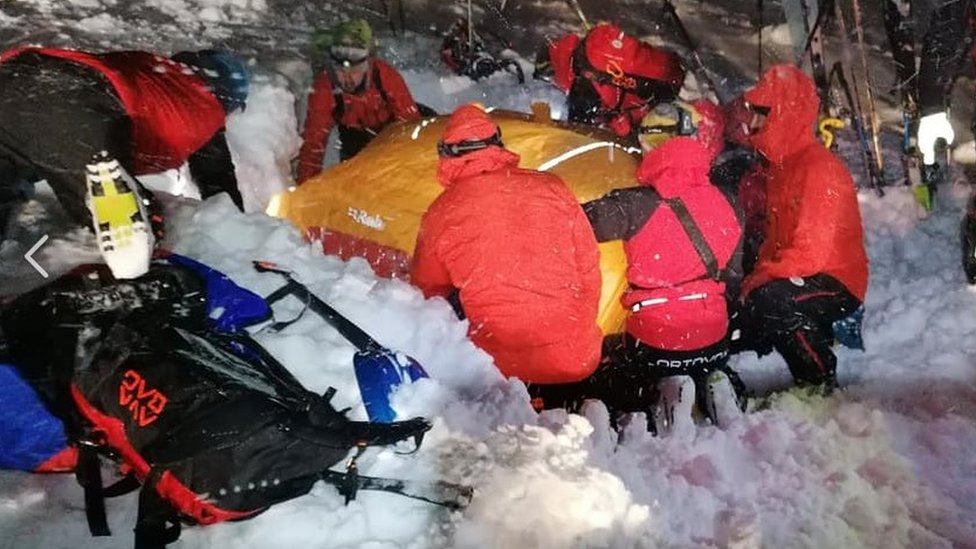
Rescuers have dubbed the survival of a man a “Christmas miracle” after an avalanche in Austria buried him in snow for five hours.

Authorities were contacted shortly before 17:00 (16:00 GMT) on Christmas Day 2019 by a man who said the 26-year-old had not yet returned from skiing.

The man had managed to get through to the skier’s mobile phone but heard only “crackling noises”.

The missing skier was located a couple hours later.

He was found beneath a meter of snow with his avalanche transceiver, which pinpointed the man on Mt Pleschnitzzinken in the north-western area of Upper Styria.

Transceivers are worn on the body and emit an electromagnetic signal. They can also be used in search mode to pick up signals from other devices.

‘Extremely lucky’

A team from the Gröbming mountain rescue and local police dug the man out of the snow and he was taken down to the valley suffering from hypothermia but otherwise unharmed.

“You can’t move under the snow like this,” said Stefan Schröck of the Styria mountain rescue service. “The man was extremely lucky, he had a large enough air pocket under the blanket of snow, so he had oxygen and was able to breathe.”

Surviving for five hours under an avalanche happens only every 20 years in the Alps, according to Mr Schröck. If you are not found within 15 minutes of an avalanche your chances of survival are slim and if you are to survive beyond an hour you need a source of oxygen.

Skier brought out after five hours

Most Colorado Avalanches Don’t Involved Beginners

November, 2020

The Colorado Avalanche Center (CAIC) recently published a report related to how the COVID-19 pandemic and correlated surge of backcountry use has impacted avalanche numbers in Colorado. One key finding was that while the number of backcountry beginners involved in snow avalanches stayed similar before and after the pandemic and the number of intermediate users involved in avalanches actually decreased, the number of advanced skiers involved in avalanches spiked.

Another trend discovered in the report was that more avalanche-related accidents occurred during ‘considerable’ avalanche risk days, despite less total ‘considerable’ risk days during the season.

During their analysis, the Avalanche Center categorized those involved in avalanches based on their skill level. Fifteen percent were beginner, 25 percent were intermediate, 47 percent were advanced, and 8 percent were expert.

According to the CAIC Avalanche Center, results from this study align with previous research that has indicated that avalanche education does not reduce avalanche exposure.

Another interesting finding from the CAIC study was that most avalanche incidents during the 2019-2020 season occurred during level 2 (moderate) risk, accounting for 60 percent of incidents. Thirty percent of avalanches occurred during level 3 risk (considerable) risk.

North Cascades Highway closes for the season due to avalanche risks

The heavy snows of the past few storms mean the time has come for the annual North Cascades Highway closure in Washington state. WSDOT announced the closure Monday as snow has filled the avalanche chutes that line the highway, which pose a safety risk for drivers and road crews.

The seasonal avalanche closure currently begins at the Ross Dam Trailhead on the west side and Silver Star Gate 37 miles away on the east side. As the snow accumulates this fall and winter, the closure will extend a few more miles in each direction.

The earliest closure was on Oct. 17 in 2003, and the latest “closure” was in 1976 when so little snow fell the pass didn’t need to close that winter. That is the only time that’s occurred since 1972. In the winter of 1989, it didn’t close until Jan. 3, 1990.

Hikers, skiers, snowmobilers and other recreationalists can access the closed portion of highway during the winter season. Users should park in designated parking areas to allow plow drivers the space they need to clear snow around the closed stretch’s access gates.

Sign greets travelers to the North Cascades Highway (WSDOT image)